About Spirorbis spirorbis (Linnaeus, 1758)
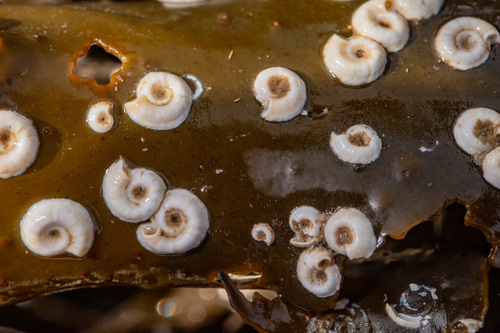
Spirorbis spirorbis, first described by Linnaeus in 1758, secretes a very small, unridged, off-white calcareous tube. The tube is approximately five millimeters in diameter, and forms a flat clockwise spiral coil when viewed from above. It also has a peripheral flange at the point where it attaches to a substrate. This species has a smooth, white, sinistral (left-handed) coiled shell that encloses an orange body, which measures around 3 millimeters in length. When exposed above water, the worm retreats fully into its tube, but when submerged, its green tentacles are visible. The worm has a short abdominal region and a slightly broader thorax, which ends in ten stiff tentacles that it uses to filter food from water. One of these tentacles is slightly larger than the others and shaped like a saucer; this modified tentacle acts as an operculum, which seals the shell opening to protect the worm from predators and desiccation when it is out of water. Spirorbis spirorbis is found on both sides of the North Atlantic Ocean. Its confirmed range includes the coasts of Great Britain, Ireland, Spain, Portugal, Prince Edward Island, Newfoundland, the Gulf of St Lawrence, and the St Lawrence estuary, and it may also occur from North Norway to the English Channel, and as far south as Cape Cod. It typically grows on Fucus, Laminaria, other seaweeds, and on rocks and stones. It is widely distributed and abundant on the middle and lower shore, and can be found down to a depth of approximately thirty meters.