About Spirobranchus giganteus (Pallas, 1766)
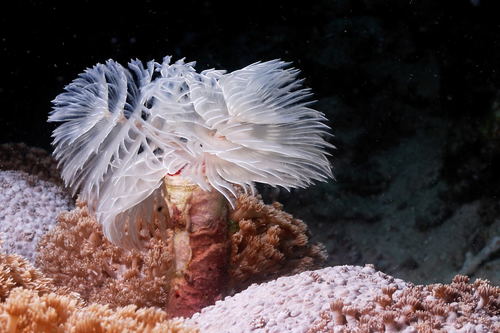
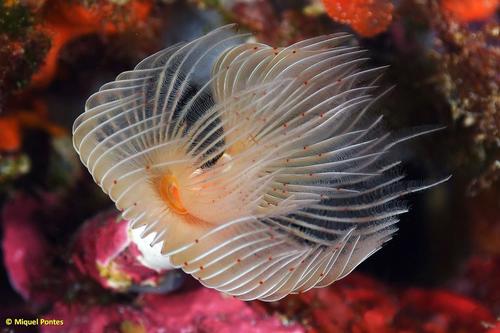
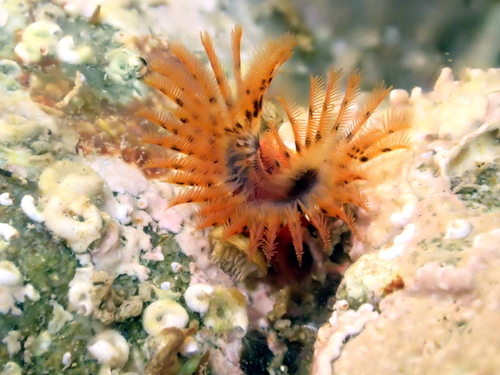
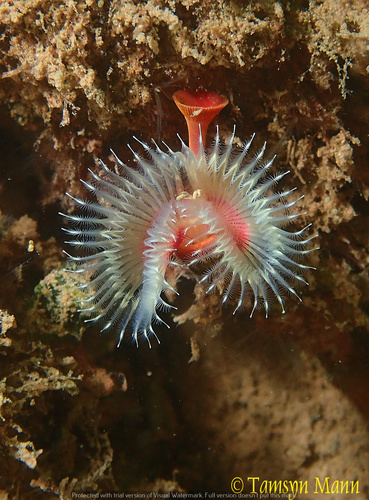
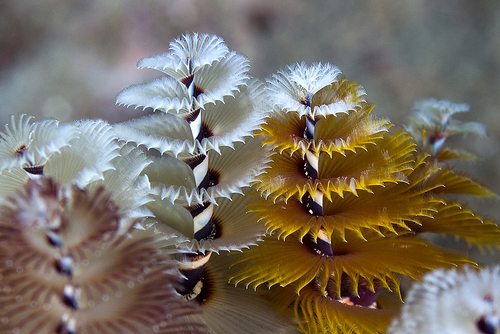
Both the common name and scientific name of Spirobranchus giganteus refer to its two brightly colored spiral structures, which are the feature most commonly seen by divers. These multicolored spirals are highly modified structures that function in feeding and respiration. Like most tube-building polychaetes, Spirobranchus giganteus has a tubular, segmented body that reaches approximately 3.8 cm (1.5 in) in length, and is covered with chaetae—small appendages that help the worm move. Since the worm never moves outside its tube, it has no specialized appendages for movement or swimming. The worm's most distinctive features are two "crowns" shaped like Christmas trees. These crowns are highly modified prostomial palps, which are specialized mouth appendages. Each spiral is made up of feather-like tentacles called radioles, which are heavily ciliated. Cilia move any prey trapped in the radioles to the worm's mouth. While radioles are primarily feeding structures, Spirobranchus giganteus also uses them for respiration, so these structures are commonly called "gills". One key difference between Christmas tree worms and other Sabellida fan worms is that other fan worms do not have any specialized body structure to plug their tube openings when they withdraw inside. Like many other members of its family, Spirobranchus giganteus has a modified radiole that usually holds a plug called an operculum, which the worm uses to seal its tube opening when it withdraws inside. As an annelid, Spirobranchus giganteus has a complete digestive system and a well-developed closed circulatory system. Like other annelids, these worms have well-developed nervous systems with a central brain and many supporting ganglia, including pedal ganglia, which are unique to Polychaeta. Compared to other annelids, Spirobranchus giganteus has faster mitochondrial sequence evolution, due to its nucleotide composition and divergent protein sequences. Like other polychaetes, Spirobranchus giganteus excretes waste using fully developed nephridia. When reproducing, the worms release gametes directly into the water, where eggs and sperm become part of the zooplankton and are carried by currents. Spirobranchus giganteus is distributed across a range from the Caribbean to the Indo-Pacific. Spirobranchus giganteus is commonly found completely embedded in the heads of massive corals, such as stony corals in the genus Porites and brain corals. Like other members of its family, it can secrete a calcareous tube around its body. This tube acts as the worm's home and protection, and can reach up to 20 cm in length. The tube is usually deeply embedded in the coral skeleton. The worm typically settles on an existing head of living coral before secreting its tube; as coral tissue grows over the calcareous tube, the worm gains increased protection. When the worm retreats into its tube, the operculum seals the opening, and the operculum is further protected by sharp, antler-shaped spines. As sedentary inhabitants of coral reefs, Christmas tree worms are primarily filter feeders. They use their brightly colored radioles to filter microorganisms from the water, which are then transported directly into the worm's digestive tract. Few organisms are known to prey on tube-dwelling polychaetes, and Spirobranchus giganteus is no exception. The relationship between Spirobranchus giganteus and its host corals remains poorly understood. However, movement of the worm's operculum can occasionally abrade coral tissue, and coral tissue mortality increases when filamentous algae grow on the worm's operculum. Christmas tree worms (Spirobranchus giganteus) include both male and female individuals. They reproduce by releasing eggs and sperm into the water. Eggs are fertilized in the water, then develop into larvae that settle on coral heads and burrow into the coral to form their burrows.