About Spiranthes cernua (L.) Rich.
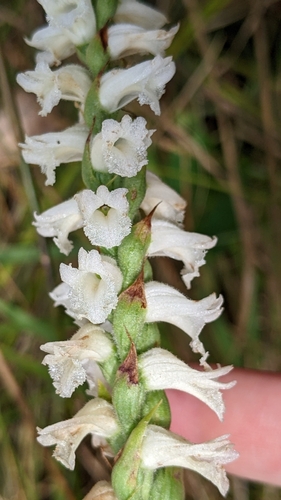
Plants of Spiranthes cernua reach up to 50 centimetres (20 inches) in height. They produce 1 to 5 narrow, upright basal leaves that measure 2.6 centimetres (1.0 inch) long and 2 centimetres (0.8 inch) wide. The leaves are present when the plant flowers, but wilt after flowering is complete. Its white flowers are arranged in a spiral around the stem. Each individual flower is 6–12 millimetres (0.2–0.5 inches) long, made up of 3 sepals and 3 petals; all of these structures curve forward to give the flower a long bell shape. The flowers are slightly to strongly nodding, a trait that gives the species its name, with older flowers typically nodding more than younger new flowers. The top dorsal sepal is convex and recurved upwards toward its tip. The bottom petal, called the lip, curves strongly downwards toward its tip. This species is native to central and eastern North America, with its range extending north to Ontario and Quebec, west to Nebraska, south to Texas, and east to Nova Scotia. Spiranthes cernua grows in wet meadows, mossy seeps, maritime dune swales, Sphagnum-dominated areas around the edges of ponds and lakes, and along roadsides. This orchid blooms in autumn, from August through November. Native bees, including bumblebees, feed on its nectar and act as pollinators for the plant. A commonly cultivated variety is Spiranthes cernua 'Chadds Ford', which is grown for its larger flowers, ease of cultivation, and other positive traits. This cultivar is also often labeled as Spiranthes odorata, but botanically it is neither of those two species; instead it belongs to the separate third species Spiranthes bightensis.