About Spirama retorta Clerck, 1764
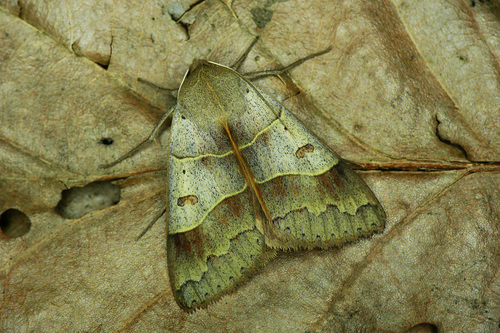
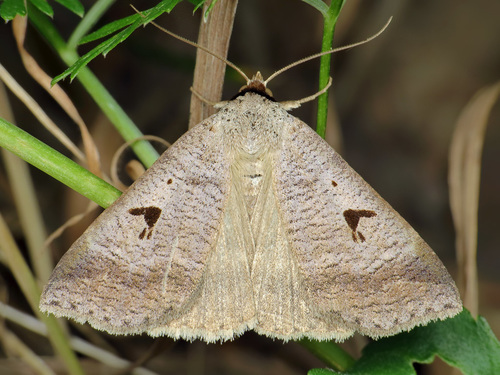
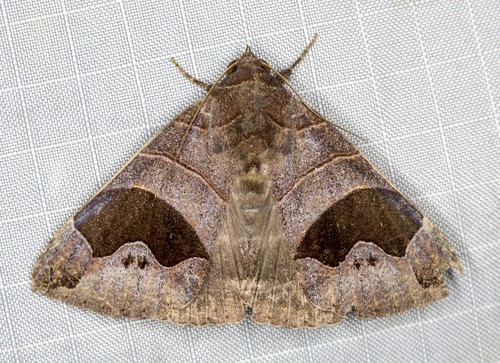
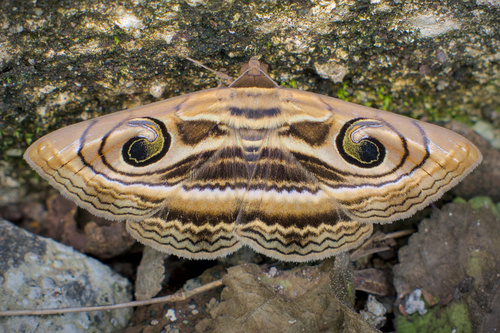
Spirama retorta Clerck, 1764 has a wingspan of 64–76 mm in males and 66–88 mm in females. The wing pattern often resembles the face of a snake with a slightly opened mouth. Its forewings have an arched costa leading to a nearly rectangular apex. Males have a fold on the inner area of the hindwing that holds an erectile ridge of very long hair, and their antennae are fasciculate. Male S. retorta have dark chestnut-brown heads and collars; the thorax is paler with dark bands, and the abdomen is crimson with triangular black dorsal patches. All wings are fuscous brown. On the forewing, the costal and outer areas are more or less suffused with purplish, and sometimes have an olive tinge. An antemedial line curves outwards below the costa, then runs obliquely to the inner margin. Beyond the end of the cell, there is a large "inverted-comma" mark with ochreous and black edges, and some white on the inner edge of the "tail"; the center of the mark is fuscous-black. A curved postmedial line passes around the stigma or is interrupted by it. A second postmedial line curves outwards below the costa and is slightly sinuous. There are two crenulate sub-marginal lines, and two more prominent lines located within the margin. Hindwings have an indistinct antemedial line, an indistinct medial line, faint traces of two postmedial lines, and a sub-marginal line. The ventral side of the wings is suffused with dull red, and each wing has two medial lines and a single postmedial line. Females are basically ochreous colored. Their forewings have a larger stigma than males, and their hindwings have prominent markings. Two antemedial lines, an ochreous submarginal line, and two crenulate black lines inside the margin can be seen on female wings. The female ventral side is orange-scarlet; each wing has a cell-spot, medial, postmedial and submarginal lines, and a series of lunules inside the margin. Caterpillars of this species feed on Acacia mangium, Acacia auriculiformis, Acacia crassicarpa, and Falcataria moluccana; the association with Acacia mangium was investigated in samples from Peninsular Malaysia. Predators including Sycanus leucomesus, Cantheconidea furcellata, Mallada basalis, and Vespa affinis have been observed feeding on S. retorta caterpillars.