About Spinus xanthogastrus (Du Bus de Gisignies, 1855)
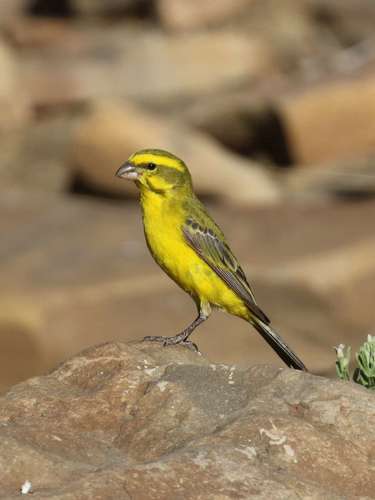
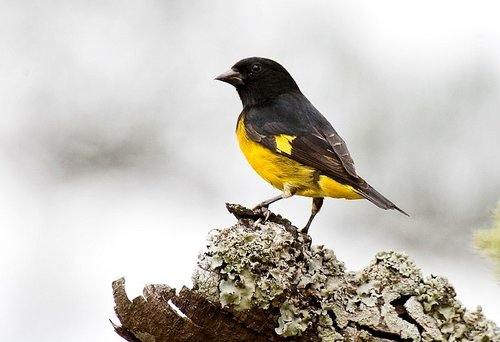
The yellow-bellied siskin, Spinus xanthogastrus, is a small bird that measures 10.5 cm in length and weighs 12 g. Males are entirely black apart from a bright yellow belly, yellow tail sides, and yellow wing patches. Females have dark olive green upperparts and pale yellow underparts that grow brighter on the belly. They have blackish tails and wings, and also show bright yellow primary wing patches and yellow tail sides. Young birds look similar to females, but have dusky fringes on their upperpart feathers and smaller yellow patches on their wings and tails. This species' song is a pleasant chattering twitter, and its call is a sharp pyee. The subspecies S. x. stejnegeri, found from extreme southeastern Peru to central Bolivia, is larger and has a longer bill than the nominate subspecies S. x. xanthogastrus. Males of this subspecies have larger yellow wing patches and more extensive black coverage on the flanks. Females of S. x. stejnegeri are darker olive on their upperparts than the more northern nominate birds. The yellow-bellied siskin is more strongly associated with woodland habitats than the superficially similar lesser goldfinch (Spinus psaltria). Lesser goldfinches are paler, have a white wing patch, and sing a more musical song than yellow-bellied siskins. In terms of behaviour and ecology, the yellow-bellied siskin breeds in mountain oak forests at altitudes between 800 and 3,000 m. It builds a shallow cup nest made from rootlets, bark, and lichens, positioned 2.4–3.7 m high in the dense foliage of a small tree growing in a clearing. Females lay two or three green-tinged white eggs in April or May, and incubate the eggs alone. While this species is not migratory, it wanders across its range when it is not breeding. In some areas including central Costa Rica, the yellow-bellied siskin has been relentlessly persecuted for the cage-bird trade. In remote or protected areas where the species remains common, flocks of up to 30 birds forage in the tree canopy for small insects and oak flowers, and will descend into clearings to feed on seeds. Males may sing when gathered in social groups.