About Spinus spinus (Linnaeus, 1758)
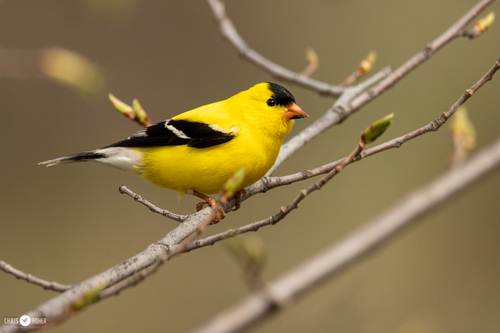
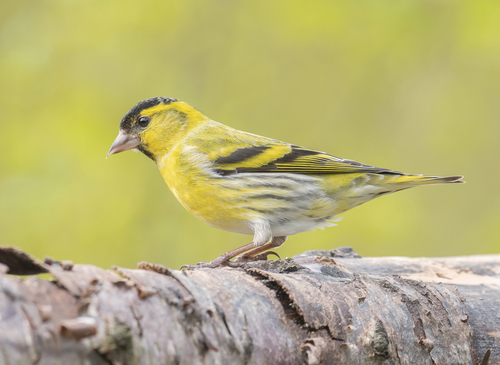
Spinus spinus, commonly called the Eurasian siskin, is a small short-tailed finch. Adults measure 11–12.5 cm (4.3–4.9 in) in length, have a wingspan of 20 to 23 cm (7.9 to 9.1 in), and weigh between 12 and 18 grams (0.42 and 0.63 oz). This species displays clear sexual dimorphism in plumage. Males have a greyish-green back, yellow rump, yellow tail sides with black tips, black wings marked by a distinctive yellow stripe, a yellowish breast that fades to whiter, striped plumage toward the cloaca, a black chin bib, two yellow auricular patches, and a black cap on the head. The amount of black on the male bib varies widely between individuals, and bib size correlates with dominance within flocks. Females have more olive-toned plumage than males, with greenish caps and auriculars, a white bib, and a slightly striped whitish-yellow rump. Juvenile birds share a similar color palette to females, with dull, subdued overall plumage. Adult males have bright green and yellow overall plumage, with a black cap and unstreaked throat and breast. Adult females typically also have green and yellow plumage tones, including yellow on the supercilium and breast sides, green on the mantle, and yellow on the rump. The base color of the Eurasian siskin’s underparts is usually pure white; in females and juveniles, the center of the belly and lower breast are often mostly or entirely unstreaked. The species has broad yellow wingbars with white tips. Its beak is short with a decurved culmen; while it is slender, it is also strong, a shape adapted to its feeding habits that lets it reach seeds between the scales of spruce cones and inside alder fruit. The siskin has dark brown legs and feet, and black eyes. Its flight is rapid and bounding, matching the flight pattern of other finches. Eurasian siskins are generally easy to recognize, but can sometimes be confused with other finches including the citril finch, European greenfinch, and European serin. This species is distributed across most of Eurosiberia and northern Africa. Its breeding range is split into two separate zones within the Palearctic realm: the eastern Asian coast, and central and northern Europe. Birds can be found year-round in Central Europe and some southern European mountain ranges. They also breed in northern Scandinavia and Russia, and overwinter in the Mediterranean basin and the region around the Black Sea. In China, they breed in the Khingan Mountains of Inner Mongolia and in Jiangsu province, and overwinter in Tibet, Taiwan, the lower Yangtze River valleys, and the southeast Chinese coast. The Eurasian siskin is occasionally sighted in North America, where the closely related similar pine siskin (Spinus pinus) occurs. This species has an unusual seasonal migration pattern: every few years, far larger numbers migrate south, greatly increasing the size of overwintering populations in the Iberian Peninsula. Two main theories explain this event: one proposes it happens in years when Norway spruce produces abundant seeds in central and northern Europe, leading to increased population sizes, while the other suggests larger southward migrations occur when the siskin’s preferred foods (alder or birch seeds) fail. Outside the breeding season, Eurasian siskins form large flocks, often mixing with redpolls. The species does not remain in the same area long-term, and changes the sites it uses for breeding, feeding, and overwintering from year to year. It inhabits forested areas at specific altitudes on mountainsides, and has a particular preference for humid locations. Coniferous woodlands, especially spruce stands, are the preferred breeding habitat. It will also breed in mixed woodlands. In winter, it favors stubble, croplands, and areas with seed-bearing trees. The British breeding range of this species, once limited to a local population, has expanded greatly due to an increase in commercial conifer plantations. Eurasian siskins are very active, restless birds, and highly social, forming small cohesive flocks especially in autumn and winter. They are fairly trusting of humans, and can be observed from close distances. During the breeding season, however, they are much more timid, solitary, and difficult to observe. A German legend claims siskins guard a magic stone in their nests that makes them invisible. This is one of the few species documented to perform allofeeding: subordinate same-sex individuals regurgitate food for dominant group members, which supports strong flock cohesion and indicates a hierarchical flock structure. Pairs generally form during winter before migration. Males compete aggressively for females. During courtship, the male fluffs his crown and rump feathers to appear larger, extends his tail, and sings repeatedly. Males and females also perform mating flights between trees, though these flights are less striking than those seen in other finch species. Nests are typically built at the end of a relatively high branch in a conifer (such as spruce, fir, or pine), where the structure is well-hidden and hard to access. Breeding pairs form small colonies of up to six pairs, with nests located close together. The nest is small and bowl-shaped, constructed from small twigs, dried grasses, moss, and lichen, and lined with down. The first brood hatches in mid-April. The female lays 2–6 eggs per clutch; the eggs are white, light grey, or light blue with small brown spots, and measure approximately 16.5 mm by 12 mm. Incubation lasts 10–14 days and is done entirely by the female. Chicks are altricial and nidicolous. They leave the nest after 15 days while still only partially feathered, then remain near the nest area for up to a month, until their plumage is fully developed and they disperse. Eurasian siskins usually raise a second brood between mid-June and mid-July.