About Spinus psaltria (Say, 1822)
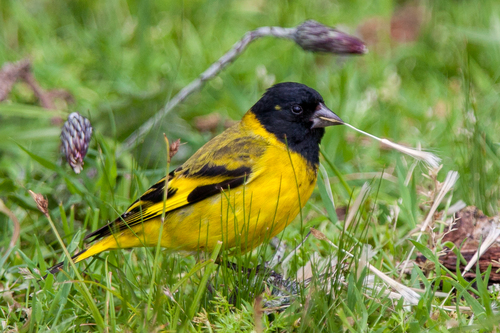
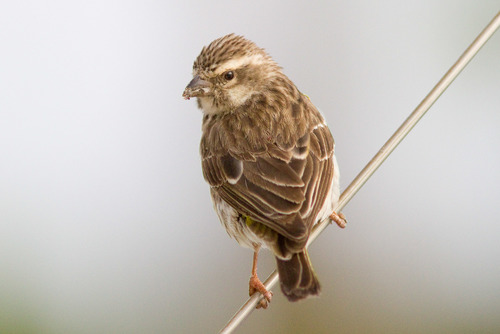
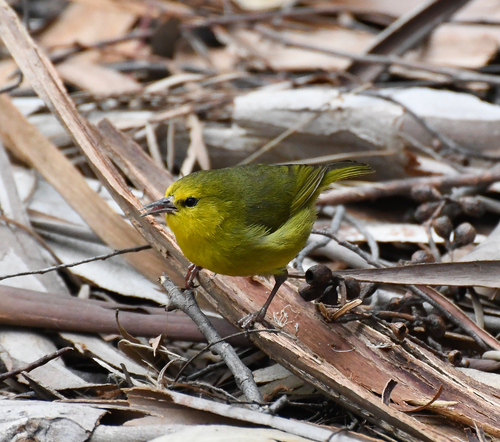
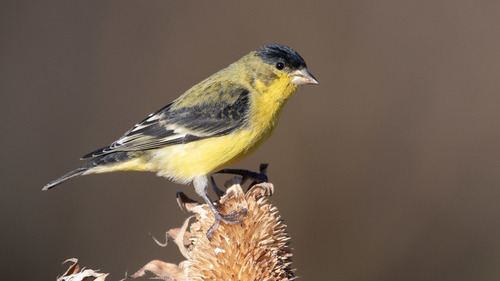
Spinus psaltria, commonly known as the lesser goldfinch, is not only the smallest Spinus finch native to North America, but it may also be the smallest true finch in the world. Some sources note that other more subtropical Spinus species, such as the Andean siskin (Spinus spinescens), have a slightly smaller average body size. This species measures 9 to 12 cm (3.5 to 4.7 in) in total length and weighs between 8 and 11.5 g (0.28 to 0.41 oz). For standard body measurements, the wing chord is 5.5 to 7 cm (2.2 to 2.8 in), the tail is 3.9 to 4.7 cm (1.5 to 1.9 in), the bill is 0.9 to 1.1 cm (0.35 to 0.43 in), and the tarsus is 1.1 to 1.2 cm (0.43 to 0.47 in). There is a slight size cline running from northwest to southeast across the species' range: the largest individuals, found in Mexico and areas further south, are up to one-fifth larger than the smallest individuals from the extreme northwest of the range, and this size difference is more pronounced in females. There is also considerable variation in the amount of black plumage on the head and back of males, which has led to the proposal of five subspecies. However, this variation appears to be a simple clinal change in allele frequency, so these proposed "subspecies" may be more accurately classified as color morphs or geographic forms. Males are easily identified by their bright yellow underparts and large white patches on the outer tail rectrices and at the base of the primary wing feathers. The plumage on their back, upper head, and ear-coverts ranges from solid black to medium green, and the darkness of the back, crown, and ear regions varies roughly independently; as a general rule, the ear regions are never darker than the other regions. Across most of the species' range, dark-plumaged males (called psaltria, or black-backed goldfinch) are the most common. Light-plumaged males are called hesperophilus, or green-backed goldfinch, and are most often found in the far western United States and northwestern Mexico. The broad zone where both light and dark males occur regularly is widest in the north, and stretches across the full width of the Rocky Mountains and the Sierra Madre Occidental. This zone reaches the Pacific Coast between southern Sonora and northern Sinaloa, approximately from the area around Ciudad Obregón to Culiacán. In the United States, the widest range of different phenotypes occurs in Colorado and New Mexico. East of the 106th meridian west in southwestern Texas, and across most of Mexico, almost all males have black backs. S. p. colombianus, found east and south of the Isthmus of Tehuantepec, has a richer yellow underpart color in males. This subspecies, along with the even more yellow S. p. jouyi from the Yucatán Peninsula and adjacent parts of Mexico, and S. p. witti from the Tres Marías Islands off the coast of Nayarit, requires further study; at least the first two of these also appear to be significantly larger and have longer bills than other forms. Females and immature individuals have more or less grayish olive-green upperparts, and yellowish underparts that are buffier in immatures. They only have a narrow strip of white on the wings, with other white markings present in some forms, and little to no white on the tail. They are most reliably distinguished from other members of the genus by the combination of their small size, upperparts with no white or yellow, and a dark gray bill. In any plumage, this bird can easily be mistaken for a New World warbler if its characteristic finch bill is not clearly seen. Like other goldfinches, it has an undulating flight pattern during which it frequently calls; for this species, the call is a harsh chig chig chig. Another distinct call is a very high-pitched, drawn-out whistle, often rising from one pitch to another (sounding like teeeyeee) or falling (sounding like teeeyooo). The song is a prolonged warble or twitter, more distinctly phrased than the song of the American goldfinch, and often includes imitations of other bird species. This goldfinch's distribution extends from the southwestern United States north as far as the Columbia River in Washington, and south as far as Venezuela and Peru. It migrates seasonally out of some parts of its range in the United States, but remains a year-round resident in other parts, and has rapidly expanded its range across most of the Pacific Northwest as a year-round resident in recent decades. The lesser goldfinch often occurs in flocks, or at least in loose associations with other individuals. It uses almost any habitat that contains trees or shrubs, with the exception of dense forest, and is common and easy to spot in many areas, often coming near residential areas. It is common at bird feeders in the Southwestern United States, and will visit almost any location that has thistle sock feeders. Flocks of at least six birds are often seen at feeders. It feeds mostly on tree buds and weed seeds; geophagy (the eating of soil) has been observed in this species. The nesting season falls during summer in the temperate parts of its range; in tropical parts of its range, it appears to breed year-round, with less frequent breeding in September and October. It lays three or four bluish white eggs in a cup-shaped nest built from fine plant materials including lichens, rootlets, and strips of bark. The nest is placed in a bush or at low to middle levels in a tree. Molting in this species follows two different patterns that correspond quite well with variation in the blackness of the upperparts plumage. A broad zone of intergradation between the two molting patterns also exists here. Birds in Pacific populations molt after breeding, and females also shed a small number of body feathers before breeding. When juvenile males molt into adult plumage, they shed more flight feathers than juvenile females do. East of the 106th meridian west, birds undergo a substantial molt before breeding and replace an additional set of feathers after breeding, and post-juvenile molt does not differ significantly between males and females. However, this difference in molting patterns appears to depend on differing rainfall patterns; simply put, birds across at least the North American part of the range molt most of their plumage at the end of the dry season, and may replace additional feathers at the end of the wet season. The IUCN lists the lesser goldfinch as a species of Least Concern due to its very large range, even though it appears to be undergoing local population declines. For example, it is rare in the foothills of the Ecuadorean Andes.