About Spindalis portoricensis (H.Bryant, 1866)
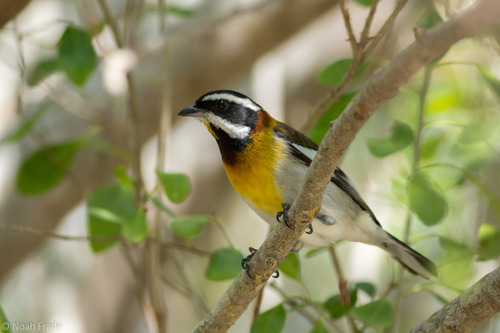
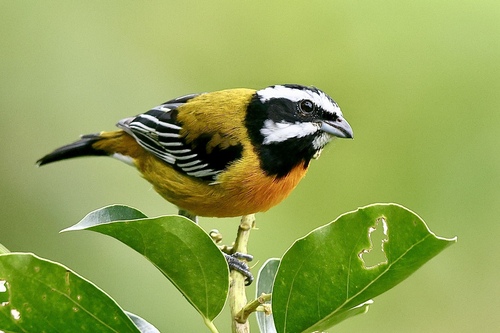
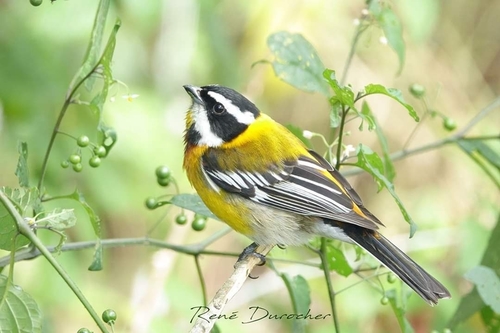
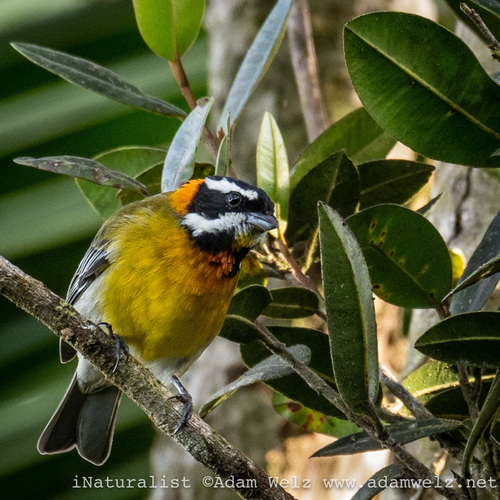
The Puerto Rican spindalis, Spindalis portoricensis, shows clear sexual dimorphism in both coloration and body size and weight. Males have bright coloration: they are green on the upper body, with an orange neck and chest, a black head marked by two white stripes (one above and one below the eyes), and gray to black tails and wings with small white stripes at the tips. Females, by contrast, are duller overall, with a dull olive-green color and faintly visible white stripes. Females are slightly heavier than males but smaller in measured lengths. Male weights range from 22.5 to 37.0 grams, averaging 30.8 grams, while female weights range from 28.0 to 41.1 grams, averaging 33.5 grams. Male wing lengths range from 82 to 88.5 mm, averaging 85.2 mm, while female wing lengths range from 80 to 85.5 mm, averaging 82.6 mm. Male tail lengths range from 59 to 68 mm, averaging 63.3 mm, while female tail lengths range from 56 to 65.5 mm, averaging 60.6 mm.
This species is native to the main island of Puerto Rico, where it is distributed across the entire island, and is rarely found at elevations above 1000 meters. Today it is more common in plantations than in its natural habitat, the forests of Maricao and El Yunque National Forest. It can also occur in gardens and other areas where fruit is grown, where it scavenges for flower nectar, and can be attracted to sugar solution.
Puerto Rican spindalis are most often found in pairs, but may also move in small flocks. They engage in mobbing behavior, where a flock of one or more bird species attacks a known predator to defend their eggs or hatchlings; this behavior has been observed in immature Puerto Rican spindalis targeting the Puerto Rican boa. In 2006, an individual was recorded performing "beak swinging", a behavior where the bird uses its beak to navigate vines. The vocalizations of the Puerto Rican spindalis are less complex than most other Spindalis species; only the songs of S. dominicensis are less elaborate. Like all species in the genus Spindalis, males produce high-pitched sounds at 8 kHz or higher, typically singing from high treetops. Females sing quiet "whisper songs", usually from dense vegetation close to the ground. The species' most common vocalization is described as a continuing series of high-pitched, thin, sibilant notes given in a rhythmic pattern. Other recorded vocalizations include a fast tweet and a short chi chi chi call.
For reproduction, the Puerto Rican spindalis builds cup-shaped nests out of various plant materials. Each clutch contains 2 to 4 eggs. Eggs are typically light blue with brown patches around the larger end, though regional variations in egg appearance exist. On average, eggs measure 24 by 17 mm.