About Spilornis holospilus (Vigors, 1831)
Scientific name: Spilornis holospilus (Vigors, 1831).
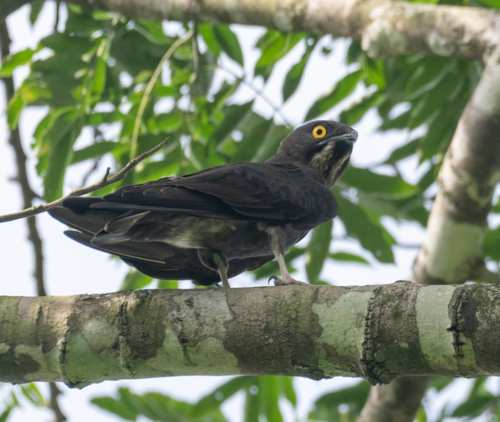
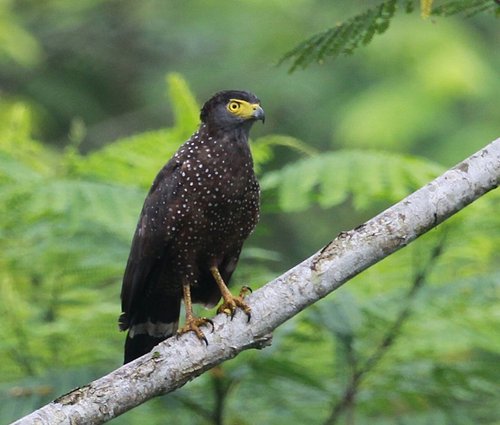
Description and taxonomy: According to eBird, this is a fairly large, common raptor that occurs in forest and more open wooded areas from the lowlands to the lower mountains. It is dark brown with white speckles on the crown and upperparts, rufous-brown on the underparts with large white spots. It has a distinctive gray cheek and yellow eye. It differs from other raptors within its range by its bare yellow skin between the bill and eye, and in flight by the dark terminal band on its wings and tail. It often gives a whistled "weeeeeuuuu weu weu" call during flight, and sometimes produces only a single note. This species is monotypic.
Habitat and conservation status: Its natural habitats are tropical moist lowland forest, montane forest, second growth, and cultivated areas, occurring up to 2,500 meters above sea level. The IUCN has classified this species as Least Concern, because it has a large range, is common throughout its range, and appears to adapt to second growth. Despite this classification, populations are still declining. Threats include habitat loss caused by slash-and-burn farming, mining, illegal logging, and habitat conversion, as well as hunting and poaching for the illegal wildlife trade. It occurs in multiple protected areas including Pasonanca Natural Park, Bataan National Park, Mount Banahaw, Mount Kitanglad, Mount Apo, and Northern Sierra Madre Natural Park. However, like all protected areas in the Philippines, enforcement of protection is lax, and deforestation continues even in these nominally protected areas.
Ecology and behavior: This bird feeds on amphibians, reptiles, and other live prey. Little is known about its breeding habits. A female with a single egg in its oviducts was collected in April 2020.