About Spilopelia senegalensis (Linnaeus, 1766)
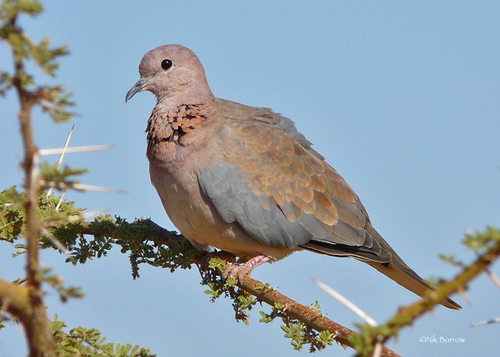
The laughing dove, Spilopelia senegalensis, is a slim, long-tailed pigeon that typically measures 25 cm (9.8 in) in length. Its underside is pinkish brown, with lilac-tinted head and neck. The head and underparts are pinkish, and this color fades to buff on the lower abdomen. Adult individuals have a chequered rufous and grey patch on the sides of the neck, formed by split feathers. Upper body parts are brownish, with a bluish-grey band running along the wing. South Asian populations have a uniform, dull brown back. African subspecies S. s. senegalensis and S. s. phoenicophila have bluish grey rumps and upper tail coverts, and differ from each other in the shades of their neck and wing feathers. S. s. aegyptiaca is larger, with vinous coloring on the head and nape and rufous upper wing coverts. The tail is graduated, and the outer feathers have white tips. Sexes cannot be distinguished from each other when observed in the field. Young birds do not have the chequered neck markings that adults have, and their legs are red. Plumage varies slightly between populations: individuals from more arid zones are paler. Abnormal leucistic plumages have been recorded for this species. The laughing dove's chuckling call is a low rolling croo-doo-doo-doo-doo with amplitude that rises and falls. This is a common, widespread species that lives in scrub, dry farmland, and areas of human habitation, and it often becomes very tame. Its native range covers most of Sub-Saharan Africa, Saudi Arabia, Iran, Iraq, Afghanistan, Pakistan, and India, and it is also found in Cyprus, Greece, Palestine, Israel, Lebanon, Syria, Jordan, the UAE, and Turkey; populations in these latter areas may be the result of human introduction. Most populations are mostly sedentary, but some populations do move. Birds ringed in Gujarat have been recovered 200 km north in Pakistan, and exhausted laughing doves have been recorded landing on ships in the Arabian Sea. A population thought to belong to the nominate subspecies was introduced to Perth in 1889, and it has become established across Western Australia. Birds that land on ships can be carried to new regions to establish new populations. The laughing dove is usually seen in pairs or small parties, and only rarely gathers in larger groups. Larger groups form most often when drinking at waterholes in arid regions. Small numbers assemble on trees near waterholes before flying down to the water's edge, where they can suck up water like other members of the pigeon family. Laughing doves feed on fallen seeds (mainly grass seeds), other vegetable matter, and small ground insects including termites and beetles. They are fairly terrestrial, foraging on the ground in grasslands and cultivated areas. Their flight is quick and direct, with regular wing beats and an occasional sharp flick of the wings, which is typical of pigeons in general. During courtship display, the male follows the female while performing head bobbing displays and cooing. The male pecks at his folded wings in a behavior called "displacement-preening" to solicit copulation from the female. A receptive female accepts by crouching and begging for food. The male may engage in courtship feeding before mounting and copulating. Mated pairs may preen each other. Males may also launch upward into the air with wing clapping above their backs, then glide down in a gentle arc during display. The laughing dove has a spread-out breeding season across Africa. In Malawi and Turkey, breeding can occur almost year-round. In Zimbabwe, breeding is mainly from May to November, and in Egypt and Tunisia, it occurs from February to June. In Australia, the main breeding season runs from September to November. The nest is a very flimsy platform made of twigs, built in a low bush, and sometimes in crevices or under the eaves of houses. Both parents participate in nest building: the male brings twigs, which the female then places to form the nest. Two eggs are laid, with one day between the laying of each. Both parents share the work of building the nest, incubating the eggs, and feeding the young. Males spend more time incubating the nest during the day. Incubation does not start until the second egg is laid, and the eggs hatch after around 13 to 15 days. Nesting adults may feign injury to distract predators and draw them away from the nest. The same pair can raise multiple broods in the same nest; one pair in Turkey has been recorded raising seven broods. Initially, altricial hatchlings are fed regurgitated crop-milk, a secretion produced from the lining of the parent bird's crop. The young fledge and leave the nest after approximately 14 to 16 days. In Africa, the Jacobin cuckoo sometimes lays its eggs in the nests of laughing doves. Feral Australian populations are sometimes infected by a virus that causes symptoms similar to psittacine beak and feather disease, which affects parrots. Several ectoparasitic bird lice from the genera Coloceras, Columbicola, Bonomiella and Hohorstiella have been found on this species. A blood parasite, Trypanosoma hannae, has also been recorded in laughing doves. The southern grey shrike has been observed preying on an adult laughing dove in northwestern India, and the lizard buzzard preys on this species in Africa. Some South African laughing doves have a beak deformity that causes overgrowth of the upper mandible.