About Spilomyia sayi (Goot, 1964)
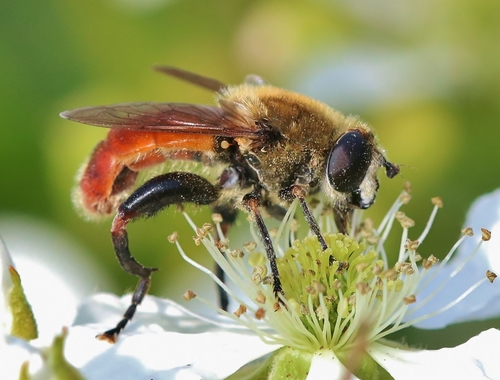
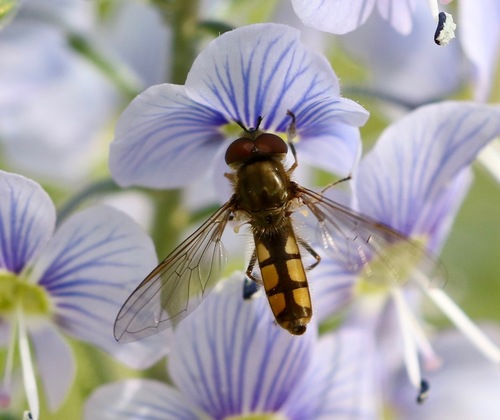
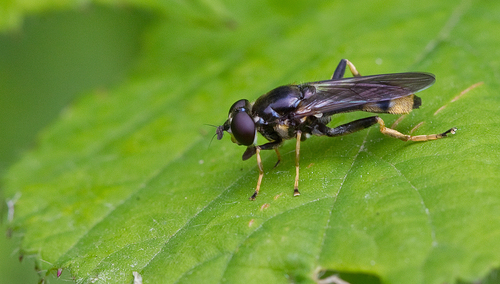
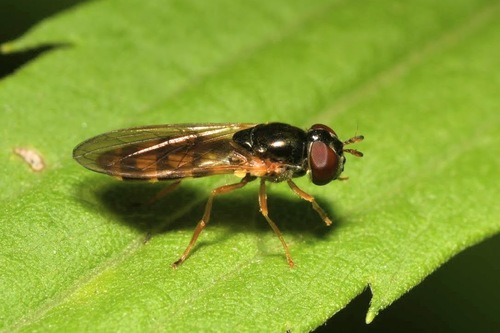
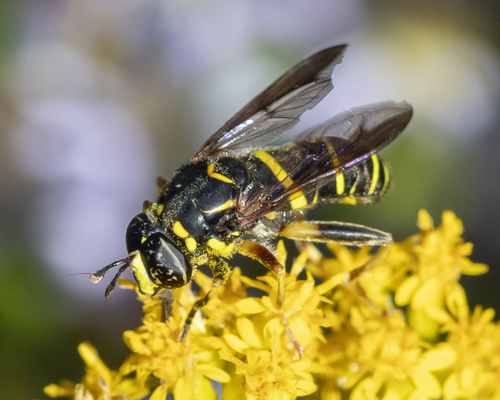
This species is scientifically named Spilomyia sayi (Goot, 1964). For explanation of morphological terms used, see Morphology of Diptera. Adults measure 10–16 mm (0.4–0.6 in) in body length. The head has a black vertex set against an overall black background. In females, the antennal prominence is yellow. The face profile is nearly straight; it is yellow with a wide median black stripe. The antennae are elongated, matching the depth of the face in length. They are colored reddish brown to brownish black. The arista is yellow, bare, and the flagellum is moderately elongated. The pedicel is very elongated, measuring nearly twice the length of the scape. The trapezoidal flagellum is one and a half times longer than it is wide. The eyes are bare; living specimens have a distinct clear brown color pattern, and male eyes are holoptic. The black scutum of the thorax bears a prominent inverted V-shaped yellow marking just above its posterior margin. A small yellow spot sits on the humeri, with a larger yellow spot located on the inner side of the humeri, and a slender yellow line runs above the wings. The scutellum is black, with a very narrow yellow rim. The pleurae are black with distinct yellow markings: a large elongated yellow spot on the mesopleurae, a large rounded yellow spot on the sternopleura, and a smaller yellow spot (sometimes absent) above the front coxae. The wings are elongated. They are brownish along the front border and hyaline behind. Cell R4+5 is acute and slightly petiolate, cell r1 is open, and the crossvein r-m is strongly oblique. For the legs: the base of the front tibia is yellow, and the rest of the front tibia is black; the front tarsi are entirely black. Both the front and mid femur are strongly swollen. The base of the mid femur is yellow, and the rest of the mid femur is brown. The hind femur has only a small yellow area at its base, with the rest mostly black, and it bears an anteriolateral spur. The mid and hind tibia are light ochraceous, and the mid and hind tarsi are pale brownish yellow. The abdomen is black, elongated, and cylindrical, being barely wider than the thorax, and it bears four yellow bands. The first abdominal segment is entirely black. The second segment has a single conspicuous anterior yellow band that is strongly arcuate, with its convexity facing forward, and this band continues backward onto the third abdominal segment. The third segment has a single median yellow band that is narrowly interrupted at the midline. The fourth segment also has a median interrupted yellow band, plus an additional yellow band along the segment's posterior edge. A small narrow yellow streak extends a short distance inward from the posterior angles of both the second and third abdominal segments. This species is distributed in Canada and the United States.