About Spilogale gracilis Merriam, 1890
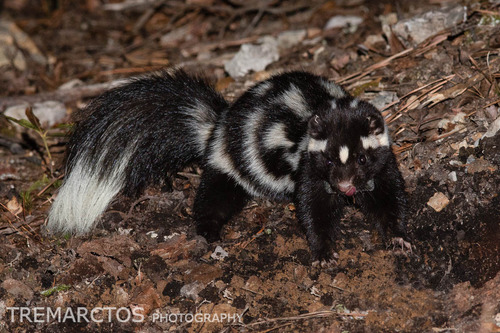
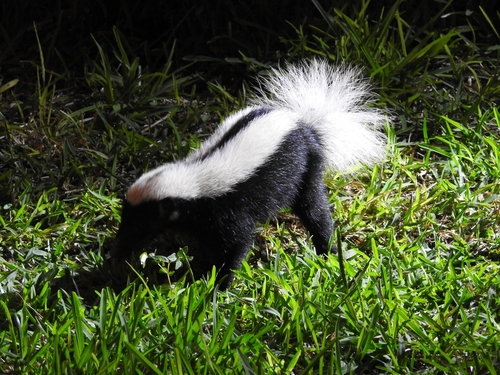
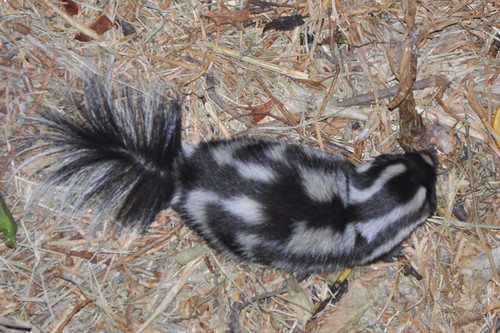
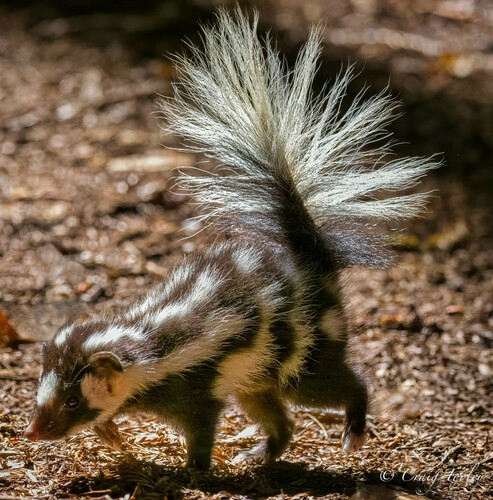
The western spotted skunk (Spilogale gracilis Merriam, 1890) measures 35–45 cm (14–18 in) in total length, making it smaller than the striped skunk (Mephitis mephitis). Males weigh 336 to 734 g (11.9 to 25.9 oz), which is significantly heavier than females that weigh 227 to 482 g (8.0 to 17.0 oz); on average, males are only around 6% longer than females. Adult western spotted skunks have bold black and creamy white patterning: three longitudinal stripes sit on each side of the front of the body, and three vertical stripes mark the hind body. One pair of longitudinal stripes runs along each side of the spine, the second pair crosses the shoulders and extends forward onto the face, and the third pair lies lower on the shoulders, curving downward at the middle of the body to form the first pair of vertical stripes. Behind these, the second pair of vertical stripes runs from the knees to the rump, while the final stripes are often little more than spots. Rarely, the normally black fur can appear red or brown, and the normally white areas may look gray or yellow; the cause of this color variation remains unclear. The species has short, rounded ears, a white spot between the eyes, and a white patch below each ear. It has a noticeably large, long-haired tail that measures 10 to 16 cm (3.9 to 6.3 in); most tail hair is black, but the tip is white, and the upper surface of the tail may also be white. The claws on the forefeet are longer and more curved than the claws on the hind feet. The western spotted skunk is distinguished from common striped skunks by its unique pattern of black and white spots and stripes, as well as its smaller size. Like other related skunk species, the western spotted skunk has a pair of large musk glands that open just inside the anus, and can spray musk through muscle contraction. Its musk is similar to that of striped skunks, but contains the additional component 2-phenylethanethiol, and lacks some of the compounds produced by striped skunks. These differences are reported to give the western spotted skunk's musk a more pungent odor, that does not spread as widely as the striped skunk's musk. The western spotted skunk is found across the western United States, northern Mexico, and southwestern British Columbia, Canada. It inhabits mixed woodlands, open areas, and farmlands. Its preferred habitat varies widely based on the resources available in the local area. In regions like Idaho and Washington, it favors riparian areas with brush thickets for hiding and foraging. By contrast, individuals of the species living in areas such as eastern Oregon or northern Mexico are often found near cliffs and canyons. The western spotted skunk typically reaches sexual maturity more quickly than other skunk species. Mating usually occurs in September, when females enter estrus; if they do not breed early, both sexes remain fertile for several months after this time. After fertilization, the embryo develops to the blastocyst stage, then enters a period of dormancy for several months before implanting in the uterine wall around April. Including this delayed implantation period, gestation lasts 230 to 250 days. Litters of two to five young, called kits, are born in May. At birth, kits are blind and almost hairless, and weigh around 11 g (0.39 oz). Young females become sexually mature at around 4 to 5 months of age. In captivity, western spotted skunks have lived for almost ten years.