About Spigelia marilandica (L.) L.
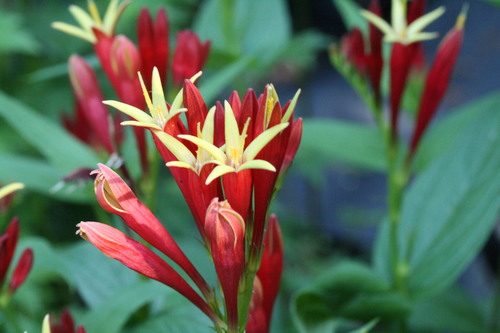
Spigelia marilandica (L.) L. is an upright perennial herbaceous plant. It reaches 30 to 61 cm (1 to 2 ft) in height, with a spread of 15 to 46 cm (0.5 to 1.5 ft). It produces 3 or 4 pairs of leaves per stem; proximal leaves are sessile, opposite in distal positions, and their blades are usually ovate to lanceolate, sometimes elliptic, measuring 4–12 × 1–5 cm, with a base that is rounded to cuneate. Its corollas are bright red on the outside and yellow to greenish yellow on the inside. The flowers are red, erect, and tubular, with a star-shaped yellow center at the tip. Flowering occurs in late spring and early summer, with sporadic blooming in fall. Seeds are held in a two-sided capsule, grouped into clusters of 4 to 7, and dispersed individually when mature. This species is native to inland areas of the Southeastern and Midwestern United States, and it is not known to occur in Maryland. It most commonly grows in moist to dry woodlands and forests, usually on circumneutral soils, in partial or full shade. It can also be found in low moist woods, ravines, or stream banks. Confirmed populations are located in South Carolina, southwestern North Carolina, Tennessee, Illinois, Oklahoma, and range south to the Florida Panhandle and Texas; some floras report it also occurs as far north as Virginia, New Jersey, and Pennsylvania, and in Alabama. It grows in USDA zones 5b through 9. It is used as an ornamental plant, and it is more popular in the UK and Europe than in its native United States, where commercial availability in the plant trade is limited, and nursery propagation is primarily vegetative. It has several medicinal uses: it is used to treat hypertension and heart disease. Dried roots are used as an anthelmintic (dewormer), and are followed by a saline aperient to avoid unpleasant side effects and ensure the toxic root is expelled along with the worms.