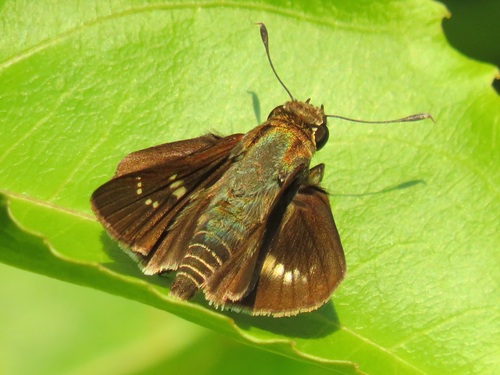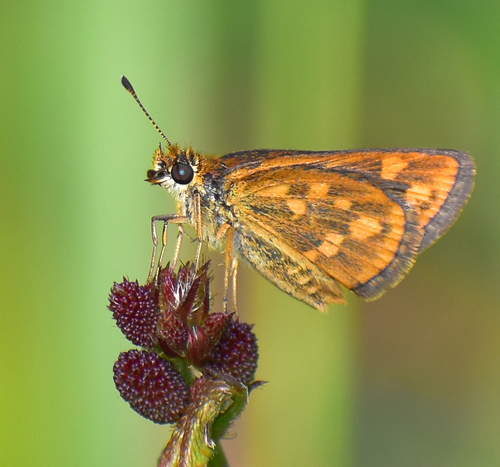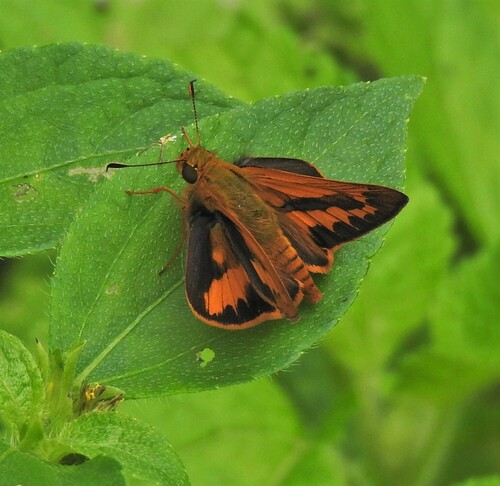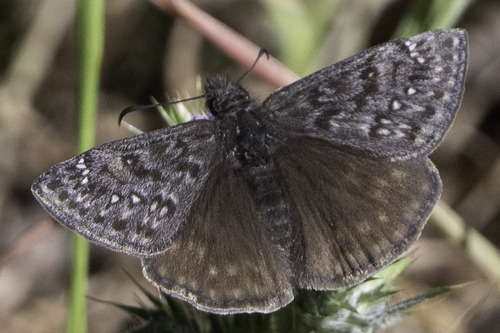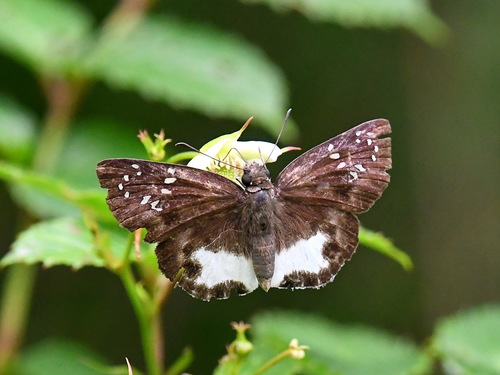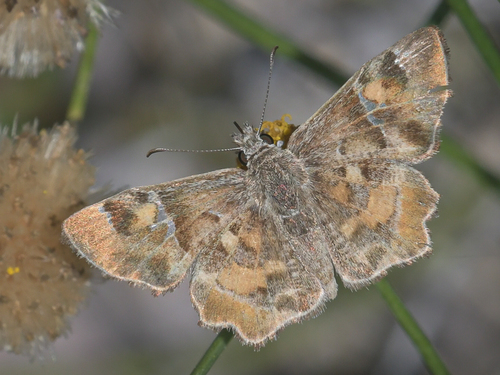
About Spialia sertorius (Hoffmannsegg, 1804)
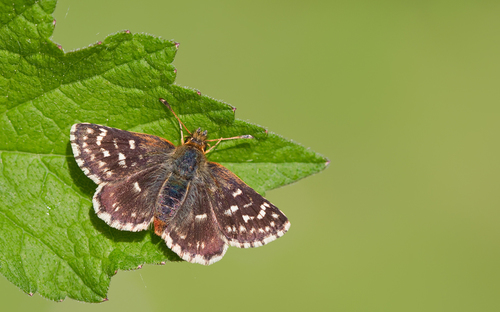
The red-underwing skipper, Spialia sertorius, can be confused with species of the genus Pyrgus. The underside of its wings has a cinnamon-red to yellowish base tone, while Pyrgus species typically have an underside base tone that is primarily greenish to brownish. This distinguishing color is less evident in older butterflies, and natural color deviations can occur, so identification should always rely on the characteristic arrangement of spots on the underside of the hind wing. On the upper side of the forewing, there is a series of small, distinctly bright spots in the submarginal band that follows a regular flat curve toward the front edge. The four spots in the post-discal region, closer to the wing base, lie in a straight row; in Pyrgus species, only three of these spots are aligned side by side, with the fourth positioned out of the row. This species has a wingspan of 22-26 mm. Identification can be particularly difficult in Spain, where the closely related species Spialia rosae, formally described in 2016, flies alongside Spialia sertorius at altitudes around 1000 m. Spialia sertorius is widespread across Western and Central Europe. Its range extends south through southern Europe into North Africa, and east as far as western Poland, the Czech Republic, Slovenia, and Croatia. It is not found in Scandinavia or Great Britain, and is already extinct in the Netherlands. Within Germany, it is absent from the northeastern federal states. Because its caterpillar host plant Sanguisorba minor has specific location requirements, Spialia sertorius is strongly associated with poor grasslands growing on limestone or calcareous conglomerates. While the host plant occurs most often in arid grasslands or gaps in pioneer semi-dry grassland stages, Spialia sertorius strongly prefers to occupy small sites that offer especially favorable thermal conditions for the host. In Central Europe, the species occurs from low altitudes up to altitudes above 1000 m, with recorded occurrences reaching a clear maximum at 400-500 m, a peak that is disproportionately high compared to most other species' reports. Above 1000 m, the species' thermal requirements are only met at sites with particularly favorable microclimates, such as south-facing slopes. The altitudinal limit of the host plant in the Bavarian Alps is usually just a little over 1200 m. However, there are documented records of Spialia sertorius at altitudes around 1700 m, and between 1700-2000 m, from warm years following the Second World War; these individuals were likely drifted upward from lower elevations. Adult butterflies fly from April to September, depending on location. There are usually two generations per year, and adults of the second generation are smaller than those of the first. Spialia sertorius can produce two generations across all major regions of Central Europe. The significantly lower number of recorded observations of the second generation in this region indicates that second-generation adults appear less frequently, and do not occur every year. A small second generation is also recorded from the Palatinate, a pattern explained by a large portion of the spring generation's offspring delaying development, only pupating after overwintering in April. The earliest recorded Bavarian specimens come from the second half of April during the hot spring of 2007. By the start of May, first-generation observations have been recorded in multiple other years. The main flight period of the first generation usually begins in mid-May, peaks at the end of May, and then observation numbers drop sharply by the end of July. From around mid-August, an increase in reports indicates the emergence of the second generation. Fresh adult butterflies were observed on the Munich plain at the beginning of September. In the Alpine region, recorded flight dates only extend from mid-May to mid-August. Available data shows that a second generation does not form everywhere, nor does it form regularly. Even so, there are a small number of observations from altitudes over 1000 m after mid-July, which indicates that occasional second generations can appear at these elevations in favorable years. The red-underwing skipper exclusively uses Sanguisorba minor as an oviposition site and caterpillar food source. First-generation females mostly lay eggs on still-closed flower heads, though they occasionally lay eggs on leaves. Because Sanguisorba minor only regularly blooms again after summer drought in arid grasslands, second-generation females in most locations only have leaves available to lay eggs on. As a result, they mostly glue their eggs to the upper side of leaflets from the host's pinnate leaves, and prefer leaves that lie close to the ground. Young caterpillars hatching from eggs laid in flower heads feed on ripening seeds and flower parts during their first two larval stages; caterpillars hatching from eggs laid on leaves feed on those leaves initially. Later instars live in leaf bags constructed from host plant leaflets. According to field observations from Switzerland, caterpillars overwinter inside a partial leaf of Sanguisorba minor that is spun together to form a protective shelter. Pupation occurs on the ground, inside a web made of host plant leaf pieces. Adult red-underwing skippers have a characteristic very rapid flight that stays close to the ground. Males are the easiest to spot, as they are territorial and regularly return to sites such as Sanguisorba minor flowers. Adults are not very frequently observed visiting flowers. Multiple reports of nectar feeding on Hippocrepis comosa and Lotus corniculatus exist from Bavaria. These two plants are also important nectar sources for the species in Baden-Württemberg and the Palatinate. Additionally, the species has been observed feeding on Thymus spp., Globularia cordifolia, Teucrium montanum, Geranium sanguineum, and Pimpinella spp. in Bavaria. Males, in particular, frequently puddle on moist soil.