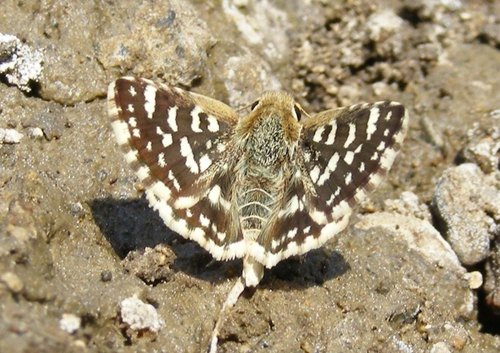
About Spialia galba (Fabricius, 1793)
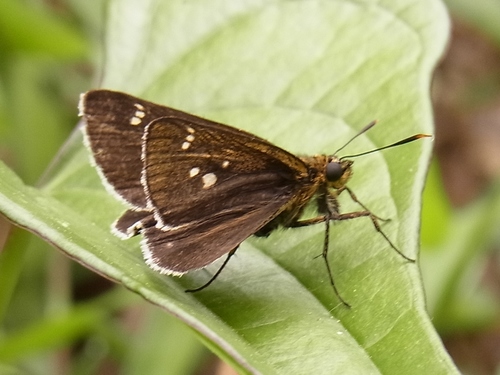
Male Spialia galba have an upperside that is black with a faint olive tint and is marked with white spots. On the forewing, there are three spots positioned within the cell: sub-basal, medial, and terminal. There is one spot on the sub-median vein below the sub-basal spot, followed by a discal series of eight spots. This series starts with three sub-apical spots that lie close together near the costa, then two grouped spots with the lower one larger, then two larger, more or less square connected spots set slightly inwards, and a final spot on the sub-median vein placed even further inwards. A complete sub-marginal series of small spots, one per interspace, is also present, along with four short white streaks on the outer half of the costal line. On the hindwing, there is a sub-basal spot in the cell, a larger somewhat square-shaped spot at the end of the cell with a smaller spot below it and an even smaller spot above it, and a sub-marginal series of small spots, one in each interspace, that fade out towards the upper part of the wing. The cilia of both wings are checkered black and white. The underside of the male is grey. All spots on the forewing match the arrangement seen on the upperside, but they are larger. On the hindwing, the abdominal fold is white, and cell spots are extended to create three sub-basal spots. The spot at the end of the cell expands into a continuous white band with irregular edges that runs from the costa to the abdominal fold. Sub-marginal spots match the pattern of the upperside. The cilia of both wings are checkered grey and white. The antenna shaft has white spots on its upper surface and is pure white on its underside, except for the tip of the club, which is dull orange. Palpi, head, and the upper side of the body match the wing color, while the underside of the body and the legs are white. Females are usually larger and have a darker black base color than males, but share the same general marking pattern, though spots on the upperside are often smaller. This species has a wingspan of only 24 to 27 mm, and is identified by its unique pattern of black and white spots and small size. The upperside ranges from dark brown to black with a light brown gloss and many small white spots, and the wings have a chequered fringe. The underside is whitish. This butterfly is distributed from Sri Lanka and India to the Shan states of northern Myanmar, Thailand, Vietnam, and Hainan. It is very common across India up to an altitude of 1800 m. Recorded larval food plants belong to two families: Fabaceae includes soybean, while Malvaceae includes Alcea rosea, Hibiscus species, Melochia corchorifolia, Sida rhombifolia, Urena lobata, and Waltheria indica.