About Sphyrna zygaena (Linnaeus, 1758)
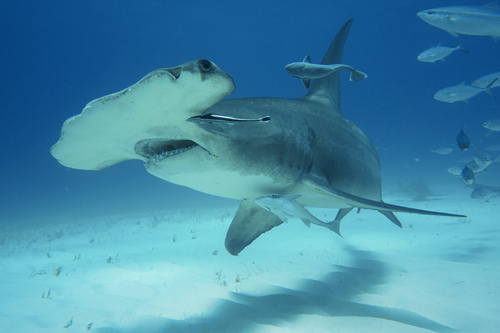
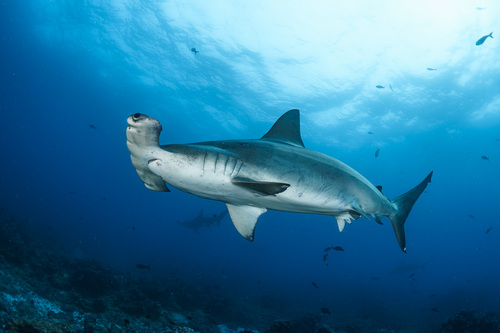
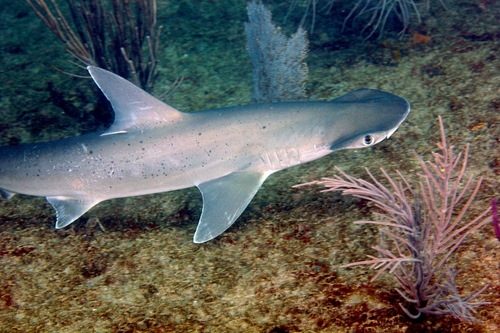
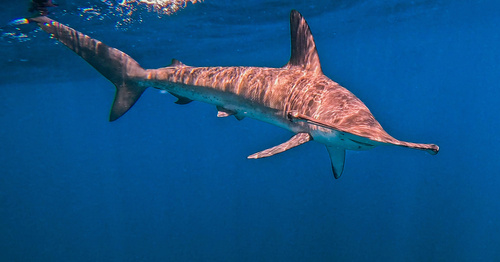
The smooth hammerhead, with the scientific name Sphyrna zygaena (Linnaeus, 1758), is the second largest hammerhead shark, only smaller than the great hammerhead. Adults typically measure 2.5–3.5 m (8.2–11.5 ft) long, with a maximum recorded length of 5 m (16 ft) and maximum recorded weight of 400 kg (880 lb). This species differs from other large hammerheads in the shape of its cephalofoil: the cephalofoil has a curved front margin with no central indentation, it is wide but short, spanning 26–29% of the shark's total body length. Its nostrils sit near the ends of the cephalofoil, with long grooves extending toward the center. The upper jaw holds 26–32 tooth rows, while the lower jaw holds 25–30 tooth rows. Each tooth is triangular, with edges ranging from smooth to weakly serrated. Its body is streamlined, and there is no dorsal ridge between the two dorsal fins. The first dorsal fin is moderately tall, sickle-shaped (falcate) with a rounded tip. The pectoral and pelvic fins are not falcate, and have nearly straight rear margins. The anal fin is larger than the second dorsal fin, it has a long free rear tip and a strong notch along its rear margin. Its dermal denticles are densely packed; each denticle has 5–7 horizontal ridges (3 ridges in juveniles), which create a W-shaped rear margin. The back is dark brownish gray to olive, a color that differs from the plain brown of most other hammerheads, and lightens toward the flanks. The belly is white, and the underside of the pectoral fins sometimes has dark edges. Among hammerhead sharks, the smooth hammerhead is the most tolerant of temperate water, and occurs worldwide at higher latitudes than any other hammerhead species. In the western Atlantic, it ranges from Nova Scotia to the Virgin Islands and from Brazil to southern Argentina. In the eastern Atlantic, it ranges from Ireland to Côte d'Ivoire, and is also found in the Mediterranean Sea. Only 8 individuals have been recorded in British waters; all but one (caught at Banffshire) were found in the southern part of the island, and all but two, recorded in 2004 and 2019, were documented more than 100 years ago. A commonly repeated claim of a 1937 capture in the Kattegat (Denmark) is incorrect: a photo from the incident shows the animal was actually a basking shark. A confirmed 2003 observation of a hammerhead in the North Sea off Jutland is most likely a smooth hammerhead. In the Indian Ocean, this species is found off the coasts of South Africa, India, and Sri Lanka. In the western Pacific, it occurs from the Gulf of Tonkin to southern Japan and the Russian Far East, as well as off Australia and New Zealand. In the central and eastern Pacific, it is found off the Hawaiian Islands, California, Panama, the Galapagos Islands, Ecuador, and Chile. A 1954 report of two unidentified hammerheads off British Columbia suggests these were most likely smooth hammerheads. This species is generally considered amphitemperate, meaning it is absent from the tropics, though there are rare reports from tropical waters including the Gulf of Mannar off India, and off southern Mozambique. Its presence in the tropics is hard to confirm because it is easily confused with other hammerhead species. Although the smooth hammerhead generally prefers subtropical and warm temperate regions, a study of captures in the West Atlantic and Gulf of Mexico off the United States recorded the species in water temperatures ranging from 7.5 to 27.5 °C (45.5–81.5 °F). Compared to scalloped and great hammerheads, the smooth hammerhead stays closer to the surface, most often in water less than 20 m (66 ft) deep. It has however been recorded diving as deep as 200 m (660 ft). It prefers inshore waters such as bays and estuaries, but is sometimes found in the open ocean over the continental shelf and around oceanic islands. It has also been reported entering freshwater habitats, such as Florida's Indian River. In summer, smooth hammerheads migrate poleward to stay in cooler water, and migrate back toward the equator in winter. Adult smooth hammerheads are either solitary or form small groups. Large numbers may gather during annual migrations; schools of over a hundred juveniles under 1.5 m (4.9 ft) long have been observed off the eastern Cape of South Africa, and schools thousands strong have been reported off California. During hot summer weather, they can be seen swimming just below the surface with their dorsal fins exposed. Young smooth hammerheads are preyed on by larger sharks such as the dusky shark (Carcharhinus obscurus); adult smooth hammerheads have been observed being consumed by killer whales (Orcinus orca) off New Zealand. Known parasites of the smooth hammerhead include the nematodes Parascarophis sphyrnae and Contracaecum spp. The smooth hammerhead is an active-swimming predator that feeds on bony fishes, rays, other sharks including members of its own species, and cephalopods. It feeds on crustaceans such as shrimp, crabs, and barnacles to a lesser extent. It readily scavenges food from fishing lines. In some areas, stingrays are a favored prey and make up most of its diet. The venomous barbs of stingrays are often found lodged in and around the mouths of these sharks; one examined specimen contained 95 such spines. In northern Europe, the smooth hammerhead feeds on herring and seabass, while in North America it preys on Spanish mackerel and menhaden. Off South Africa, smooth hammerheads feed on squid such as Loligo vulgaris and small schooling fish such as pilchard over deep coral reefs at the edge of the continental shelf. Individuals longer than 2 m (6.6 ft) eat increasing numbers of smaller sharks and rays. Off Australia, squid are the most important prey, followed by bony fish. While confirmed events are rare, there are observations of smooth hammerheads attempting to prey on dolphins. Like other hammerheads, the smooth hammerhead is viviparous. Once developing young use up their yolk supply, the empty yolk sac develops into a placental connection that the mother uses to provide nourishment to the developing offspring. Females produce relatively large litters of 20–50 pups after a 10–11 month gestation period. Birthing takes place in shallow coastal nursery areas, such as Bulls Bay in North Carolina. Pups measure 50–61 cm (20–24 in) long at birth. Females reach sexual maturity at 2.7 m (8.9 ft) long, while males reach maturity at 2.1–2.5 m (6.9–8.2 ft) long, with size at maturity varying by location. Off South Africa, newly mated females are caught in February, and females carrying full-term embryos are caught in November. Off the east coast of Australia, birthing occurs between January and March, and ovulation takes place around the same time. This shark is thought to live 20 years or more.