About Sphyrna mokarran (Rüppell, 1837)
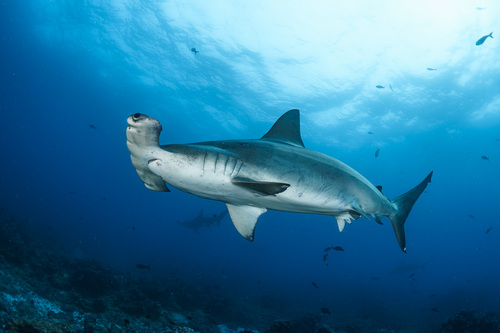
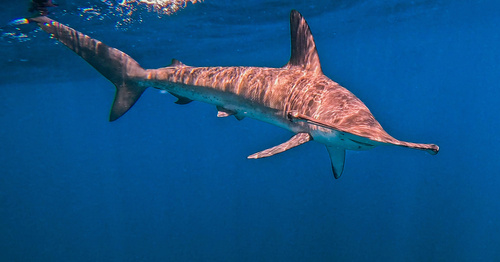
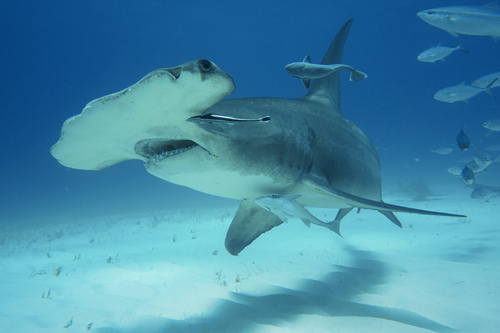
The great hammerhead (scientific name Sphyrna mokarran (Rüppell, 1837)) has a streamlined body and an expanded cephalofoil, which is a typical body shape for hammerhead sharks. Adults can be told apart from the scalloped hammerhead and the smooth hammerhead by the shape of their cephalofoil: the great hammerhead's cephalofoil has a nearly straight front margin, rather than an arched one, and has distinct medial and lateral indentations. The width of the cephalofoil equals 23 to 27 percent of the shark's total body length. Its teeth are triangular, strongly serrated, and grow more oblique toward the corners of the mouth. There are 17 tooth rows on either side of the upper jaw, with two or three additional teeth at the symphysis, the midline of the jaw. On either side of the lower jaw, there are 16 to 17 tooth rows, with one to three teeth at the symphysis. The first dorsal fin of the great hammerhead is very distinctive: it is very tall, strongly sickle-shaped, and originates over the insertions of the pectoral fins. Both the second dorsal fin and the anal fin are relatively large, with deep notches along their rear margins. Its pelvic fins are sickle-shaped with concave rear margins, which differs from the straight rear pelvic fin margins of the scalloped hammerhead. The great hammerhead's skin is covered with closely spaced dermal denticles. Each denticle is diamond-shaped; smaller individuals have three to five horizontal ridges that lead to marginal teeth, while larger individuals have five or six such ridges. Great hammerheads are dark brown to light gray to olive on their upper bodies, and fade to white on their undersides. Adult fins do not have markings, but the tip of the second dorsal fin may be dark in juvenile sharks. Most mature great hammerheads measure at minimum 3.5 m (11 ft) long and weigh over 230 kg (510 lb), while the typical maximum is 4.6 m (15 ft) long and 449.5 kg (991 lb) in weight. A small portion of the population, almost entirely female individuals, grow much larger. The longest great hammerhead ever recorded measured 6.1 m (20 ft). The heaviest known great hammerhead is a 4.4 m (14 ft) long pregnant female caught off Boca Grande, Florida in 2006, that weighed 580 kg (1,280 lb); her high weight came from carrying 55 neonatal pups. Unverified reports suggest exceptionally large great hammerheads may reach 900 kg (2,000 lb) in weight. The great hammerhead lives in tropical waters worldwide, between the latitudes of 40°N and 37°S. In the Atlantic Ocean, it occurs from North Carolina to Uruguay (including the Gulf of Mexico and the Caribbean Sea), and from Morocco to Senegal, as well as in the Mediterranean Sea. It can be found along the entire rim of the Indian Ocean. In the Pacific Ocean, it ranges from the Ryukyu Islands to Australia, New Caledonia, and French Polynesia, and from southern Baja California to Peru. Unconfirmed reports note it may also occur off Gambia, Guinea, Mauritania, Sierra Leone, and Western Sahara, and it is occasionally sighted near Hawaii, though these sightings have not been confirmed. Great hammerheads live from inshore waters less than 1 m (3.3 ft) deep, out to offshore depths of 80 m (260 ft). They prefer coral reef habitats, but also live on continental shelves, island terraces, in lagoons, and in deep water near land. They are a migratory species; populations off Florida and in the South China Sea have been recorded moving closer to the poles during the summer. The great hammerhead is a solitary, nomadic predator, and other reef sharks generally keep a wide distance from it. If confronted, it may perform an agonistic display, dropping its pectoral fins and swimming in a stiff or jerky pattern. Juvenile great hammerheads are preyed on by larger sharks such as bull sharks (Carcharhinus leucas), while adult great hammerheads have no major natural predators other than killer whales, which hunt hammerheads of any age. Yellow jacks (Carangoides bartholomaei) have been observed rubbing against the flanks of great hammerheads, possibly to remove parasites. Schools of pilot fish (Naucrates ductor) sometimes travel alongside great hammerheads. Several copepod species parasitize the great hammerhead, including Alebion carchariae, A. elegans, Nesippus orientalis, N. crypturus, Eudactylina pollex, Kroyeria gemursa, and Nemesis atlantica.