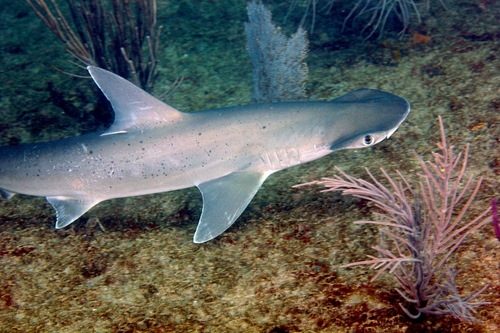
About Sphyrna lewini (Griffith & Smith, 1834)
The scalloped hammerhead (Sphyrna lewini) can be easily distinguished from other hammerhead sharks by a central indentation on the front edge of its head, with two additional indentations on either side of the central one that create its characteristic "scalloped" appearance. It has a very large, slightly hooked first dorsal fin, and a much smaller second dorsal fin. Its body is typically uniform grey, greyish brown, bronze, or olive, with a white underside that provides countershading. When sexually mature, males usually measure 1.5 to 1.8 m (4.9 to 5.9 ft) long and weigh around 29 kg (64 lb), while larger mature females measure 2.5 m (8.2 ft) and weigh around 36.2 kg (80 lb). According to FishBase, the maximum recorded length for the species is 4.3 m (14 ft) with a maximum weight of 152.4 kg (336 lb); one gravid female caught off Miami measured 3.26 m (10.7 ft) and was reported to weigh 200 kg (440 lb).
This species has a very high metabolic rate that shapes its feeding behavior, and it occupies a tertiary trophic level. Like many other shark species, scalloped hammerheads use shore areas as breeding grounds. Due to their high metabolic rates, young scalloped hammerheads require large amounts of food, or they will starve. S. lewini is also known for having a large, complex brain that supports high levels of cognitive ability, social intelligence, and sensorimotor function. The species performs intricate migrations, maintains complex habitat relationships, and captures prey with athletic movement. Its social intelligence is particularly critical for its group aggregating behavior, which lets the species breed with the fittest individuals and support more successful population proliferation.
The dentition of scalloped hammerheads is made up of small, narrow, triangular teeth with smooth edges, though larger individuals may have slightly serrated teeth. Teeth at the front of the mouth have upright cusps, and the cusps of lower jaw teeth are more upright than those of the upper jaw.
The scalloped hammerhead is a coastal pelagic species that lives over continental and insular shelves and in nearby deeper water. It occurs in warm temperate and tropical waters worldwide, between 46°N and 36°S latitude. It can be found at depths of over 500 m (1,600 ft), but is most commonly found in waters shallower than 25 m (82 ft). During the day, it is more often found close to shore, and hunts further offshore at night. Adults are found alone, in pairs, or in small schools, while young sharks form larger schools. Juveniles and pups thrive in shallow coastal habitats such as bays and mangroves, which offer shelter from predators and nutrient-rich water from deposited sediment.
Research conducted by non-governmental organization Misión Tiburón, using conventional and acoustic shark tagging methods, found that adult scalloped hammerheads migrate from pelagic waters around Cocos Island to mangroves in Golfo Dulce, a tropical fjord on Costa Rica's Pacific coast. Female scalloped hammerheads give birth to live young in this fjord, and juveniles remain in the shallow root systems of the mangroves for around three years. After this period, they leave Golfo Dulce and migrate back to Cocos Island to feed in pelagic waters.
The gestation period for scalloped hammerheads is around 12 months, and the species gives birth to live young. Compared to other shark species, scalloped hammerheads produce large litters of 12 to 41 pups, most likely to offset high infant mortality. Like most sharks, this species does not provide parental care. Nursery grounds for the species are predictable and reused year after year, and adult sharks are faithful to their natal sites. Even with this natal site fidelity, natal sites still see high infant mortality, as limited resources cannot support all young, so only the fittest individuals survive to maturity. If a population is depleted, it recovers through reproduction rather than immigration. This species does not attack conspecifics even during periods of starvation. The species has migratory behavior, so food deprivation can occur during migration and as young individuals grow. While the Taiwan population of scalloped hammerheads appears to reach maturity at an earlier age, the species as a whole is still reported to be slow to mature.