About Sphyrapicus varius (Linnaeus, 1766)
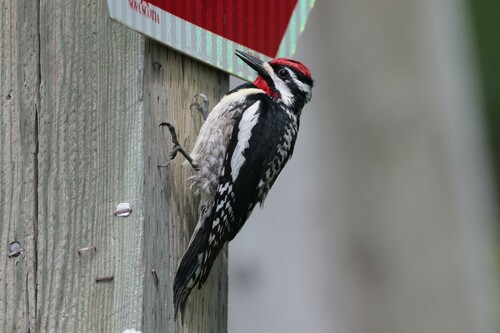
This species is the yellow-bellied sapsucker, with the scientific name Sphyrapicus varius (Linnaeus, 1766). Adults measure around 19 to 21 centimetres (7+1⁄2 to 8+1⁄4 inches) in length, with an average weight of 50.3 grams (1.77 oz); individual weights can range from 35 to 62 grams (1.2 to 2.2 oz). Their wingspan falls between 34 and 40 centimetres (13+1⁄2 to 15+3⁄4 inches). Males have a bright red forehead, which very occasionally appears yellow, while females have a lighter shade of red on the forehead. For females, red may only appear on the forehead, if it appears at all, as females rarely have a black head marked with a few buff spots. The crown is usually red and bordered by black, and may sometimes be mixed with black in females. A white stripe starts above the eye, extends and widens toward the nape, and is interrupted by a thin black line on the hindneck. A broad black stripe runs through the ear-coverts and down the side of the neck. Below this black stripe, another white stripe runs from the nasal tufts to the side of the breast. Sexes can be distinguished by the color of the throat and chin: these are white in females and red in males. The mantle is white, with irregular black bars extending from the mantle to the rump. The lower rump is white, and the uppertail-coverts are white with some black webbing. The wing coverts are black, with a white panel on the median and central greater-wing coverts. Flight feathers are black with white tips. The innermost tertials are marked with black and white. The underwing is barred with greyish and white. The uppertail is black, with some black webbing and occasional white tips on the outer feathers. Except for the pale breast and upper underparts, the underparts have a yellow tint that transitions to whiter coloring toward the lower underparts. Black arrowhead-shaped markings run from the side of the breast down to the undertail coverts. The bird has a relatively short, straight, chisel-tipped bill that ranges from slate to blackish in color. The legs are blue-grey to green-grey, and the irides are deep brown. Juveniles are overall dark olive-brown, with a buff-striped head and streaked crown. The throat is usually white, though male juveniles may have some red coloring here. Upperparts are generally mottled pale and blackish. The breast has a scaly pattern, and the center of the belly is very pale yellow. The tail is more heavily barred than that of adults. The yellow-bellied sapsucker is distributed across Canada, eastern Alaska, and the northeastern United States. These birds winter in the eastern United States, the West Indies, and Central America. It has also been recorded as a very rare vagrant in Ireland and Great Britain. During the breeding season, it is generally found in deciduous and mixed coniferous forests up to 2,000 metres (6,600 ft) in altitude. During the non-breeding season, it usually inhabits forests, but will sometimes use forest edges, open woodland, and semi-open habitats. It can also be seen around larger trees in pastures, clearings, and suburban areas, and occasionally occurs in palm groves. In the non-breeding season, it can be found from sea level up to 3,200 metres (10,500 ft), reaching up to 3,400 metres (11,200 ft) in some areas. It most commonly occurs between 900 and 3,000 metres (3,000 and 9,800 ft) in this season.