About Sphyrapicus ruber (J.F.Gmelin, 1788)
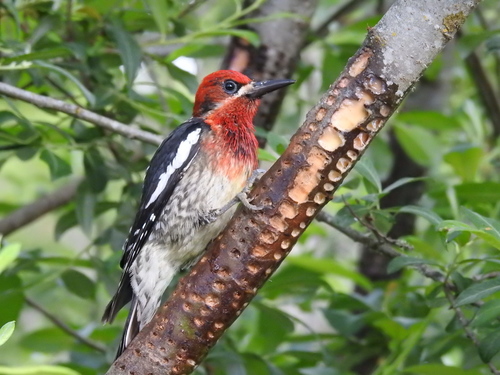
Sphyrapicus ruber (first described by J.F. Gmelin in 1788) is commonly known as the red-breasted sapsucker. Adult red-breasted sapsuckers have a red head and upper chest, a white lower belly, and a white rump. Their back and wings are black with barring, and they feature a large white wing patch. The northern subspecies S. r. ruber has yellow bars on the back and a yellow upper belly. The southern subspecies S. r. daggetti has white bars on the back and a pale belly. Wing barring is white in both subspecies. These birds produce a variety of sounds: their vocalizations include different chattering, squeals, and scream-like calls, and they also drum with their bills on many different surfaces. Most of these sounds are used to establish territory and attract mates, and are made separate from the noise of drilling feeding holes and excavating nest cavities. Red-breasted sapsuckers breed from southeast Alaska and British Columbia south through the Pacific Coast Ranges of western Washington, Oregon, and northern California. Their usual breeding habitat is forest containing pine, hemlock, Douglas fir, fir, and spruce, though they also use other woodland habitats. They prefer old-growth forest, and require living trees to provide the sap they feed on.