About Sphyraena viridensis Cuvier, 1829
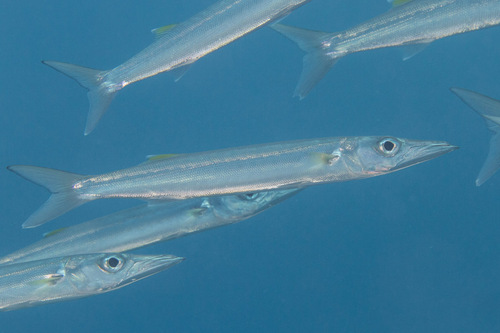
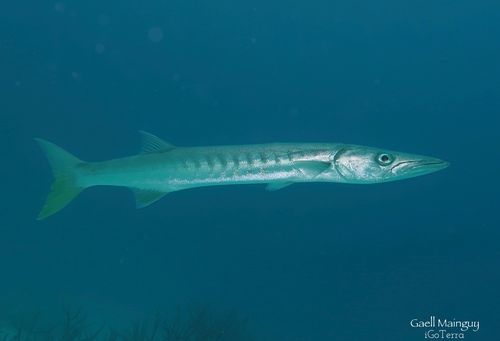
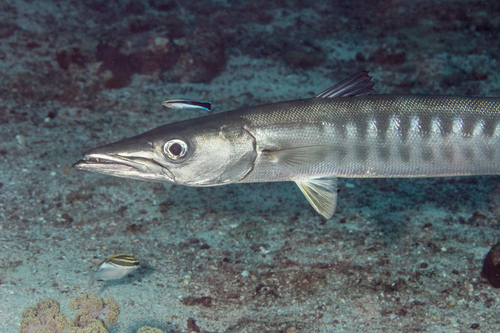
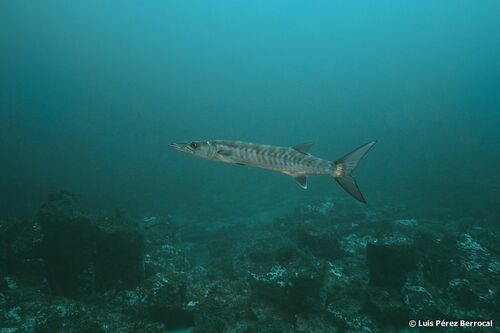
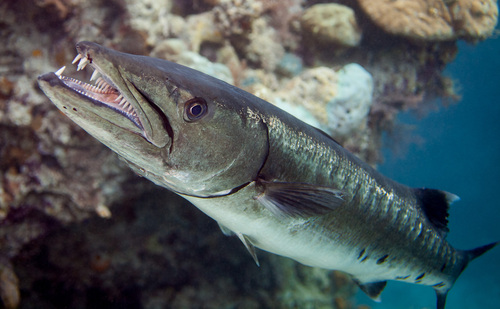
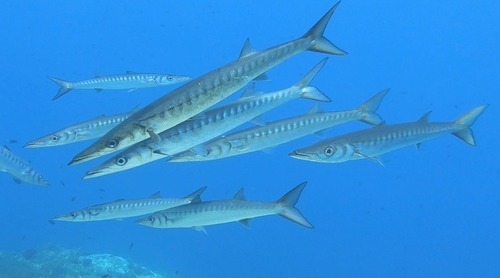
Sphyraena viridensis, first described by Cuvier in 1829, has a fusiform body with a long, streamlined, pointed snout. It has a large mouth containing two rows of sharp, fang-like teeth and a protruding lower jaw. Unlike the European barracuda, which has scales on both the anterior and posterior margins of the preoperculum, S. viridensis has no scales on this structure. Numerous dark transverse bars run across its back; these bars typically extend below the lateral line, which is not the case for the same markings on the European barracuda. The bars fade in preserved dead specimens. Adult S. viridensis generally have countershaded colouration, being dark on the upper body and silvery on the lower body, while juvenile individuals are dark yellow or greenish. This species is smaller than the European barracuda. It reaches a standard length of 65 cm (26 in), with an average adult length of 35 to 40 cm (14 to 16 in), though specimens up to 1,190 mm (47 in) have been caught off the Azores. The current rod-and-line catch record is a 10.2 kg (22 lb 8 oz) individual caught off Lanzarote in the Canary Islands in 2007. The full distribution of S. viridensis remains unclear because the species has often been confused with the European barracuda. It is confirmed to occur in subtropical regions of the eastern Atlantic, around the Azores, Madeira, Cape Verde Islands, and Canary Islands. It has also been recorded in the Mediterranean Sea, including off the coasts of Lebanon, Israel, Algeria, Corsica, and Sicily, as well as in the Adriatic Sea and Aegean Sea. It has even been recorded as far north as Cornwall in the United Kingdom.