About Sphyraena qenie Klunzinger, 1870
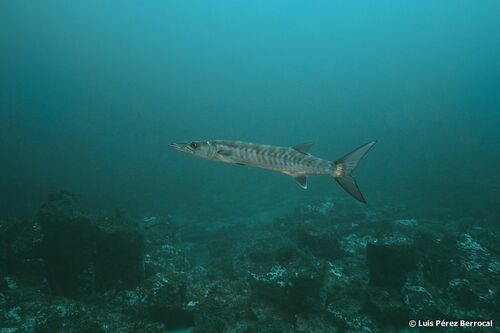
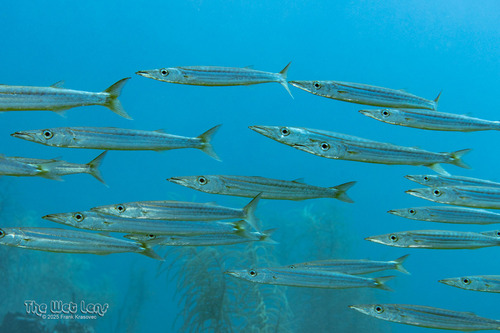
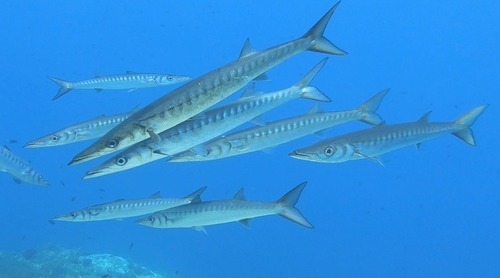
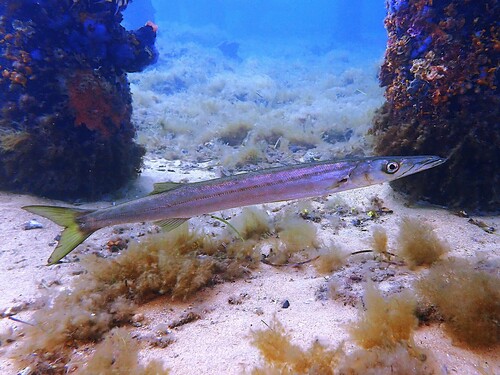
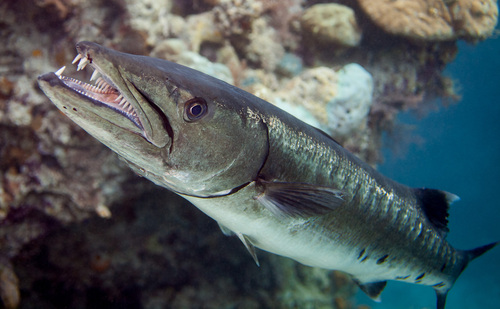
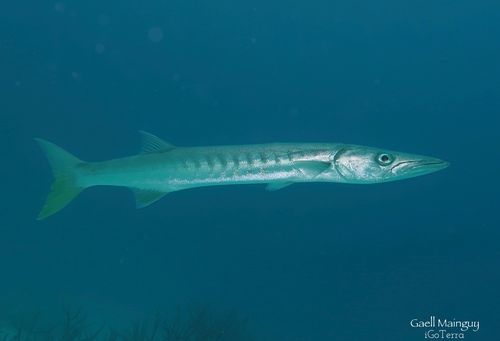
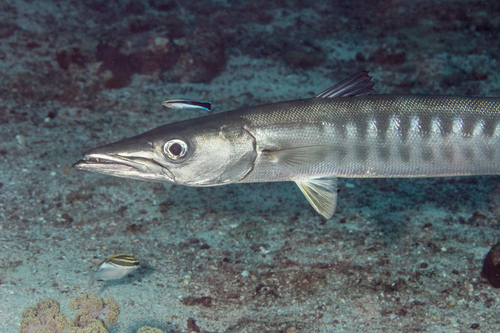
Sphyraena qenie, commonly called the blackfin barracuda, reaches a maximum total length of 140 cm (55 in). It is distinguished by 18 to 22 long, v-shaped black lateral bands running along its body, with the apex of each v pointing forward; this band count separates it from similar species S. jello and S. putnamae. Other key identifying features include elongated last rays on the second dorsal fin and anal fins, a blackish caudal fin, and a complete lack of gill rakers. In its mouth, the upper jaw (maxilla) aligns vertically with the front of the eyes, the lower jaw is longer than the upper jaw, and the upper jaw has a distinct conical tip unique to this species. Unlike most other barracuda species, the blackfin barracuda’s preopercle does not have a thin flap. The anal fin is positioned midway below the second dorsal fin, with the heart located near the anal fin. Compared to the closely related S. putnamae, S. qenie has 19 to 20 longitudinal scale rows level with the middle and ventral margins of the eye, while S. putnamae has only 11 to 15. Between the eye and the preopercular margin, S. qenie has 25 to 27 scales, versus 15 to 20 in S. putnamae. Additional differences include a shorter upper jaw (which emphasizes the longer lower jaw), more anterior placement of the first dorsal and pelvic fins, longer anterior rays on the anal fin and second dorsal fin, and a slimmer body insertion in S. qenie. Sphyraena qenie was originally misclassified as a smaller form of Sphraena nigripinnis, until scientists observed that S. nigripinnis has a relatively deeply forked caudal fin with two large, well-developed lobes. This barracuda species is distributed from the Red Sea and East Africa across the Indian and Western Pacific, reaching as far east as French Polynesia. It inhabits tropical and temperate waters, with the tropical and subtropical waters of the Indo-Pacific Ocean providing a favorable habitat. The first recorded sighting of S. qenie in Indian waters was in 1966. Rare occurrences of the species have also been documented in the tropical Eastern Pacific. In Japan, it is found in waters surrounding the Ryukyu Islands, Amami Oshima, Yonaguni, Tanega, and Ishigaki Islands. Only adult blackfin barracudas migrate to the Ryukyu Islands from tropical waters when water temperatures become too high, and the species is also spotted near Okinoerabu Island from July through October each summer. Blackfin barracuda are most often found on coral reefs down to a depth of 50 m (160 ft), where they form large schools. From late afternoon through dusk, they leave the reefs to hunt for prey in relatively deeper waters. The blackfin barracuda is not popular as a sport fish, but it is targeted by longline fishing. It has flavorful, delicate flesh that makes it valued as bait, particularly for catching tuna. It is typically caught at night via trawling, which explains why it is not commonly encountered in American Samoa. In a study of mercury (Hg) levels in remote Oceania coral reef systems, S. qenie was an important indicator species for measuring mercury levels in undisturbed remote reef ecosystems. The study found that mercury levels in reef predators from unimpacted waters were high by World Health Organization standards, suggesting potential health concerns from consuming these top-trophic level reef fish at the time of the study.