About Sphyraena novaehollandiae Günther, 1860
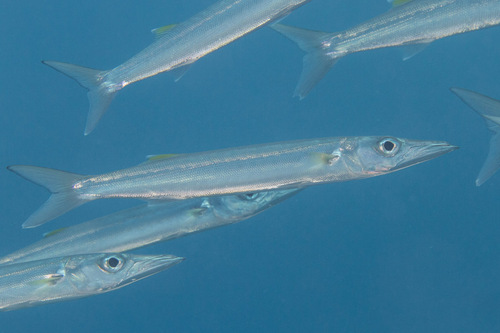
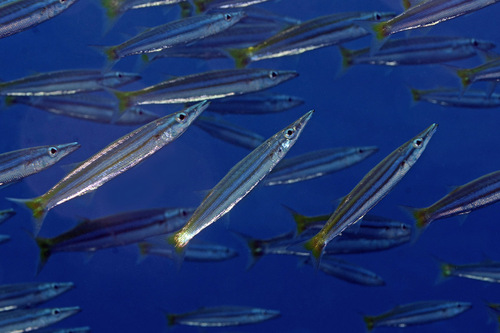
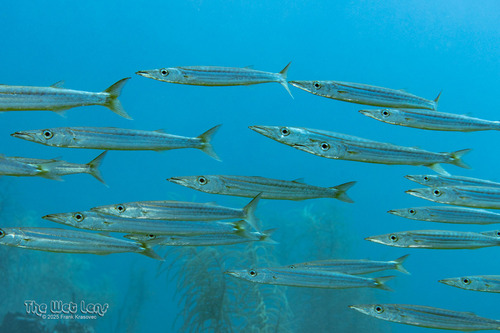
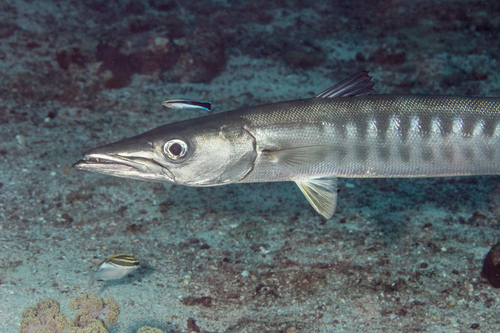
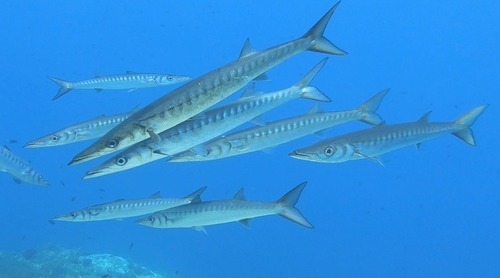
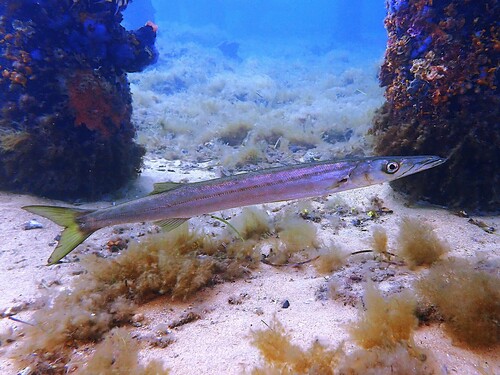
The Australian barracuda, Sphyraena novaehollandiae, has a greenish back, silvery flanks that fade to white on the belly, and a greenish-yellow tail. It has the characteristic fusiform shape of barracudas, but is slimmer than most other species in the genus Sphyraena. It has a conical snout, a protruding lower jaw, fang-like teeth lining the jaws, and a non-protracting upper jaw. The origin of its dorsal fin sits well behind the end of the pectoral fins. This species reaches a maximum total length of 1.1 metres and a maximum weight of 5 kilograms. The Australian barracuda is distributed along the south coast of Australia, and along the east coast as far as Victoria and Tasmania. It has also been officially recorded from northern New Zealand and Kiribati. There are doubtful records of this species from South Africa, the Maldives and Japan, and these most likely stem from misidentification, where confusion with related species has obscured the species' true distribution. The Australian barracuda prefers cooler inshore waters, and favours patches of the seagrasses Zostera or Heterozostera, areas of seaweed, or sandy areas located close to weed patches or reefs. It is a pelagic species that gathers in large shoals and is highly migratory. It feeds on smaller fish, cephalopods, crustaceans, and bloodworms. It is described as an ambush feeder, but is also known to actively pursue prey. It is an opportunistic predator that can exploit almost any available prey species. The wide variety of prey it takes indicates that it hunts across all levels of the water column, taking demersal species such as Haletta semifasciata and Metapenaeopsis prawns, and pelagic species such as pilchards, southern sea garfish, and squid. In South Australia, the Australian barracuda has a short spawning season that runs from November through January and February. Most females reach sexual maturity and reproduce once they grow to a length of 42 centimetres, a size they normally reach at around 2 years of age. Spawning is thought to occur in a series of batches. During the spawning season, Australian barracuda are absent from their usual habitats, which suggests they migrate offshore to spawn in deeper water. Females lay an average total of 375,000 eggs per spawning season, and their fecundity increases as their size grows. This species can live for up to 20 years.