About Sphyraena barracuda (Edwards, 1771)
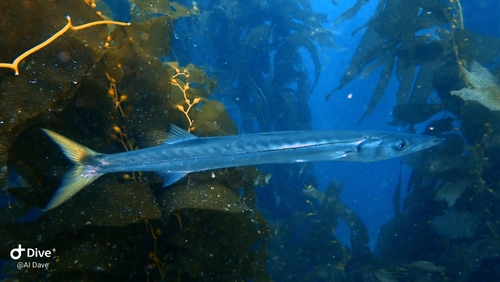
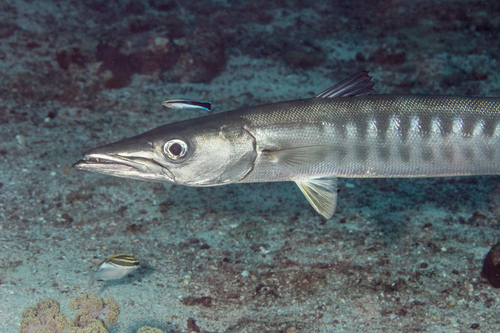
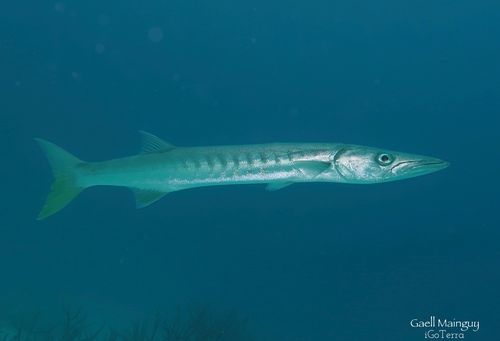
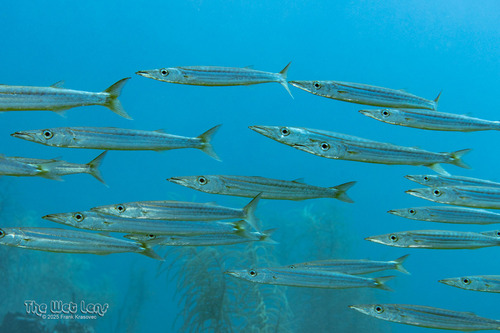
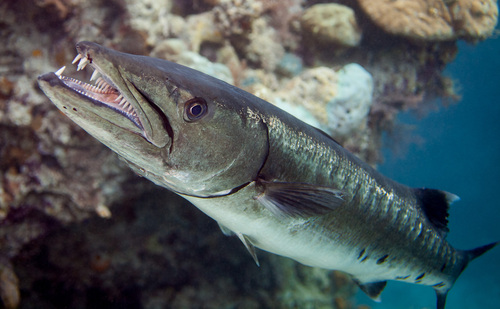
Great barracudas (Sphyraena barracuda) are elongated fish with powerful jaws. The lower jaw of their large mouth juts out past the upper jaw. They have strong, fang-like teeth that differ in size, set into sockets in the jaws and on the roof of the mouth. Their head is quite large, pointed, and has a pike-like appearance. The species is blue-gray on the upper body, fading to silvery and chalky-white on the underside. Sometimes, a row of darker stripes runs along the upper flank, with black blotches on each lower flank. The second dorsal fin, along with the anal and caudal fins, range in color from dark violet to black, with white tips. Great barracudas are large fish, and the largest species in their genus. Mature individuals are usually 60–100 cm (24–39 in) long and weigh 2.5–9.0 kg (5.5–19.8 lb). Exceptionally large individuals can exceed 1.5 m (4.9 ft) in length and weigh over 23 kg (51 lb). A record-sized specimen caught on rod-and-reel weighed 46.72 kg (103.0 lb) and measured 1.7 m (5.6 ft), while another even longer specimen measured 2 m (6.6 ft). The largest great barracuda ever recorded is said to have measured 3 m (9.8 ft).
This species occurs in tropical to warm temperate waters, in subtropical regions of the Indian, Pacific, and Atlantic oceans. It is primarily found in ocean waters near the equator, and takes shelter in habitats ranging from mangroves to deep reefs and seagrass beds, at depths up to 110 m (360 ft). Juveniles and small adults usually live in nearshore areas like mangroves and seagrass meadows, while adults are most often found farther from shore around artificial structures, reefs, and rock outcroppings. The fish use these structures for shelter. A tagging and monitoring study of great barracudas in the Bahamas found that a large share of the studied population remained in their home habitats for long periods; however, a small portion of the population traveled outward from these habitats, indicating the species is capable of large-scale migration.