About Sphyraena argentea Girard, 1854
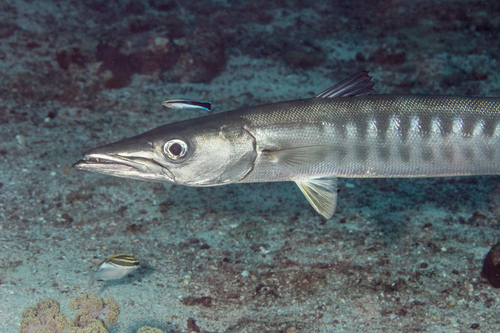
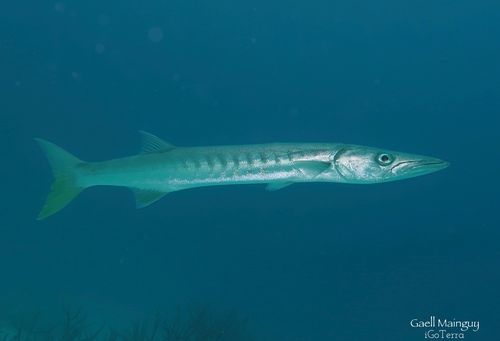
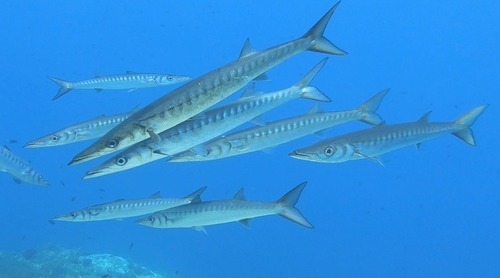
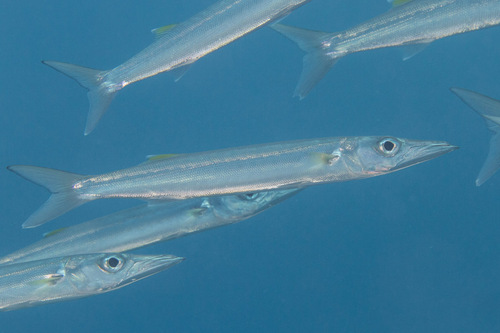
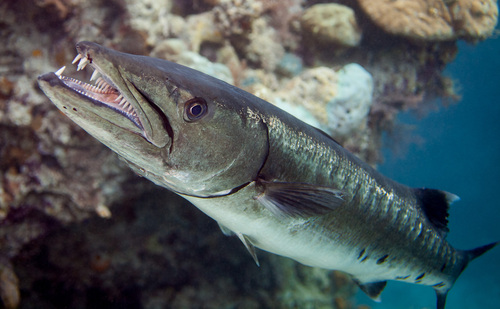
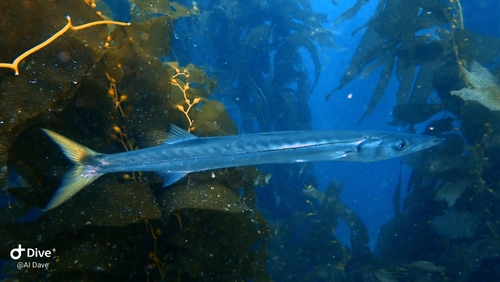
The Pacific barracuda (Sphyraena argentea Girard, 1854) has an elongated, cylindrical, very slender body with a long, pointed snout. Its scales are pale bluish to pale brown on the front sides of the body. It can be distinguished from other barracuda species by its silvery, shiny backsides, small scales, and the complete absence of bars or spots on its body. Like other barracudas, it is known for its intimidating mouth filled with sharp teeth and fang-like structures. The Pacific barracuda is a predatory fish with aggressive hunting traits, and its protruding lower jaw supports its carnivorous feeding habits by helping it catch slippery prey. On average, Pacific barracuda weigh 1–3 kg and measure 1 to 1.1 m in total length, and they rarely exceed 1.2 m in length. This species has a distinctly forked tail fin and widely separated dorsal fins. Pacific barracuda are found in the Northeast Pacific Ocean, typically off the U.S. West Coast. Though generally classified as a pelagic species, and can be found as far north as southern Alaska, it is most common along the coast of California, extending south to the southern tip of Baja California Sur, Guadalupe Island, and near the mouth of the Gulf of California. In winter, Pacific barracuda migrate in shoals south from the U.S. West Coast to Baja California, and generally do not travel further south, though individuals have been sighted as far south as the Pacific coast of Panamá. The natural habitat of the Pacific barracuda is offshore marine waters; adults typically move closer to shore or into coastal areas, while young Pacific barracuda are sometimes found further inland in bays or lagoons, and in brackish, shallow waters. Deeper-dwelling individuals have been recorded at depths of around 37 m (121 ft). Pacific barracuda form schools and travel through the ocean in these groups. Most Pacific barracuda reach sexual maturity at 2 years old. Two-year-old females can produce approximately 50,000 eggs, while older females produce between 200,000 and 400,000 eggs. Like most fish, Pacific barracuda use external fertilization and lay their eggs in intervals. Parent Pacific barracuda do not provide care for their young. They are pelagic spawners and open water egg scatterers, meaning they do not guard their eggs, and leave eggs in the open water column after spawning. Pacific barracuda are known to live up to 12 years. A documented sexual difference for this species is that females have a charcoal or black edge on their pelvic fins, while males have a yellow or olive-colored edge on these same fins.