About Sphoeroides parvus Shipp & Yerger, 1969
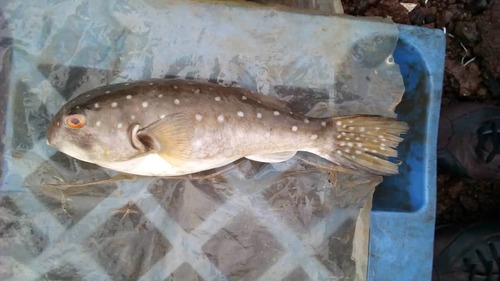
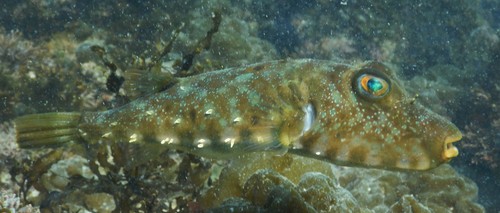
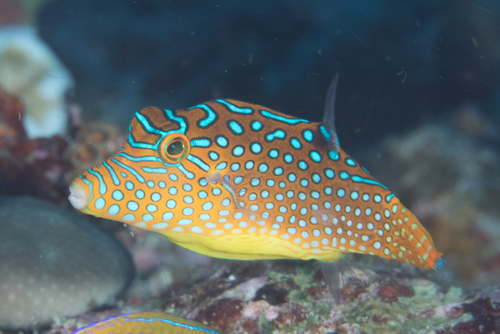
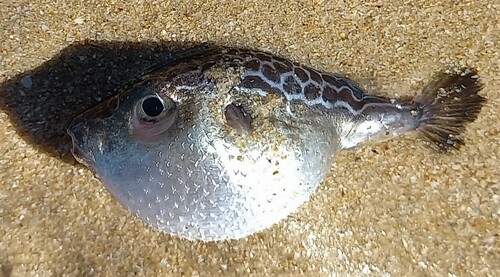
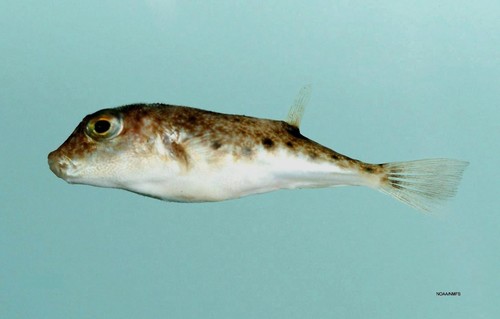
Least puffers (Sphoeroides parvus Shipp & Yerger, 1969) are members of the tetraodontid family. Their teeth are fused into beaks with a median division, forming two plates in both the upper and lower jaw. Tetraodontids also lack fin spines and ribs, and have tough skin often covered in small spiny scales. Most least puffers have 8 to 9 dorsal fin rays, and 13 to 16 pectoral fin rays. The species has no pelvic fins at all, and its caudal fin may be either dusky or plain. Unlike some related species, there is no prominent dark spot in the axil of the pectoral fin. The dorsal side of S. parvus is brownish gray, while the ventral side (belly) is mostly white. An irregularly sized and arranged ventrolateral row of black blotches divides the dorsal and ventral coloration. Irregular light and dark color patches are present on the sides and back of the body. The body of the least puffer is elongate and globular, and its sides often have a golden hue. The interorbital width is usually 25% or more of the snout length. When frightened or disturbed, the least puffer can inflate its abdomen with water. It is the smallest known species in the genus Sphoeroides, and is most closely related to S. nephelus and S. maculatus, both of which share overlapping distribution ranges with S. parvus.
The distribution of Sphoeroides parvus extends from Apalachicola Bay westward across the entire Gulf of Mexico. It is the dominant puffer species in the muddy waters of Mobile Bay and areas further west. In the clearer waters of northwestern Florida, S. parvus is replaced by S. nephelus as the dominant species. S. parvus is most closely related morphologically to S. maculatus, which occurs in the Atlantic Ocean from Canada to northeastern Florida. Researchers hypothesize that before the Florida peninsula formed, the ancestral progenitor species of both S. parvus and S. maculatus was distributed along the southern coast of the United States. The emergence of the Florida peninsula split the ancestral population into two groups, leading to the formation of one species isolated in the Atlantic and the other isolated in the Gulf. Least puffers have been recorded from very shallow waters down to depths of up to 50 meters.
S. parvus is generally abundant and common in coastal, bay, and estuarine waters over sandy and muddy bottoms. Because of this habitat preference, it is frequently caught as by-catch during inshore shrimp trawling. This species is not utilized or targeted by human activities, and its geographic range overlaps with multiple marine protected areas. For these reasons, Sphoeroides parvus is listed as Least Concern.