About Sphiximorpha willistoni (Kahl, 1897)
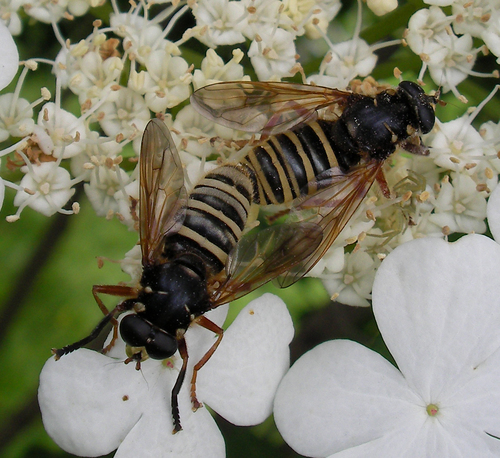
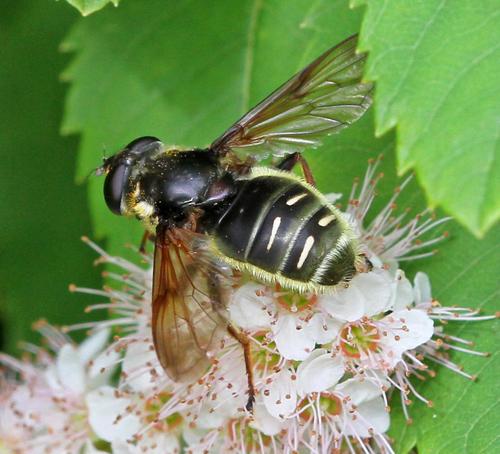
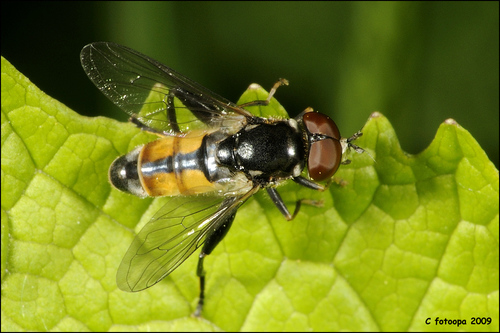
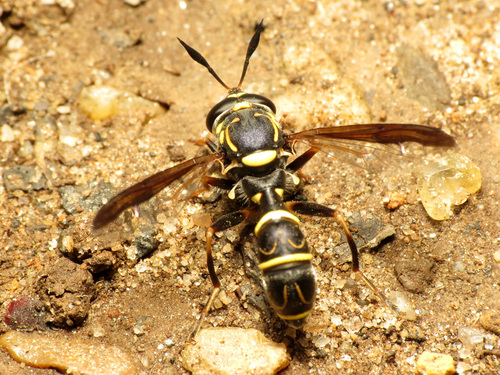
Sphiximorpha willistoni (Kahl, 1897) measures between 11–14 mm (0.43–0.55 in) in size. In overall appearance, this species mimics a wasp, with darkened forewings, elongate antennae, black and yellow markings on the thorax, and banded yellow markings on a narrow-waisted abdomen. The face is long, flat, and black with varying yellow marks. It is yellow in the middle with a large black arrowhead-shaped spot; the broadly rounded apex of this spot rests on the oral margin, and its base is narrowly connected to the broad black field below the antennae. This black field extends transversely to the eye orbit, separating the yellow of the face from a small yellow, somewhat triangular spot located at the eye orbit opposite the base of the antennae. A very narrow yellowish line runs from the antennal process to the middle of the arrowhead-shaped spot, widening below the upper portion. Some specimens have either a few yellow spots or a transverse stripe below the antenna base. Above the antenna base there is either a yellow V-shaped stripe (usually on males) or another series of 4 spots (usually on females). The frons is black, broadly connected to the black area below the antennae. A little below the middle of the frons are two small, narrowly separated, reddish brown transverse spots. The opaque portion of the frons is thinly covered with white pollen, which is only visible in certain lighting, and is most conspicuous at the eye orbit. The gena is broadly black with an abbreviated yellow stripe running from the inferior eye orbit. Male eyes touch at the top in front of the ocelli, while female eyes are widely separated. The ocelli are reddish-brown and raised above the top of the head, with two nearly touching yellow spots behind the ocelli. Another faint, hard-to-see brownish-yellow spot sits at the bottom of the eye. The antennae are very long and black, with a brownish-yellow base. The scape is slender, with the basal two-thirds reddish brown, and is scarcely longer than the flagellum. The pedicel is black and half as long as the scape. The flagellum is wider than the other antennal segments, with a sharply pointed tip. The antennifer (the base supporting the antennae) projects very little above, is entirely obsolete below, and is brownish yellow. Two yellow dots are positioned in a transverse line behind the ocelli. The vertex is reddish brown, and the sides of the lower frons are thinly covered with yellowish pile. The occiput is black, thinly covered with white pile and white pollen; the pollen is only conspicuous along the eye orbit. The scutum is black with inconspicuous, very minute brownish pubescence on the mesonotum. There is an oblique oval spot on the presutural callus, and an elongated spot on the mesopleura along the mesopleural suture. Below this elongated spot sits an oval oblique yellowish spot along the posterior end of the sterno-pleural suture. The scutellum is reddish brown; it is yellowish brown toward the sides, with the extreme base and lateral angles black, and the posterior margin narrowly brown. The sides of the thorax have an oblong longitudinal yellow spot on the posterior anepisternum, directed downward, and another smaller oblong yellow spot directed sideways below it, just above the midleg coxa. A wide, curved light yellow mark sits below the scutellum. Each side of the mesonotum is reddish brown, which appears as an outwardly arched stripe when viewed from above. The stripe starts a little in front of the scutellar ridge and extends to the transverse suture. Along the middle of the anterior mesonotum are two parallel, narrow yellowish pollinose stripes. The stripes do not quite reach the anterior border, and each terminates in a transverse yellowish pollinose spot on the transverse suture; the stripes are faintly visible behind this spot. The black ground color of the mesonotum is concealed by the pollen of these stripes. The sternum is very thinly covered with whitish pollen. Note: depending on the angle of the head, the small spots behind the ocelli may appear as two yellow spots on the base of the thorax. The abdomen is black, much contracted at the base of the second segment, covered with short, appressed yellowish pubescence and slightly raised yellow stripes. The ventral segments are black, with posterior margins bordered pale yellow on the second, third, and fourth segments. The border is very narrow on the fourth segment and broadest on the second; the ventral segments are thinly covered with whitish pubescence. Abdominal segment one is very short and wide, with no markings. Long yellow pubescence grows along the sides of this segment. Abdominal segment two is long and narrow, much contracted at the base, and about as long as the third segment. It has a yellow mark anteriorly on each side, and the posterior margin has a yellow band of even width that reaches the lateral margin. The band on the second segment is a little broader than the bands on the other abdominal segments. Segment three is short, with a yellow band of even width on the posterior margin that also reaches the lateral margin. There is also a faint U-shaped or curved yellowish pollinose line on each side of the center, closer to the lower margin. Both ends of the line diverge and do not reach segment two. Segment four is longer, with a yellow stripe on its lower margin. It also has a larger U-shaped yellowish pollinose line on each side of the center, extending almost the entire length of the segment. A narrow yellow band runs along the posterior margin of the fourth segment, with a convex anterior outline that does not reach the lateral margin on either side. Segment five is entirely black, not pollinose at all, and its sparse pubescence is a mix of yellowish and blackish hairs. The anterior half of the wings is brown, while the posterior half is hyaline. The brown area is limited posteriorly by the fourth vein at the base, and by the spurious vein to just barely beyond the anterior cross vein. The brown area also extends to the R4+5 vein, narrowly bordering it posteriorly a short distance before the vein stump, which it follows exteriorly. After that, it rather broadly borders the third vein posteriorly, with its outline diverging from that vein. The extreme margin of the wing immediately beyond the apex of the third vein is greyish hyaline, not brown. The base of the wing is yellowish, and the cells within the brown area are somewhat lighter along their middles. The veins are dark brown; the base of the wing and the portion of the fifth vein between the second basal and anal cells are yellowish brown. The last section of the third vein forms a very slight angle before its middle, from which a short vein projects into the first posterior cell. The halteres and tegulae are yellowish. The femora are black, with faint yellow coloring at the joints, and the hind side of the middle femora is fringed with whitish hairs. The hind femora are long and slightly thickened. The distal half of the femora has two rows of minute black spines beneath; this is most conspicuous on the hind femora, and least conspicuous on the front femora. The tibiae are yellowish-brown basally, with the remaining portion black. The last tarsomeres are yellow, with the rest of the tarsus black, except the hind tarsi which are entirely black. All trochanters are yellow. The coxae are black, with brownish coloring at the tip.