About Sphinx perelegans Edwards, 1874
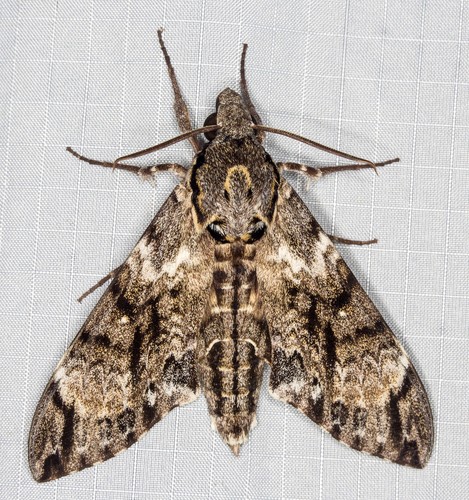
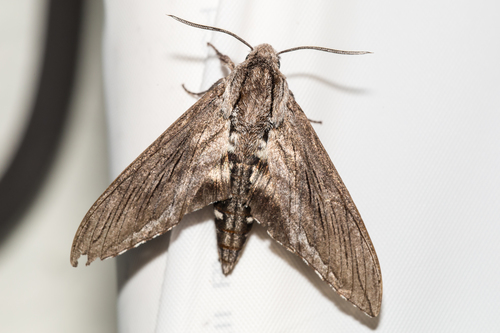
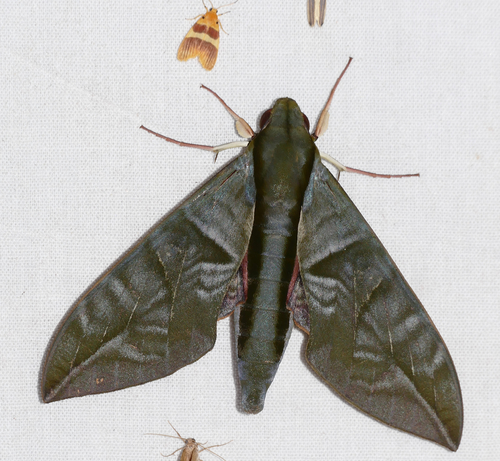
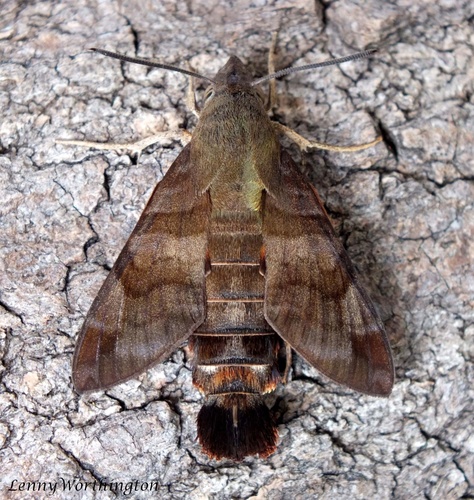
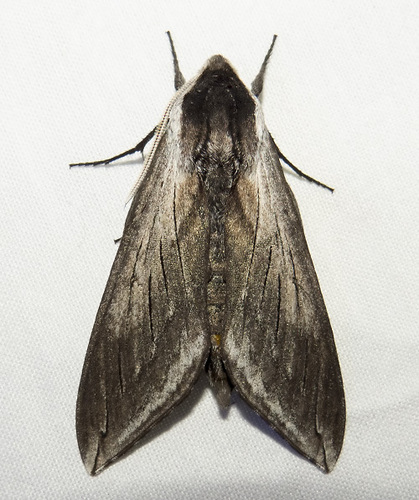
Description: Adult Sphinx perelegans are large moths with a wingspan of 9–11 cm (3.5–4.3 in), and each forewing is 43–50 mm (1.7–2.0 in) long. The forewings are dark gray, with a diffuse pale gray patch stretching from the base to the center of the wing and a pale gray line bordering the subterminal margin. The middle of each forewing is marked with several longitudinal black lines. The hindwings range from gray to black with white bands, and the fringes have dark gray and white checkering. The antennae are light gray. The thorax and top of the head are dark gray, with lighter gray coloration on the sides of the thorax near the wing base and on the sides of the head. The top of the abdomen is dark gray, with black and white stripes on each segment. The eggs are ovoid and glossy green, and become paler as they develop. Eggs are usually laid singly on the undersides of host plant leaves, though they are sometimes laid in groups of two or three. Newly hatched larvae are pale yellow, up to 5 mm (0.20 in) long, and have a long dark horn. As the larvae feed, they turn pale green and eventually grow to 70–75 mm (2.8–3.0 in) long. When they mature, larvae develop a series of oblique white stripes edged with purple along their sides, and their horn turns blue. Once fully mature and ready to pupate, larvae dig a sparsely silk-lined chamber in soil up to 10 cm (3.9 in) deep to pupate inside. The brown pupae measure 45–47 mm (1.8–1.9 in) long.
Distribution and habitat: This species is native to the western coast of North America, ranging from British Columbia, Canada to Baja California Sur, Mexico. Within the United States, it occurs in Arizona, California, Colorado, Idaho, Montana, New Mexico, Oregon, and Washington. West of the Cascades, S. perelegans lives in low elevation brushland and oak woodland. At higher elevations of the Cascades and Siskiyou Mountains, it inhabits mixed hardwood-conifer forests. At middle elevations around the Rocky Mountains and Blue Mountains, it can be found in hardwood-conifer forests and juniper-hardwood woodlands.