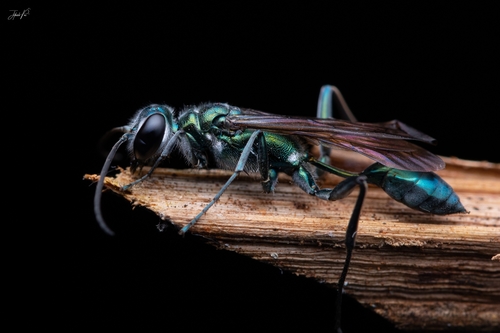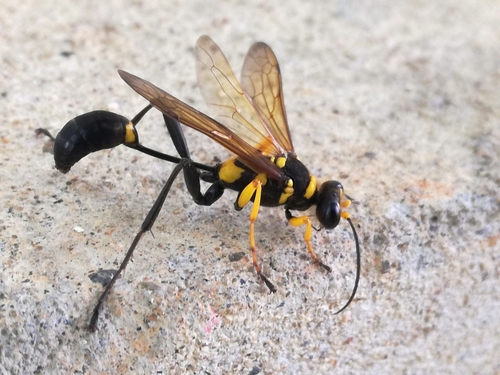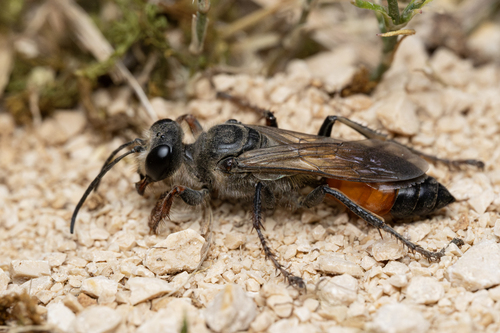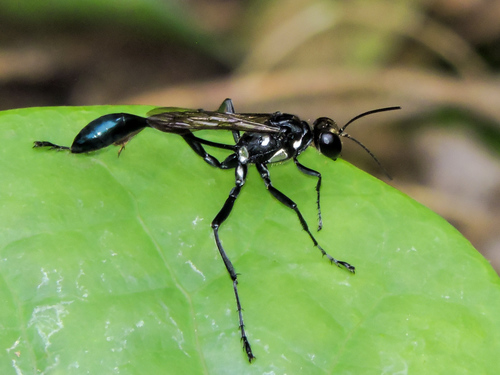
About Sphex pensylvanicus Linnaeus, 1763
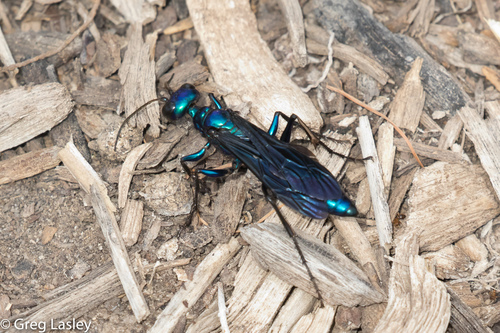
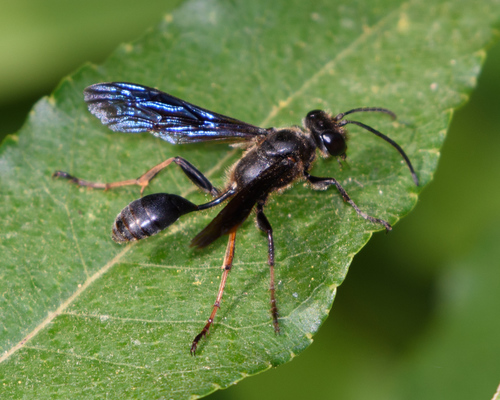
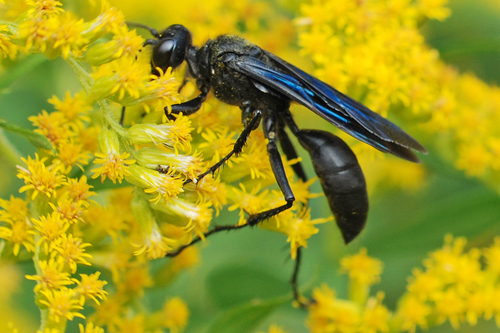
Sphex pensylvanicus is a large, entirely black species of wasp. It is significantly larger than its congener Sphex ichneumoneus, the great golden digger wasp, and also darker in overall coloration: S. pensylvanicus has a fully black body and smoky wings with blue iridescence, while S. ichneumoneus has yellow wings, red legs, and a partly red abdomen. Males of S. pensylvanicus are smaller than females, reaching 19–28 mm (0.7–1.1 in) in length, compared to a typical female body length of 25–34 mm (1.0–1.3 in). According to John Bartram, the sting of this wasp is painful, but does not cause swelling like stings from other wasps. S. pensylvanicus is distributed across most of the contiguous United States and northern Mexico. In the late 20th century, its range expanded north into New York and the Canadian provinces of Quebec and Ontario. Adult female S. pensylvanicus build underground nests, which they provision with various orthopteran insects, particularly species from the genera Microcentrum, Amblycorypha, and Scudderia. They sting captured prey three times: once in the neck and twice in the thorax. This sting paralyzes the prey, though the prey can survive for weeks after being stung. The paralyzed prey is then carried back to the wasp's nest. While females are collecting prey, they are vulnerable to kleptoparasitism: birds including the house sparrow (Passer domesticus) and the grey catbird (Dumetella carolinensis) steal the prey the wasps have caught. The eggs of S. pensylvanicus measure 5–6 mm (0.20–0.24 in) long by 1 mm (0.04 in) wide. Each egg is glued to the underside of a stored prey insect, between the prey's first and second pairs of legs. Each of the multiple chambers inside a nest holds a single larva, which consumes 2 to 6 katydids or grasshoppers during development. The larval stage lasts 10 days, and reaches a size of 30–35 mm (1.2–1.4 in) long by 7–10 mm (0.28–0.39 in) wide just before pupation. S. pensylvanicus is an important pollinator of several plants, including the milkweeds Asclepias syriaca and A. incarnata. It has also been recorded visiting Daucus carota, Eryngium yuccifolium, Melilotus albus, Monarda punctata, and Pycnanthemum virginianum. S. pensylvanicus is one of multiple Sphex species that are parasitized by the strepsipteran Paraxenos westwoodi.