About Sphex ichneumoneus (Linnaeus, 1758)
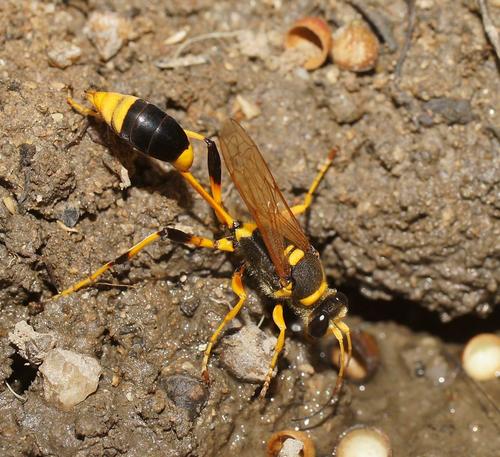
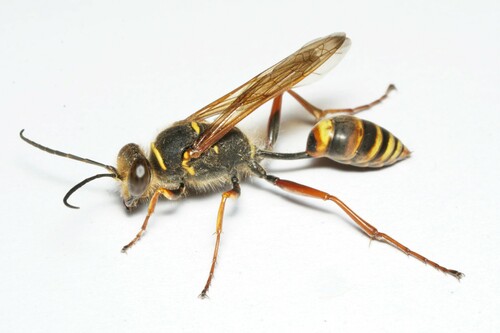
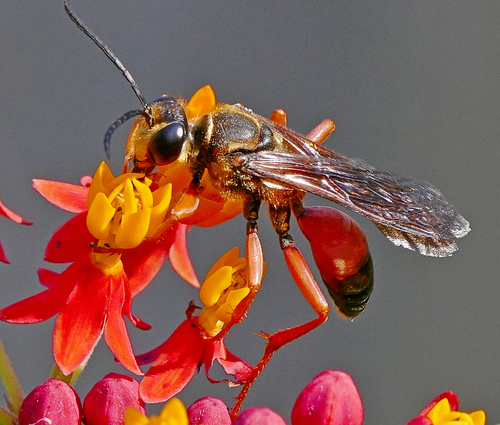
Sphex ichneumoneus, commonly known as the great golden digger wasp or great golden sand digger, is a species of wasp belonging to the family Sphecidae. It can be identified by the golden pubescence covering its head and thorax, its reddish orange legs, and a partly reddish orange body. This wasp is native to the Western Hemisphere, with a range extending from Canada all the way to South America. Adult female great golden digger wasps provision their developing young with various types of paralyzed Orthoptera. Douglas Hofstadter cites an observation recorded by Woodridge of this species continually repeating a specific behavior: checking its burrow before pulling a captured cricket inside. Hofstadter uses this repeated behavior as an example of genetic determinism, and named the repetitive pattern "sphexish" behavior. This behavior is also classified as a fixed action pattern, as described by H.J. Brockmann. For this fixed action pattern, the sign stimulus that triggers the sequence is seeing paralyzed prey in the correct orientation (with the prey's head facing the burrow) and correct position (no more than 3 cm from the burrow entrance, aligned with the dug mound). The full behavioral sequence is: if the prey still has antennae, the wasp pulls it into the burrow by the antennae. If the prey lacks antennae, the wasp will position the prey outside the entrance, enter the burrow alone, reemerge headfirst, and reevaluate the situation, though it may uncommonly attempt to pull the prey into the burrow by gripping another part of the prey's body. The burrow built by the great golden sand digger consists of a descending main shaft, with individual brood chambers arranged at right angles to this main shaft. This structural arrangement makes pulling prey into a brood chamber without getting stuck difficult, which is one possible reason the wasp always checks to confirm the path is clear before pulling prey down, preferentially pulling prey by their antennae. Additionally, female great golden digger wasps commonly build their burrows close to burrows made by other females of the species. They may even share a single nest, but they will fight with other wasps if they encounter an intruder inside their own burrow while they are retrieving prey. Because of this, an unattended nest carries a risk of intrusion for a wasp that is carrying prey, which is another reason the wasp always inspects the burrow before bringing prey inside.