About Sphenoeacus afer (Gmelin, 1789)
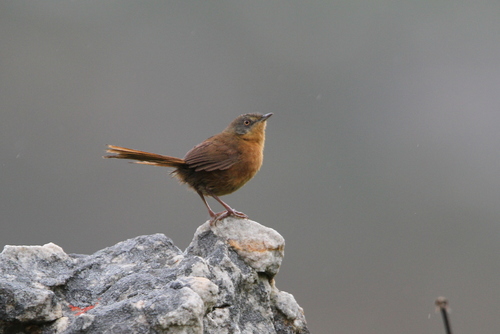
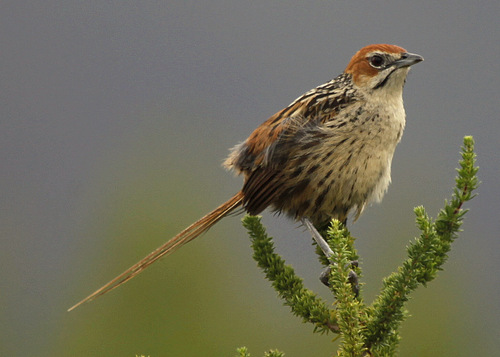
The Cape grassbird (Sphenoeacus afer (Gmelin, 1789)) measures 19 to 23 cm (7.5 to 9.1 in) in length and weighs 27–34 g (0.95–1.20 oz). Its crown and the sides of its face are rufous, with the exception of white plumage around the eye. It has black malar and moustachial stripes on its white throat. The upperparts are brown with heavy streaking, its long tail is a lighter brown, and the underparts are whitish with blackish spotting. Males and females have similar plumage, while juvenile individuals have a streaked cap and are duller in overall color than adults. The Cape grassbird's song is jangling and musical, and its call is a nasal pheeeo. Its long, pointed, straggly tail, chestnut cap and facial stripes are unique identifying features of the species. It is much larger than any cisticola, and its heavily streaked back and pointed tail rule out confusion with the moustached grass warbler. Cape grassbird breeds in southern Africa, specifically in South Africa, Lesotho, Mozambique and Swaziland, with an isolated population located in eastern Zimbabwe. It is a common species found in coastal and mountain fynbos, as well as long, rank grass growing on mountain slopes or in river valleys.