About Spheniscus mendiculus Sundevall, 1871
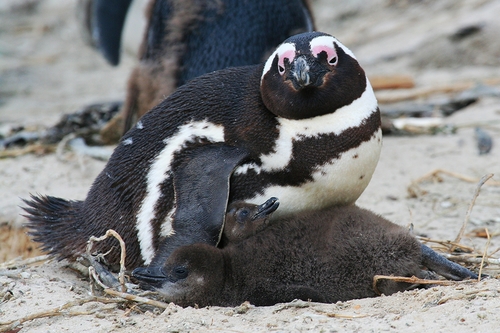
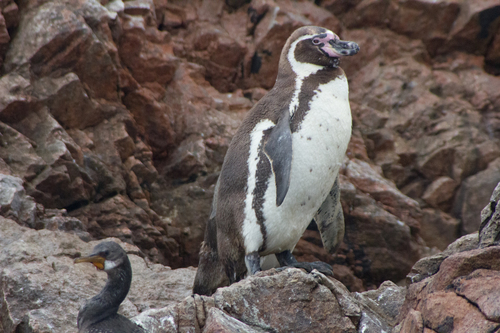
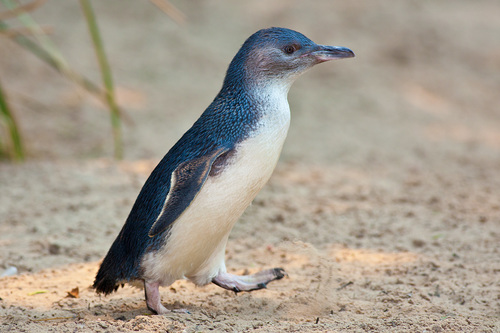
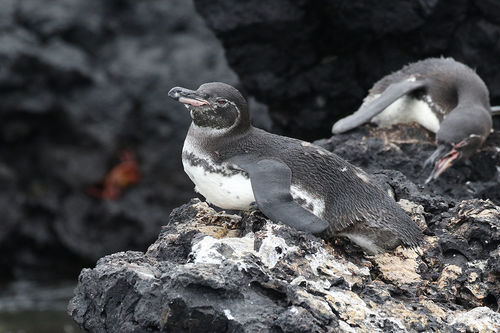
Spheniscus mendiculus Sundevall, 1871, commonly called the Galápagos penguin, has an average height of 48–50 centimetres (19–20 in) and an average weight of around 2–4 kilograms (4.4–8.8 lb). It is the second-smallest penguin species, only larger than the little penguin, and females are typically smaller than males. Galápagos penguins have a black head marked by a white border that runs from behind the eye, around the black ear coverts and chin, to meet on the throat. The top of their beaks is black, fading to pink on the bottom. They have two black bands across the breast that connect to the back, with the lower band extending down the flanks to the thigh. Juvenile Galápagos penguins differ from adults: they have an entirely dark head that is grayer on the sides and chin, and they have no breast band. Ninety percent of the global Galápagos penguin population lives on Fernandina Island and the west coast of Isabela Island, in the western part of the Galápagos archipelago. Small populations are also found on Santiago, Bartolomé, northern Santa Cruz, and Floreana. The northern tip of Isabela Island crosses the equator, meaning some Galápagos penguins live in the Northern Hemisphere, making this the only penguin species with individuals living in the Northern Hemisphere. Galápagos penguins have a symbiotic relationship with their habitat. Fernandina and Isabela Islands provide rocky coastlines that are ideal for nesting, while the surrounding waters, enriched by the Cromwell Current, hold abundant fish and crustaceans that make up the penguins' diet. This feeding habit plays a key role in the local marine ecosystem: it helps balance the marine food web and contributes to nutrient cycling. Guano produced by these penguins is a rich fertilizer that boosts the fertility of coastal soil, indirectly supporting certain plant species native to the Galápagos Islands. Galápagos penguins are a monogamous species, with each mating pair staying together for life. There are around 1,000 breeding pairs of Galápagos penguins worldwide, and breeding only occurs when specific climate conditions are met. During El Niño events, penguins often do not breed due to unfavorable climate conditions. After courtship, which includes rituals such as bill dueling, flipper patting, and mutual preening, the pair builds and maintains a nest. Most nests are established between May and July, when food availability and climate conditions are usually most optimal. Nests are built within 50 metres (160 ft) of the water on the shore. Adult penguins stay near the breeding area with their mate year-round. Females lay one or two eggs in protected locations such as caves and crevices, to shield the eggs from direct sunlight that can cause overheating. Surface water temperature also influences reproduction: penguins prefer temperatures between 17 and 22 °C (63 and 72 °F) for incubation, and nest failure occurs when temperatures rise above 25 °C (77 °F). Incubation lasts 38–40 days, and both parents share incubation duties. One parent always stays with the eggs or young chicks while the other leaves to feed, and may be absent for several days. A breeding pair usually only rears one chick to maturity. Galápagos penguins molt before breeding, and they are the only penguin species that molts twice a year. Molting takes up to 15 days to complete. They molt twice annually to cope with the typically unpredictable food availability in the Galápagos. If there is not enough food available, penguins may abandon their nests. It takes 60–65 days for chicks to become independent. Newly hatched chicks have downy feathers that do not become waterproof until the chicks grow into juveniles. Juvenile plumage, reached 30 days after a chick hatches, is dark brown or gray on the upper body and white on the lower body. These feathers mainly protect chicks from strong sun rather than keeping them warm. Bermudian naturalist Louis L. Mowbray was the first person to successfully breed Galápagos penguins in captivity. Galápagos penguins are endemic to the Galápagos Islands, and predominantly inhabit Fernandina Island and Isabela Island. These islands provide an environment that is critical to the survival and reproduction of these birds.