About Sphecotheres vieilloti Vigors & Horsfield, 1827
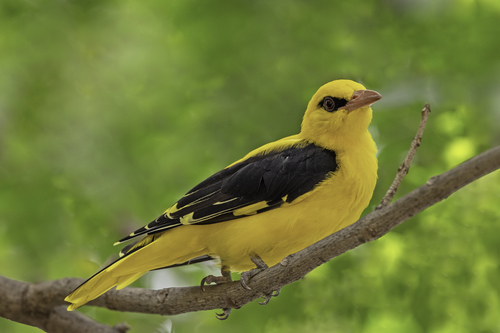
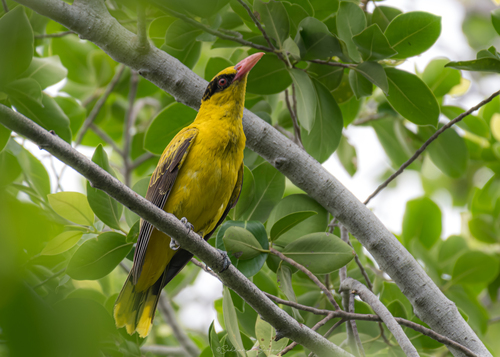
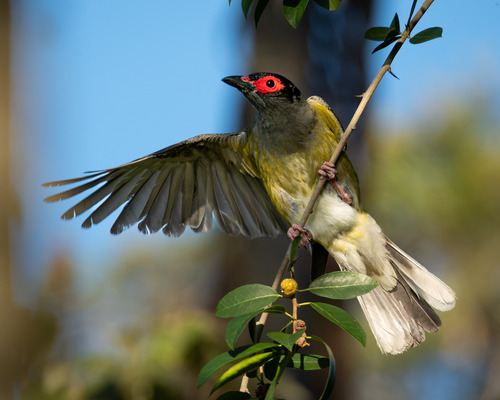
The Australasian figbird (Sphecotheres vieilloti) measures 27.0–29.5 cm (10.6–11.6 in) in total length, with a body mass of 111 to 130 g (3.9 to 4.6 oz) and a shape comparable to that of other orioles. It is likely the largest species of Old World oriole. This species exhibits sexual dimorphism, and nearly all subspecies differences appear in male individuals. Males of every subspecies share a consistent set of physical traits: a black tail with broad white tips on the outer tail feathers, white undertail coverts surrounding the cloaca, blackish primary flight feathers, a black head, distinct bright red facial skin, a black bill with a red base, and pinkish legs. In the nominate subspecies, most of the body is olive-green, while the throat, neck, and chest are grey. Subspecies cucullatus, ashbyi, and flaviventris have yellowish olive-green upperparts and bright yellow underparts that include the throat. The final subspecies, salvadorii, matches these three in upperpart color, but has a grey throat, collar, and chest just like the nominate subspecies. This gives it an intermediate appearance similar to some hybrids between the nominate and flaviventris subspecies found in Australia. Females are dull in color, with dull brownish upperparts, white undermarked with bold dark streaks, greyish facial skin, and a greyish-black bill. Juveniles look similar to females, but their underpart streaking is typically less distinct. The other orioles that share this species' range—brown orioles and olive-backed orioles—look superficially similar, but all adults of these species have entirely red bills. Australasian figbirds produce a wide variety of different short calls, and can also mimic the voices of other birds, including parrots and other oriole species. Their song is made up of a series of simple whistles. As their common name suggests, Australasian figbirds are mostly frugivorous, but they also consume small insects, nectar, and small seeds. They are mostly resident year-round, though the southern population may be migratory. The species moves nomadically in response to the availability of food. Unlike most orioles, Australasian figbirds are social. They often form flocks of 20 to 40 birds during the nonbreeding season, and even breed in small, loose colonies. They build flimsy, saucer-shaped nests from plant material, which are usually placed fairly high up in a tree. Both sexes incubate clutches of two to four eggs, which typically hatch 16–17 days after incubation begins. They have been recorded nesting near the aggressive spangled drongo and helmeted friarbird, and likely gain a benefit because these species keep potential nest predators away. Sometimes, Pacific koels parasitize the nests of Australasian figbirds, and the figbirds fall victim to this behavior.