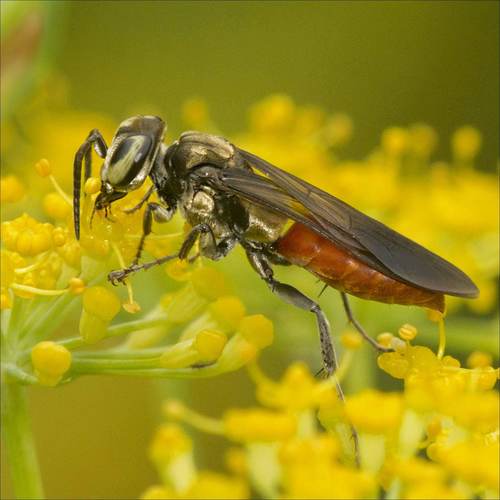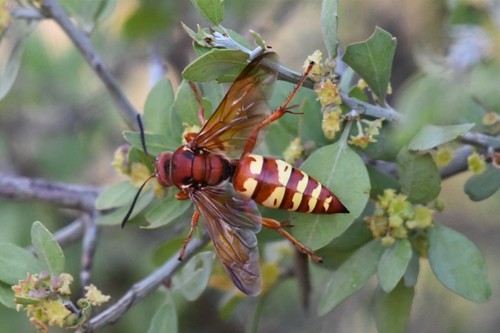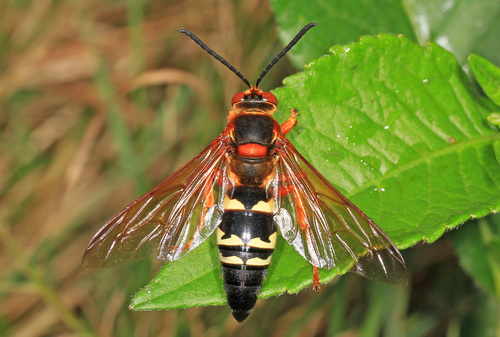
About Sphecius speciosus (Drury, 1773)
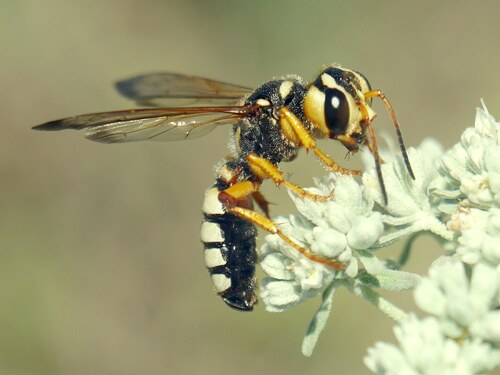
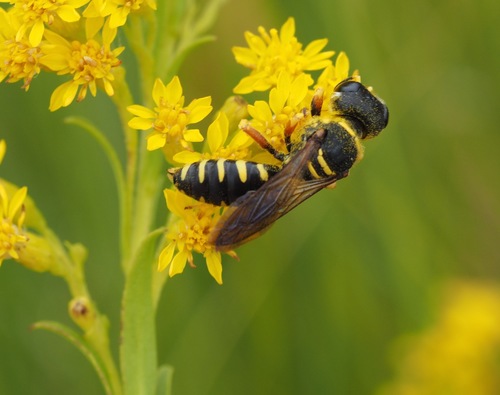
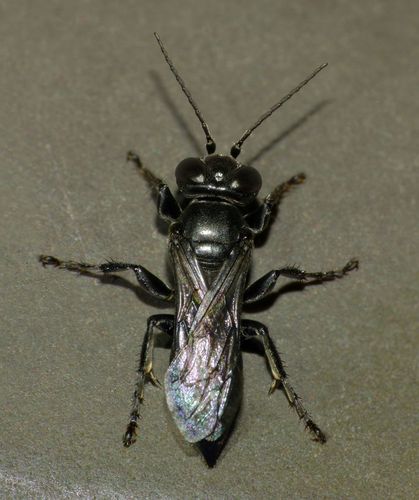
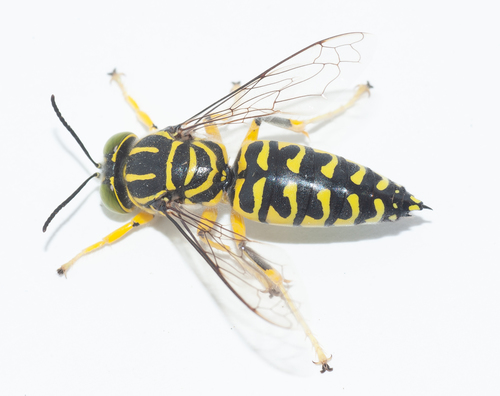
Adults of Sphecius speciosus, the eastern cicada wasp, are large robust wasps, measuring 1.5 to 5.0 cm (0.6 to 2.0 in) in length. They have hairy reddish and black markings on their thoraces, the middle body segment, and black to reddish brown abdominal rear segments marked with light yellow stripes. Their wings are brownish. Their coloration is superficially similar to that of some yellowjacket and hornet species. Females are somewhat larger than males, and both rank among the largest wasps observed in the Eastern United States; their unusual size gives them a distinctly fearsome appearance. European hornets Vespa crabro are often mistaken for eastern cicada killers, but European hornets, around 3.5 cm (1.4 in) long, are smaller than the largest cicada killers. Males are smaller than females because they receive less food during the larval stage. Since females must carry killed cicadas back to nesting burrows, a larger size benefits them, so they are given more food as larvae.
This species is distributed across the Eastern and Midwest United States, and ranges south into Mexico and Central America.
As solitary wasps, eastern cicada killers have very different behaviors compared to social wasps such as hornets, yellowjackets, or paper wasps. Female cicada killers use their stings to paralyze their prey, cicadas, rather than to defend their nests. Unlike most social wasps and bees, they do not attempt to sting unless handled roughly. Adult eastern cicada wasps feed on flower nectar and other plant sap exudates.
Adults emerge in summer, typically starting around late June or early July, and die off between September and October. They remain active in a given area for 60 to 75 days, usually until mid-September. Males emerge first to compete for access to females. Large females are commonly seen skimming over lawns to find suitable sites to dig burrows, and searching for cicadas in trees and taller shrubs. Males more often gather in groups, vigorously challenging one another for position on the breeding aggregation where they emerged, and generally investigate anything that moves or flies near them. It is not uncommon to see two or three male wasps locked together in apparent midair combat, with the group following an erratic flight path until one wasp breaks away. The aggressive behavior of male cicada killers is similar to that of male carpenter bees, another robust insect found in the same region. In both cases, while the males' vigorous territorial defense can frighten and intimidate human passersby, the males pose no danger at all. Male cicada killers only grapple with other insects, and cannot sting.
This ground-burrowing wasp nests in well-drained, sandy to loose clay soils, in bare or grass-covered banks, berms, and hills, as well as alongside raised sidewalks, driveways, and patio slabs. Females may share a main burrow, digging individual nest cells off the central tunnel. A typical burrow is 25–50 cm (10–20 in) deep and about 1.5 cm (0.59 in) wide. When digging a burrow, the female dislodges soil with her jaws, then uses her hind legs to push loose soil behind her as she backs out of the burrow. Her hind legs have special spines that help push soil behind her. Excess soil pushed out of the burrow forms a mound with a trench through it at the burrow entrance. Cicada killers may also nest in planters, window boxes, flower beds, or under shrubs and ground cover. Nests are most often built in full sun areas with sparse vegetation.
After digging a nest chamber within the burrow, female cicada killers capture cicadas and paralyze them with a sting. Once paralyzed, the female wasp holds the cicada upside down beneath her body and flies back toward her burrow. This return flight is difficult for the wasp because the cicada is often more than twice her weight, so the wasp frequently drags her prey up into the nearest tree to gain altitude before flying to the burrow. After placing one or more cicadas in her nest cell, the female deposits an egg on a cicada and closes the cell with soil. Male eggs are laid on a single cicada, while female eggs are provisioned with two or sometimes three cicadas, since adult female wasps are twice as large as males and require more larval food. New nest cells are dug as needed off the main burrow tunnel, and a single burrow may eventually hold 10 or more nest cells. The egg hatches in one to two days, and the paralyzed cicadas provide food for the wasp grub. Larvae complete their development in about two weeks. They overwinter as mature larvae inside an earth-coated cocoon. Pupation takes place in the nest cell in spring and lasts 25 to 30 days. There is only one generation per year, and no adults overwinter.
This wasp is frequently attacked by the parasitic 'velvet ant' wasp Dasymutilla occidentalis, also known as the 'cow-killer' wasp. This parasitoid wasp lays an egg in the cicada killer's nest cell. When the cicada killer larva pupates, the parasitoid larva consumes the pupa.