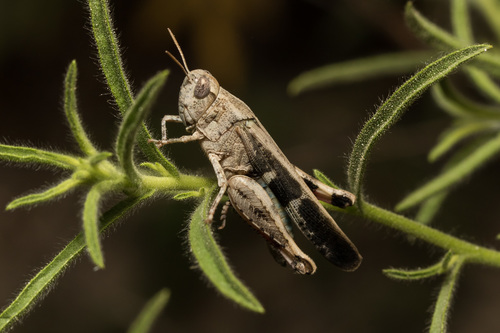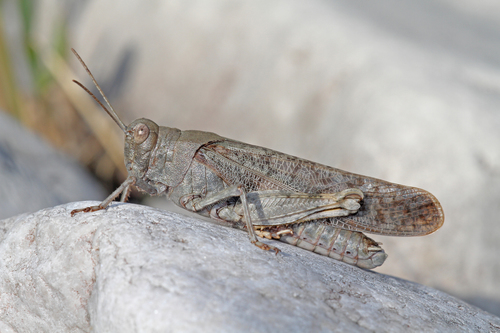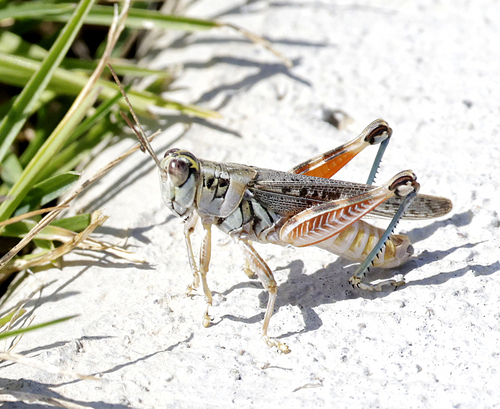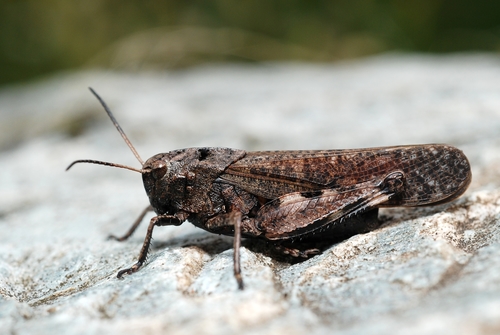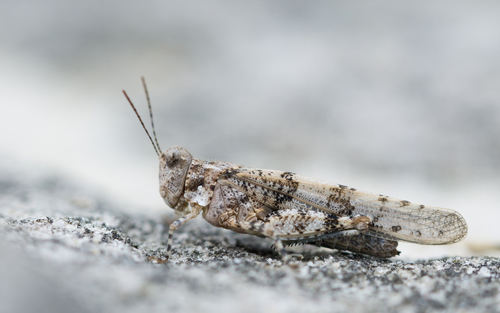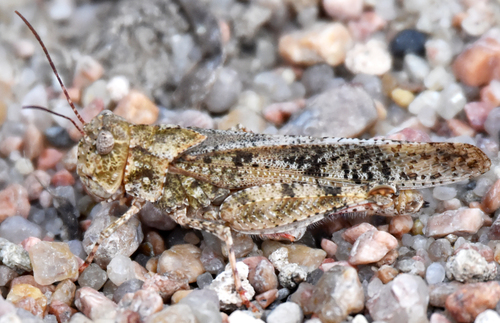
About Spharagemon collare (Scudder, 1872)
This description covers the five instars of Spharagemon collare, with the following abbreviations: BL = body length, FL = femur length, AS = number of antennal segments. Commonly called the mottled sand grasshopper, this species is distributed across northern and western United States and southern Canada. It is most commonly found in Kansas, Oklahoma, Texas, New Mexico, Colorado, and Michigan. Its optimal habitat consists of loose, sandy soil, and it is especially common along the edges of wheat fields. During reproduction, male mottled sand grasshoppers stay in a single spot for long periods until they see another moving grasshopper. Males seek out other members of their own species, both male and female. When a male identifies a female, he produces two stridulations with his legs and begins courting her. Females often reject a male’s courtship, as they only want to mate with the strongest, genetically superior males. A female rejects a potential mate by shaking her femora and hitting the ground with her rear tarsi. Mating generally occurs in May, and nymphs emerge in late May and early June. After mating, the female oviposits an egg pod 1/2 inch deep into sand, then covers it with sand. The pod holds between 21 and 28 eggs, and measures 3/4 inch long with a diameter of 3/16 of an inch. Individual eggs measure 5 to 5.2 mm long and are tan in color. The entire ovipositing process has been observed to last approximately 34 minutes. Nymphs and adults spend their entire lives in the same area where they hatched.