About Sphagnum wulfianum Girg.
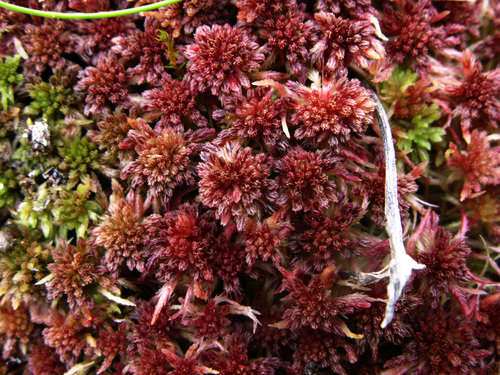
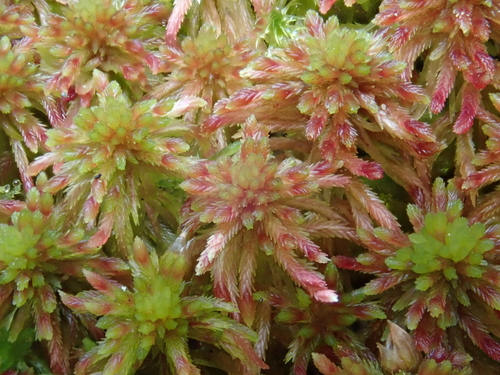
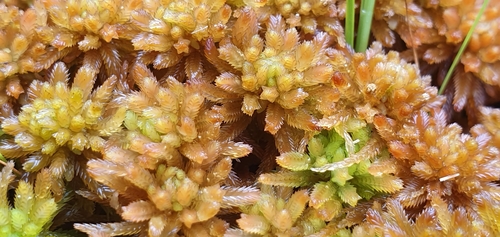
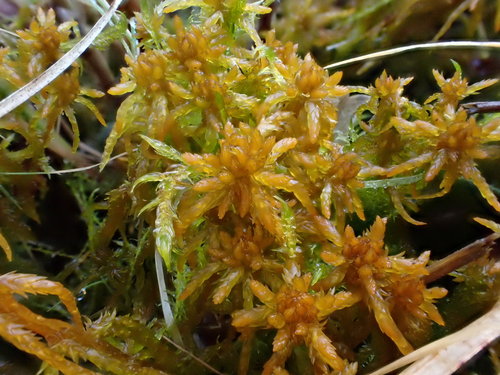
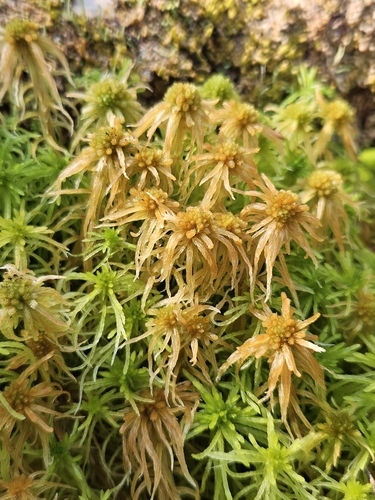
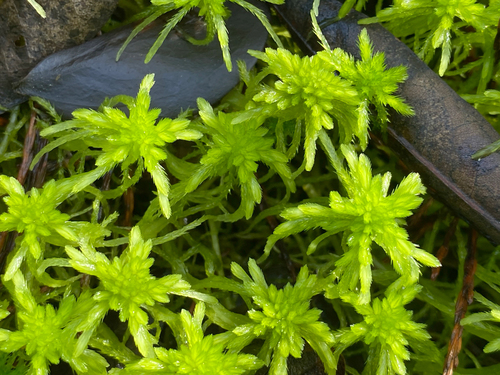
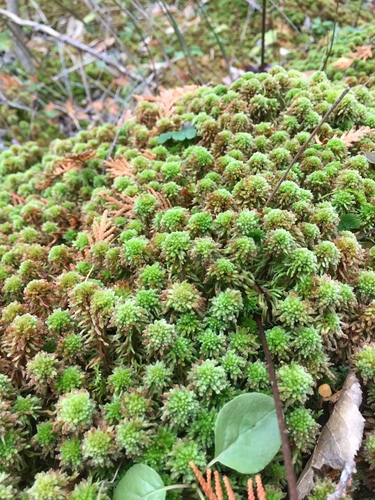
Sphagnum wulfianum Girg. is a medium-sized moss species with multiple distinctive morphological traits. It is set apart from other Sphagnum species by having 6 to 12 branches per fascicle (branch cluster), with at least three of these branches spreading. This moss is typically green, and rarely turns light brown even when growing in full sunlight. It has a very rigid, dark stem, and a dense capitulum (the cluster of branches at the stem apex) that ranges from slightly convex to hemispherical in shape. Its stem leaves are oblong-triangular, and measure between 0.75 and 1.0 mm in length. The species is distinctive and easy to recognize in the field due to its characteristic features, especially the high number of branches per fascicle, large, erect dense moss cap, and distinct brown stem. Microscopic examination reveals unique diagnostic features in its branch and stem leaves, most notably the pore pattern on the water-bearing cells of its branch leaves. These pores have distinctive surrounding rings that appear almost along the entire length of the leaf, which distinguishes S. wulfianum from similar species like S. warnstorfii, which only has these rings in the top portion of the branch leaf. Its clear visual differences from other Sphagnum species make it relatively simple to identify after one becomes familiar with its traits. Sphagnum wulfianum has a circumboreal distribution. In Europe, its main population centre is in Fennoscandia, and it also occurs across Russia including Asian Russia; additional scattered populations are found in the Baltic states, eastern Poland, and Romania, where it is counted as one of the rarest Sphagnum species. The species reaches its westernmost European limit at the Atlantic coast of Norway, in Åfjord Municipality of Central Norway. It occurs at elevations ranging from sea level up to 1,100 m (3,600 ft). In North America, S. wulfianum is found across the whole continent, and populations have also been recorded in West Greenland and northeast China. Studies in northeastern Poland have found no fossil remains of the species in peat deposits, which suggests that populations at the edge of its range may be relatively recent colonisations rather than glacial-period relict populations. While S. wulfianum is primarily a boreal forest species, it has also been recorded in the Arctic tundra zone, though these occurrences are very rare. Systematic analysis of herbarium specimens and distribution records shows that tundra habitats make up less than 0.5% of all documented locations for the species. Tundra occurrences are only found in specific geographic regions: the Yamal Peninsula, Taz Peninsula, Taymyr Peninsula, and the section of Bolshezemelskaya Tundra adjacent to the Polar Urals. The species is not found in the tundras of Yakutia, Chukotka, or the mountainous tundras of Scandinavia. This restricted tundra distribution pattern appears connected to historical vegetation changes. Paleoecological evidence indicates that S. wulfianum populations in these southern tundra regions are likely relicts from the Holocene climatic optimum, when these areas were covered by forest. Current tundra populations persist in areas that were formerly forested during warmer periods, while the species is absent from regions that had no forest cover during the Holocene. S. wulfianum is fairly common in Finland and eastern middle Sweden, and becomes increasingly rare as one approaches its western and southern range limits in Europe. In the Baltic states, it is relatively common in Estonia and Latvia but rare in Lithuania. This species most often grows in moist boreal forest environments, particularly in boggy mineral-rich spruce forests along mire borders, and rarely occurs in open habitats. It can also grow in moist birch and pine forests, and in Greenland it has been found growing in treeless arctic vegetation, demonstrating that it can survive in arctic environments. Within forest habitats, S. wulfianum grows directly on the ground or over fallen tree trunks, and usually forms small isolated cushions. When it does rarely grow in open peatlands, it prefers drier microhabitats such as stumps. Even though it has a wide overall distribution, it always occurs in small, widely scattered populations. In Estonia, the region where the species was first described, it has been found at around 20 localities, and most populations only consist of a few patches that are 1–2 m (3 ft 3 in – 6 ft 7 in) in diameter. Sphagnum wulfianum commonly grows alongside other Sphagnum species, including S. centrale, S. girgensohnii, S. russowii, and S. squarrosum. Research shows that neighbouring species affect its growth: when growing in mixed-species communities, it has reduced height growth but increased weight gain compared to when it grows in monocultures. The species appears to be a relatively weak competitor compared to other Sphagnum species that share its habitat. It typically forms small carpets and hummocks in conifer swamp habitats, especially in moist spruce forests, where it grows on damp mineral soil, peat, and peat hummocks near the bases of trees. Less often, it can be found in more open conditions in sub-arctic dwarf shrub communities or in overgrown felling areas.