About Sphagnum squarrosum Crome
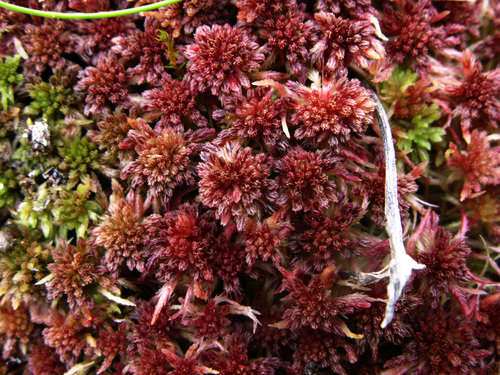
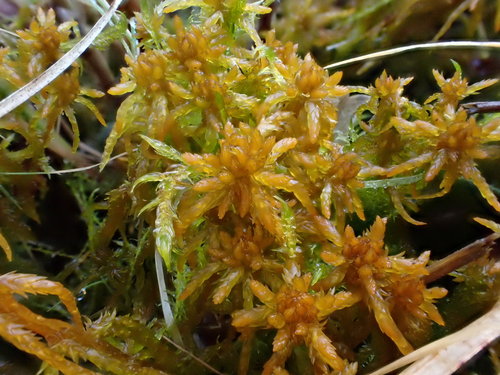
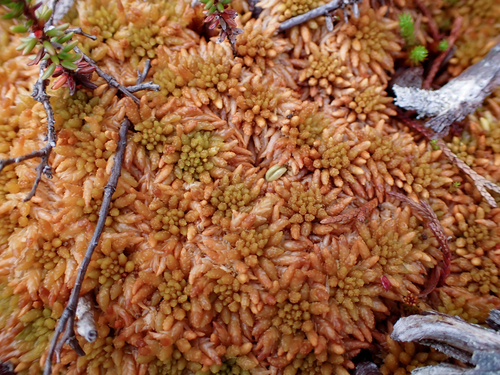
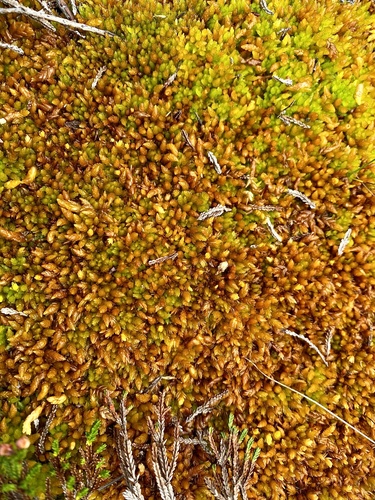
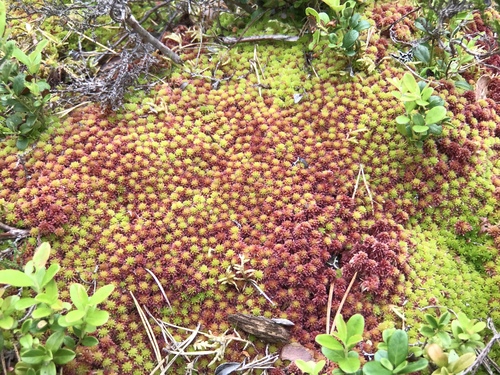
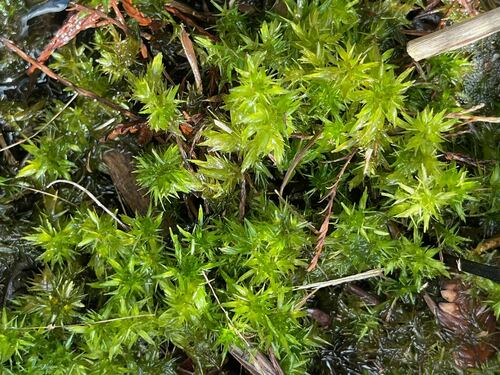
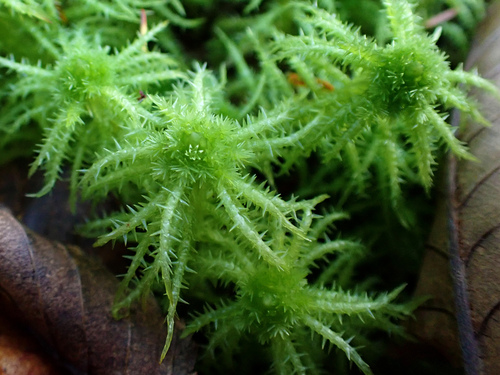
Sphagnum squarrosum Crome is easily identifiable by its distinctive spiky appearance that distinguishes it from other peat mosses. This large, robust species forms loose pale to yellow-green carpets, and may develop pale brown colouration when growing in exposed alpine or arctic habitats. Its common name "spiky bog-moss" comes from its most noticeable trait: branch leaves that spread outward at sharp angles from branches like tiny stars, a growth pattern botanists call squarrose. While the species follows the typical structural pattern of the Sphagnum genus, it has several unique distinguishing characteristics. It has a very large, prominent apical bud at its crown. Its strong stem measures 0.7–1.3 mm in diameter, with a dark brown internal cylinder that is paler in shade-grown forms. The stem cortex is made up of 2–3 layers of hyaline (colourless and translucent) cells, with the outermost layer bearing indistinct thinnings called "shadow pores". The branch cortex contains specialized pore-bearing flask-shaped cells called retort cells, which aid in water conduction. These retort cells are often relatively hard to distinguish from other cortical cells, occur in groups of one to four, and sit alongside a pale brown or yellowish internal cylinder. Branches are arranged in 4–6 branched fascicles (clusters): 2–3 spreading branches that measure 20–30 mm or more, and 2–3 pendent branches that measure 8–30 mm. Stem leaves are shorter than branch leaves at 1.6–1.8 mm long, with an ovate-lingulate to oblong-lingulate shape and broadly rounded tips. These leaves have short-lived borders 2–3 cells wide that are often lost in older leaves, though they persist longer than the borders of Sphagnum teres leaves. Branch leaves are larger, measuring 1.9–3.3 mm long. They have a broadened base that abruptly contracts at the middle to form distinct "shoulders", then tapers to a sharply reflexed, acuminate limb. The lower half of the branch leaf stays erect and concave, forming a sheath around the branch. Like all Sphagnum species, S. squarrosum has a specialized two-type cell structure. It has water-storing hyaline cells (leucocysts), which give the plant its notable water-holding capacity, and photosynthetic cells (chlorocysts). In the squarrose limb, hyaline cells are relatively small (70–100 × 15–22 μm), and grow larger toward the lower margins, reaching up to 200 × 30–50 μm. Hyaline cells bear 2–6 large, distinctly ringed pores on their adaxial surface, with similar or slightly fewer pores on the abaxial surface. Photosynthetic cells are narrowly oval-triangular to trapezoidal in cross-section, reach both leaf surfaces, and are more widely exposed on the abaxial surface. S. squarrosum is monoicious, meaning it produces both male and female reproductive structures on the same individual. Antheridial bracts are densely overlapping, often yellowish or pale brown; they are smaller than branch leaves and have less divergent apices. Inner perichaetial bracts are large with relatively narrow insertion points, widen above to a slightly notched (retuse) apex, and have abaxial resorption gaps and an eroded apex. When spore capsules form, they hold yellow-brown, papillose spores. The species displays phenotypic plasticity that varies with environmental conditions. In temperate regions, it is typically more robust and grows fuller in shaded habitats, especially along brook margins and in wet sections of forest floors. In subarctic and arctic regions, it often achieves the same robust growth in open, treeless areas. Sphagnum squarrosum has a broad geographical range that covers most of the Northern Hemisphere, occurring across North America and Eurasia. While widely distributed, it is particularly concentrated in northern regions of Europe. Its well-documented circumpolar range includes specimens from Canada (including the Northwest Territories and Yukon), the United States (including Alaska), Greenland, multiple European countries, Japan, and various regions of Russia. A 2017 report of populations in southeastern Brazil extended its known range into South America, which marks its current southernmost global occurrence. Unlike many other peat mosses that require highly acidic conditions, S. squarrosum thrives in mineral-rich environments with moderate calcium levels. Laboratory studies confirm this tolerance, showing the species maintains consistent photosynthetic rates across a wide pH range of 5.2–7.5. The species actively modifies its environment through cation exchange: it absorbs calcium and releases protons to gradually alter local water chemistry. This ability makes it an important pioneer species for wetland development; it often grows alongside S. fimbriatum in early successional stages, before more acid-loving bog species can become established. The species has distinct habitat preferences across its range. In temperate eastern Canada, it is most commonly found in shaded habitats, particularly along brook margins and wet sections of forest floors. In subarctic to arctic regions, it grows in open, treeless areas. It typically inhabits mesotrophic to slightly eutrophic conditions, growing in wet habitats including river banks, pond edges, fens, and woodland carr dominated by Salix, Betula or Alnus species. In North America, it is particularly associated with seasonally flooded woodlands, swamps, and stream margins, and can also colonize wet rock ledges in montane regions. The species reaches its northernmost extent in Svalbard, Norway, where it is the most common Sphagnum species. At around 80°32.5'N at Nordkapp, on the northern extreme of Chermsideøya in Nordaustlandet, it grows from sea level up to approximately 300 m (980 ft) elevation, forming low mats or cushions on moist, gently sloping moss-rich tundra and mineral-rich water seepages. Unlike its growth pattern elsewhere, Svalbard populations typically grow in pure stands rather than mixing with other Sphagnum species, and develop a distinct yellowish-green to pale yellowish-brown colouration, with brown, pale brown or yellowish-brown stems. S. squarrosum is ecologically adaptable across its entire range. It can tolerate periods of dryness, and grows successfully in both rain-fed and groundwater-fed conditions. It grows particularly vigorously when nutrients are abundant, and responds positively to nutrient enrichment. This adaptability is also seen in its wide altitudinal range, which spans from sea level to at least 1,100 m (3,600 ft) elevation. As a monoicious species, S. squarrosum frequently produces spores across its range, and has highly efficient dispersal capabilities. Among studied Sphagnum species, it produces both the highest number of spores per capsule and the highest overall spore output per growth patch. Studies have found no evidence of reduced fitness in self-fertilized plants. Its large capsules and small spores improve its long-distance dispersal efficiency. Compared to other Sphagnum species, S. squarrosum retains fewer spores in its capsules after dispersal, leading to greater spore release and wider distribution. Research on island colonization confirms S. squarrosum is an effective long-distance disperser, and can successfully establish populations up to 40 km (25 mi) from parent source populations. It is notable for being able to colonize habitats closer to the sea than other Sphagnum species, showing higher tolerance to salt spray and elevated ionic concentrations. Like other Sphagnum mosses, spore production is relatively uncommon in natural populations, with only around 2% of patches producing spore capsules. However, as a monoicious species, S. squarrosum has a higher potential for successful spore production than dioecious (unisexual) Sphagnum species, which require separate male and female plants growing in close proximity. S. squarrosum produces an average of approximately 243,000 spores per capsule, the highest recorded spore output of any Sphagnum species. This high output is achieved through a combination of large capsules (averaging around 6 cubic millimetres in volume) and relatively small spores (averaging 25.8 micrometres (μm) in diameter, with individual spores ranging from 19–30 μm). Spore size has a curvilinear relationship with capsule size: larger capsules generally produce more spores. The species uses an "air gun" dispersal mechanism: spores are explosively discharged from the capsule by built-up air pressure (approximately 5 x 10⁵ Pascals) during warm, dry conditions. S. squarrosum's large capsules are especially effective for this method, and shoot spores higher into the air than species with smaller capsules. Studies show that only around 7% of spores remain in the capsule after discharge, and another 7% land within the parent colony. Only about 11% of released spores land within 3.2 m (10 ft) of the parent plant, meaning the majority of spores are capable of long-distance dispersal.