About Sphagnum quinquefarium (Lindb.) Warnst.
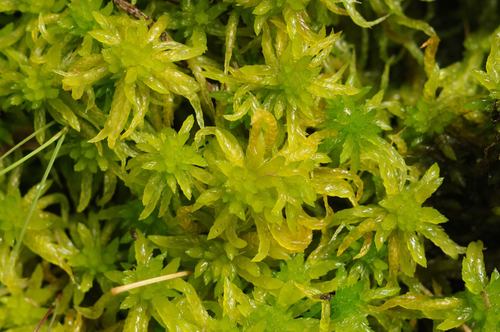
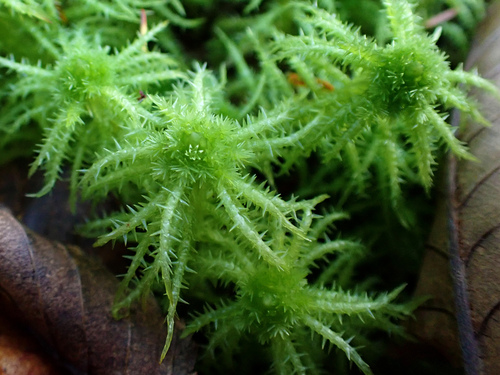
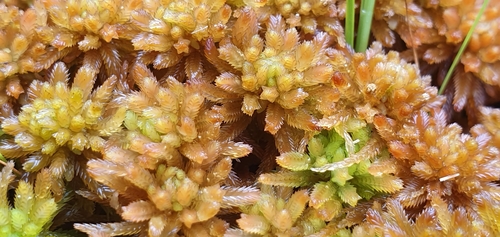
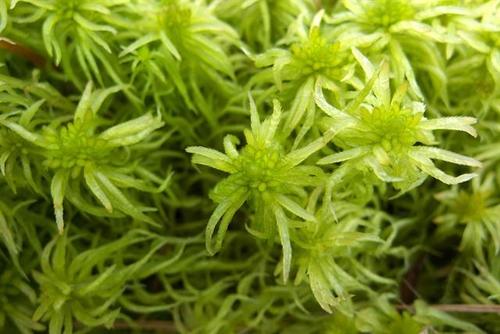
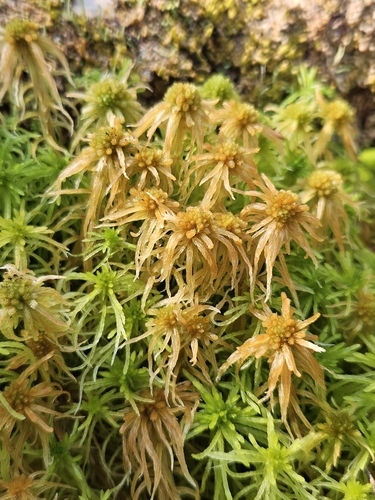
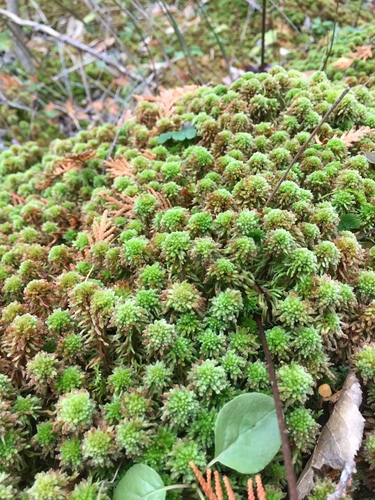
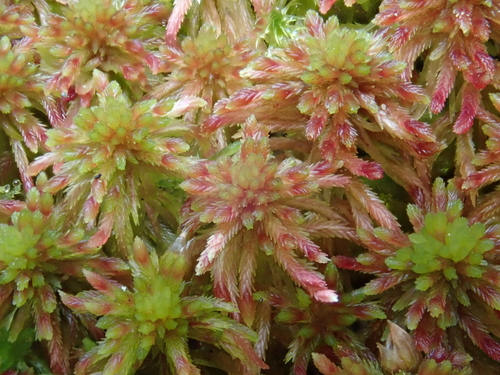
Sphagnum quinquefarium (Lindb.) Warnst. is a medium-sized peat moss that typically grows in loose, upright formations rather than dense clusters. It has pale green to yellowish-green colouring, often marked with pink or pale red patches, and the entire plant may occasionally appear entirely red. Its capitula (plant tops) have a distinctive wide triangular form, and measure only 1 mm in length.
The plant’s stem is slender, with a diameter of 0.5–0.8 mm, and is surrounded by 3–4 layers of transparent hyaline cells. It has a well-developed inner core that appears yellowish to yellow-brown, which sometimes shows reddish zones. This core is protected by an outer layer of cells that occasionally feature small pores.
A key distinguishing characteristic of S. quinquefarium is its branch arrangement. Unlike most other species in the Sphagnaceae, which typically have two spreading branches per fascicle, S. quinquefarium consistently has three spreading branches. Branches grow in spaced clusters (fascicles) along the stem, with each cluster typically holding 4–5 branches of two different types. Each cluster has three spreading branches that extend 15–25 mm and taper toward their tips, plus one or two hanging pendent branches that are at least as long as the spreading branches. This three-branched trait distinguishes it from the similar-looking Sphagnum capillifolium, which usually only has two spreading branches per fascicle. Additional distinguishing features include its flatter capitulum and stem leaves with parallel-sided basal portions.
The plant produces two types of leaves. Its stem leaves stand upright, measure 1.1–1.3 mm in length, and are triangle-shaped to tongue-like. These leaves have a distinct border that widens at the base, and contain transparent cells with fine internal fibres (fibrils) on one side. The branch leaves, which give the species its specific epithet "quinquefarium," arrange themselves in five distinct rows. These lance-shaped leaves measure 1.3–1.5 mm long and about 0.5 mm wide, with rolled-in edges at the tip. They contain specialised transparent cells with ringed pores and attach to branches at roughly 40-degree angles, creating a distinctive prismatic appearance.
Sphagnum quinquefarium is monoicous, meaning individual plants have both male and female reproductive structures, though they are often found in a single-sex state. When present, male reproductive structures (antheridia) are enclosed in red or pink modified leaves. Female reproductive structures develop into large, sheathing leaves up to 4.8 mm long. When the plant reproduces successfully, it produces spores 21–24 micrometres in diameter with a slightly rough surface. Spore capsules are commonly found in some locations.
Unlike most peat mosses, Sphagnum quinquefarium rarely grows in peatlands. Instead, it favours damp hillsides where it grows beneath dwarf shrubs, or in open woodlands particularly those dominated by birch (Betula) trees. The species has a strong preference for upland areas and well-drained spruce forests, and can also be found growing in acidophilous beech forests and on wet andesite rocks. It thrives in areas of high humidity, and is frequently found growing alongside other peat mosses, particularly Sphagnum capillifolium var. capillifolium and S. palustre. Its common companion plants include heather (Calluna vulgaris), birch trees, and various bilberry and cranberry species (Vaccinium species).
Sphagnum quinquefarium has a distinctly oceanic distribution pattern, and is most abundant in regions with strong maritime influence. In Europe, it reaches its greatest abundance in northwestern regions, particularly southern Scandinavia, though it is notably absent from the northernmost areas. In Central and Eastern Europe, the species is especially abundant in the Carpathian Mountain range. It is very common throughout the High Tatras of Slovakia and the Romanian Carpathians, where it occurs across numerous mountain ranges including the Maramureș, Călimani, and Făgăraș Mountains. The species is also well-established in Ukraine, particularly in Kárpátalja and the Eastern Beskids mountains. In the Balkan Region, it has been documented in Croatia around Zagreb and in the Papuk mountains, though it is absent from Serbia. The species extends southward through montane areas, reaching as far as Italy, the former Yugoslavia, Romania, and the Pyrenees. In the British Isles, it has a distinctive distribution pattern: it is absent from southeastern Britain, and occurs locally in northern England, Scotland, Wales, and Ireland. In the Alps, particularly in Switzerland, the species occurs in the pre-alpine zone at elevations ranging from 450–1,900 m (1,480–6,230 ft) above sea level. In more continental regions, the species is typically restricted to upland areas. Beyond Europe, S. quinquefarium has a wide global distribution, and is found in eastern Asia and along both the Atlantic and Pacific coastal regions of North America. It prefers oceanic and sub-oceanic climates with high atmospheric humidity.