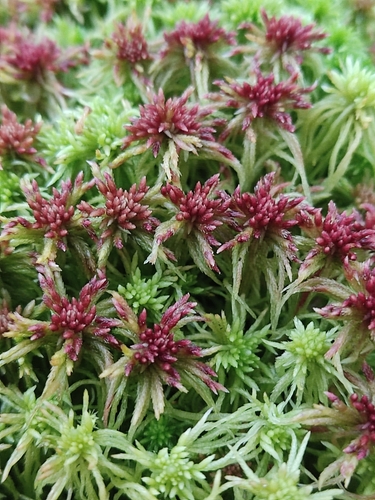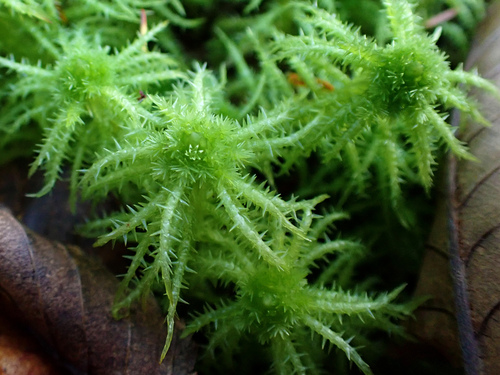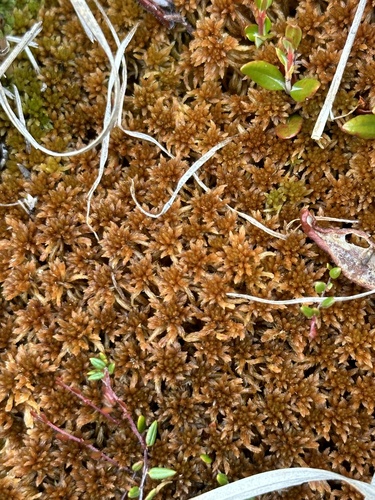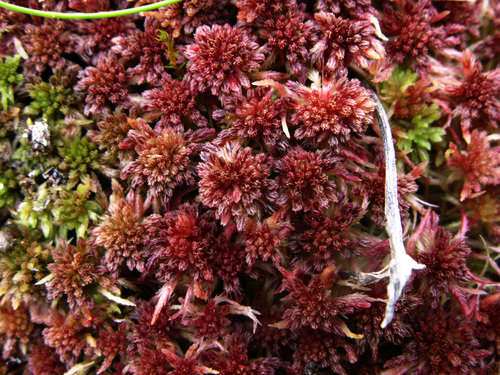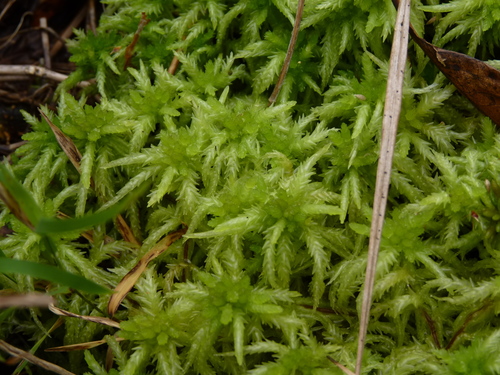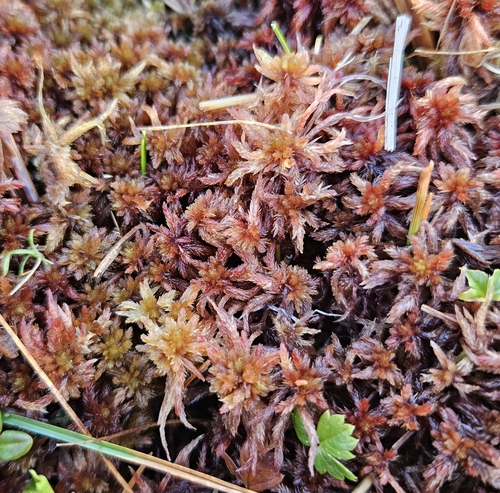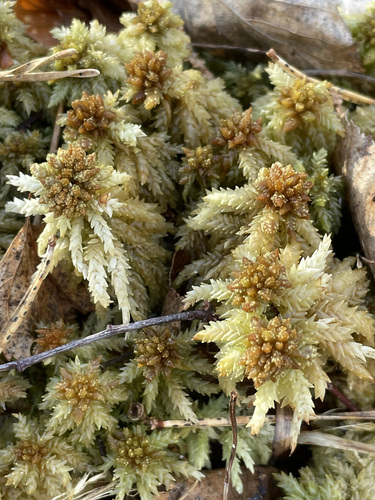
About Sphagnum palustre L.
Sphagnum palustre L. (synonym: Sphagnum cymbifolium), commonly called prairie sphagnum or blunt-leaved bogmoss, is a species of peat moss in the genus Sphagnum, family Sphagnaceae. Like other Sphagnum mosses, its elastic spiral fibers allow it to absorb up to 30 times its own dry weight in water. This species is quite common and distributed across almost the entire world. It mainly grows in wet forests, and compared to other species in its genus, it rarely grows in moors.
Across its global range, S. palustre is found throughout all of Europe, as well as in parts of America, Australia, and New Zealand. It grows in moist and wet habitats including wet forests (often coniferous forests) and marshy meadows, and rarely occurs in moors. It frequently forms large, sometimes bulge-shaped carpets, and is often found growing alongside Sphagnum fimbriatum, Sphagnum subnitens, and Sphagnum squarrosum.
S. palustre is an invasive species invading native habitat at Ka'ala, O'ahu, Hawai'i. It became established after a botanist brought a sample to the island in 1960. While the local environment does not support sexual spore reproduction for this species, it can spread via vegetative reproduction, and currently occupies an estimated area of 17.3 acres. Coordinated efforts to eradicate the invasive population have been difficult. Prairie sphagnum is among the few Sphagnum species with a wide distribution that extends into warm-temperate zones; most Sphagnum species are restricted to cold regions.
Within the British Isles, S. palustre is found across the whole archipelago. It is less frequent in the area just north of London extending west to Bristol, and occurs in scattered patches in the Republic of Ireland. It is widespread across Scotland, Wales, Orkney, Shetland, and the Isle of Man, and can also be found on the Scilly Isles.
Sphagnum palustre has a documented use in the European Union's Mossclone project, part of the EU's 7th framework program. In this project, S. palustre is multiplied in moss bioreactors to create a tool for monitoring air quality across Europe.