About Sphagnum girgensohnii Russow
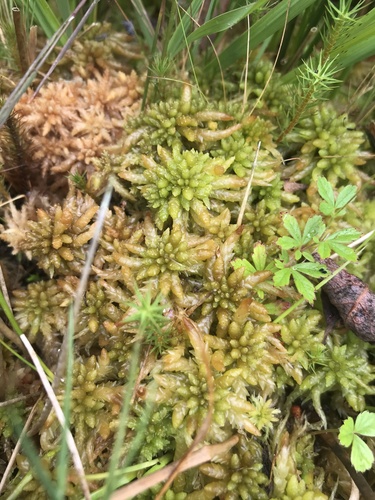
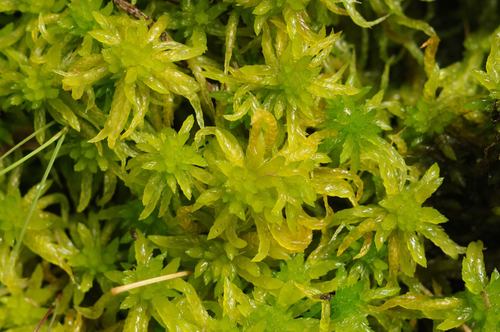
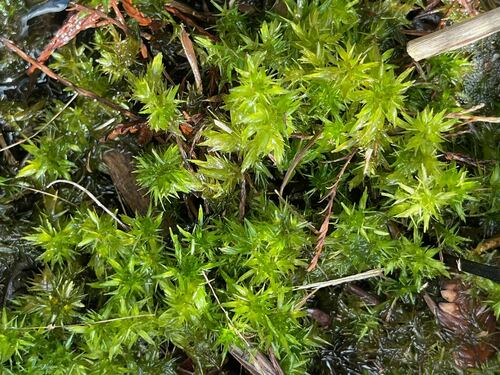
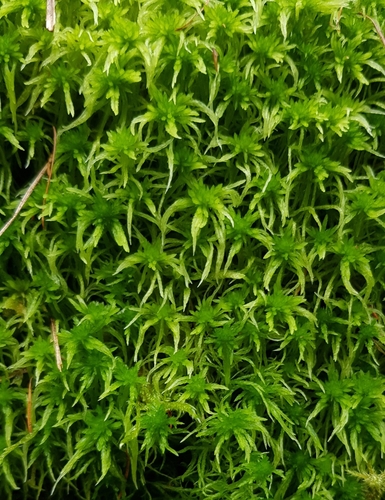
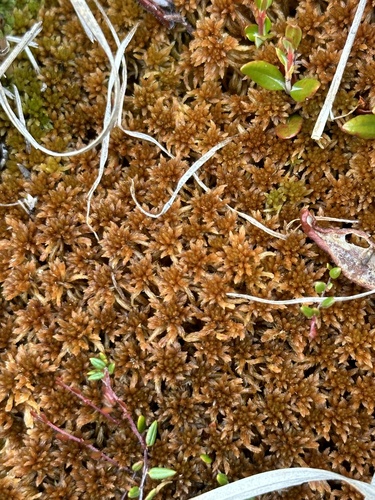
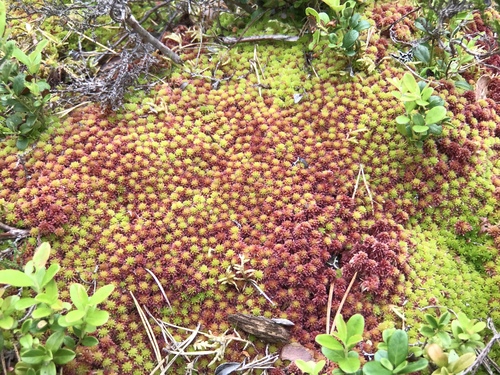
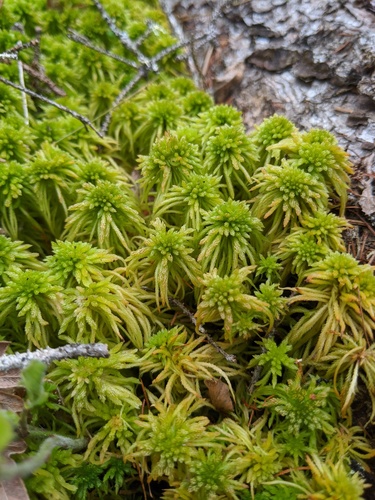
Sphagnum girgensohnii is a relatively robust species of peat moss. It typically appears in shades of green to straw-coloured, with stems ranging from pale green to light brown. Unlike some related species, it never develops red colouration. At the top of each plant is a cluster of branches called the capitulum, which often takes on a yellowish-brown hue. The plant's stem is fairly thick, measuring 0.6 to 1.0 mm in diameter. It is protected by an outer cortex layer made of 2–3 layers of transparent cells, each of which contains a distinctive large pore that is visible even under basic magnification. Branches grow in clusters of three, occasionally four, at intervals along the stem. Each cluster typically has two spreading branches that can grow exceptionally long, often exceeding 25 mm, and one or two pale, cylindrical hanging branches. Near the top of the plant, these spreading branches become shorter and slightly club-shaped. Stem leaves are upright and pressed closely to the stem, measuring 0.8–1.3 mm in length. They have a distinctive roughly rectangular or tongue-like shape, often slightly pinched in the middle, a form technically described as 'lyrate'. Stem leaves have a wide, torn apex, and are bordered by elongated cells that become distinctly broader at the leaf's base. Branch leaves, which are never arranged in five distinct rows, are fairly large for a peat moss of this type at 1.4–1.8 mm long. They have a broadly lance-like shape with strongly curved edges, giving them a somewhat pointed appearance. These leaves contain two types of cells: small living cells that hold chlorophyll for photosynthesis, and larger, empty hyaline cells that help the plant store water. The hyaline cells have numerous pores, particularly on their outer surface, which are critical for water absorption and movement within the plant. Sphagnum girgensohnii is dioecious, meaning male and female reproductive structures grow on separate plants. Male plants tend to be smaller than female plants, with shorter branches and distinctive brown reproductive structures. While the species can produce spore capsules, these structures are rarely seen. When spore capsules are present, their spores are yellowish-brown, slightly textured, and measure 23–27 micrometres (μm) in diameter. Sphagnum girgensohnii typically inhabits shaded environments with a relatively thin peat layer and notable influence from mineral-rich water. Instead of growing in deep peat bogs, it favours damp woodland settings, grassy hillsides, and ditch edges. The species is particularly common along mire margins, especially in areas where fen woodland has developed. It characteristically grows above the water table, forming loose, scattered clumps or mats, often beneath birch (Betula) or willow (Salix) trees. The species has considerable habitat flexibility, and can be found in wet depressions in swamps and dwarf shrub heaths in addition to its typical woodland habitats. In its northernmost range, the species shows even greater habitat flexibility, extending into more open mire environments. It becomes particularly abundant in subarctic peatlands dominated by cotton grass (Eriophorum), where it frequently grows alongside another peat moss species, Sphagnum russowii. While primarily considered a subalpine species, it can be found from sea level to well above the tree line, reaching elevations of up to 2,200 m (7,200 ft) above sea level. The species has a wide distribution across the Northern Hemisphere. In Europe, it occurs from Portugal to Russia, and from Svalbard to Italy and Spain, and is absent only from Moldova, Greece, and some smaller Mediterranean countries and territories. While it can be found sporadically throughout lowland regions, it becomes notably more prevalent in upland and subarctic zones. It is particularly abundant in northern Iceland and across northern Scandinavia, where it ranks among the most common Sphagnum species. In the British Isles, there is a clear north-south gradient to its distribution: the species is rare in southern Britain but becomes increasingly common moving north through Wales and northern England, reaching its greatest abundance in Scotland. It is also widely distributed across Ireland, with a similar preference for northern regions.