About Sphagnum angustifolium (Russow) C.E.O.Jensen
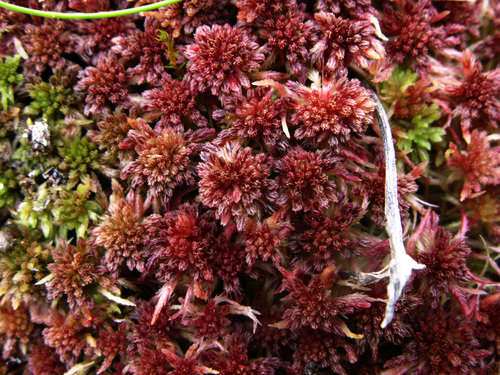
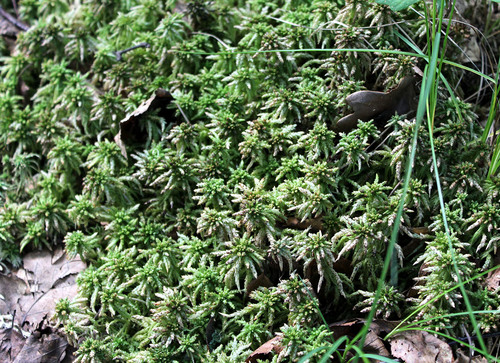
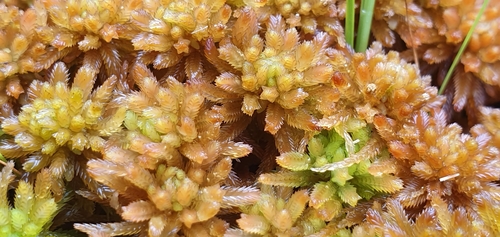
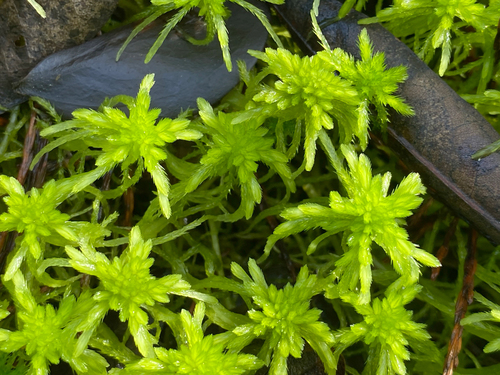
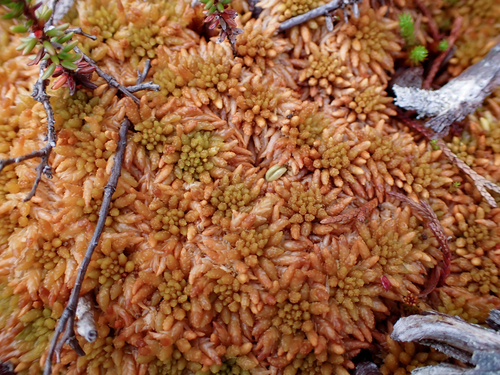
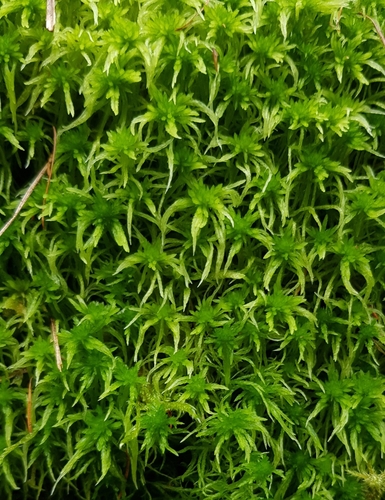
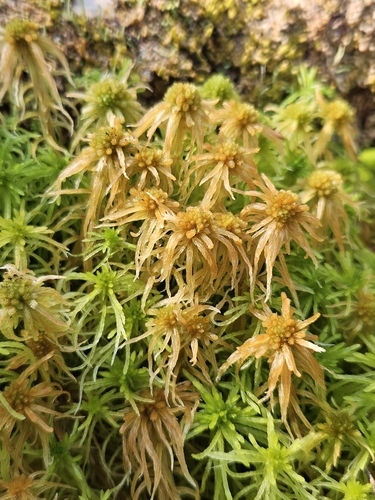
This species of peat moss, formally named Sphagnum angustifolium (Russow) C.E.O.Jensen, has the following key characteristics. The branch leaves of S. angustifolium are relatively small, measuring 1.1–1.6 mm long and 0.3–0.5 mm wide, and are lanceolate (lance-shaped). They typically overlap closely, except for plants growing in shade, and can arrange into five distinct rows. These leaves contain two cell types: small green photosynthetic cells, and larger clear hyaline cells. When viewed in cross-section, the photosynthetic cells are triangular and partially enclosed by the larger hyaline cells, which have various pores and gaps that help the plant absorb and retain water. The most reliable microscopic identification feature for S. angustifolium, except when compared to S. balticum, is the structure of its hanging branch leaves, which have distinctive large pores on their outer surface near the leaf tips. While some botanists note that translucent pink, sometimes described as red, colouration in internal branch tissue is a distinguishing feature for this species, this trait can also appear in S. recurvum, and less commonly in S. flexuosum and S. cuspidatum, so it is not a reliable diagnostic feature. Globally, S. angustifolium has a circumboreal distribution, found across northern Europe, Asia, and North America, and it clearly prefers continental areas over coastal regions. It is the only member of the S. recurvum species complex, which includes S. recurvum itself and S. flexuosum, found in the continental interior of North America. In Europe, it is widely distributed from lowland to subalpine regions, and becomes less common near coastal areas. Documented populations occur in many European countries: Bulgaria, Croatia, Czech Republic, Denmark, Estonia, Finland, France, Germany, Greece, Hungary, Latvia, Lithuania, Montenegro, Norway, Poland, Romania, Serbia, Slovakia, Slovenia, Spain, Sweden, and the United Kingdom. This species shows substantial morphological variation across its range; southern European populations often have less distinct morphological features than northern populations, which makes identification more difficult in southern Europe. Within Britain, S. angustifolium is considered relatively uncommon and sparsely distributed, and its full distribution pattern there has not yet been completely documented. In the British Isles, it is most often found in locations with a distinct flow of mineral-enriched water, favouring the more nutrient-rich end of its ecological tolerance range. In permafrost regions, S. angustifolium has distinct occurrence patterns tied to permafrost conditions. It is specifically associated with boreal regions and discontinuous permafrost zones, and is absent from the continuous permafrost zone of the Low Subarctic. This pattern suggests the species is less well-adapted to the extreme conditions of high-latitude permafrost environments. It commonly grows in collapse scars, which are areas where permafrost has thawed and caused ground subsidence. In these environments, it typically occupies positions with intermediate water table depths, and forms extensive lawn communities that represent a transitional stage between very wet, recently-thawed areas and drier, more mature peatland vegetation. S. angustifolium often becomes a dominant species during intermediate stages of ecosystem recovery in boreal collapse scars. Unlike some Sphagnum species restricted to specific microhabitat conditions, it has considerable flexibility in its habitat requirements within collapse scar environments. This adaptability lets it persist across a range of moisture conditions, though it is most abundant in areas with moderate, stabilized water tables after initial permafrost thaw. S. angustifolium adapts well to a variety of growing conditions, but is most common in wet, moderately nutrient-rich (mesotrophic) mires. It can form pure carpets or grow alongside other peat moss species, including Sphagnum riparium, S. flexuosum, S. fusbum, S. subnitens, S. recurvum var. mucronatum, S. russowii, and S. magellanicum. In bogs, it generally occupies an intermediate position between raised hummocks (mounds) and waterlogged hollows. It also grows in partially submerged areas alongside S. riparium or S. jensenii, and in drier elevated regions alongside S. magellanicum. Its tolerance for moderate shade allows it to become dominant in some wooded mires, and to occur frequently in sedge-dominated wetlands. This species responds clearly to different light conditions. It reaches peak photosynthetic performance under moderate shade, 30% light reduction, with rates up to 42% higher than in deep shade, 90% light reduction. In deep shade, it produces thin, spindly etiolated growth. Growth patterns differ by microhabitat: in hollows, growth decreases steadily as shading increases, while on hummocks the relationship between growth and shading is more complex. The lack of growth of S. angustifolium in full sunlight on hummocks suggests high light may inhibit its growth. It is most photosynthetically active during cloudy or rainy periods, which reflects its adaptation to moist, partially shaded environments. S. angustifolium has genomic and physiological adaptations to bog environments. Its 395 Mb genome includes specialized pathways that manage pH stress through hormone expression and cell transport mechanisms, supporting stable growth across a range of bog pH conditions. As an important ecosystem engineer in peatlands, S. angustifolium significantly modifies its environment and influences overall ecosystem function, playing a particularly important role in northern peatland ecosystems. It is well-adapted to open peatland areas, where it can maintain stable growth even under variable environmental conditions.