About Sphaeropteris medullaris (G.Forst.) Bernh.
Scientific name: Sphaeropteris medullaris (G.Forst.) Bernh.
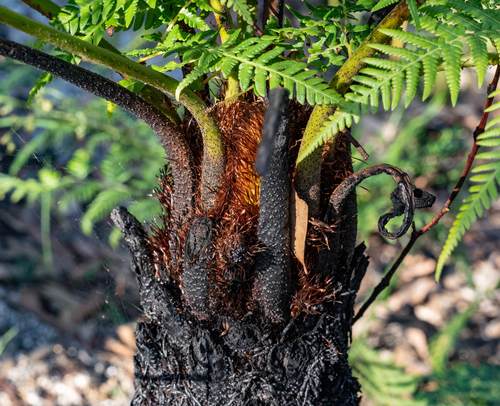
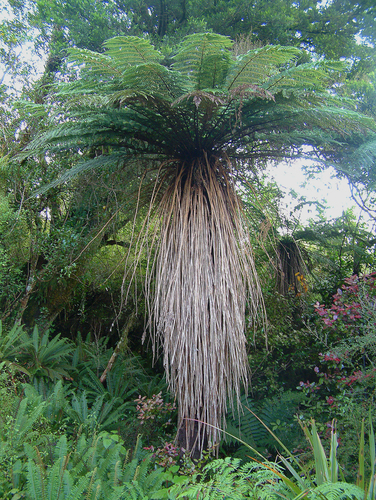
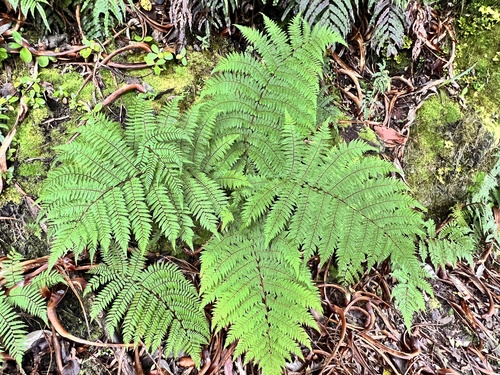
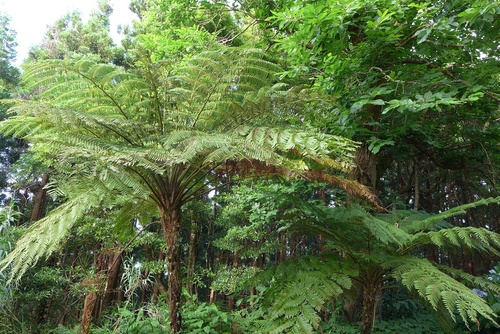
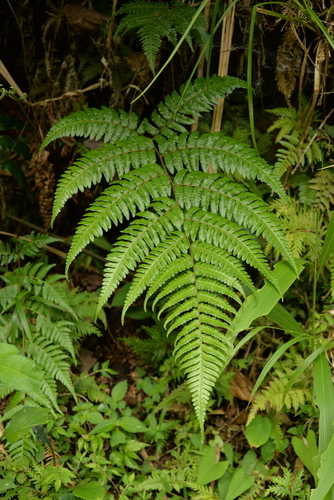
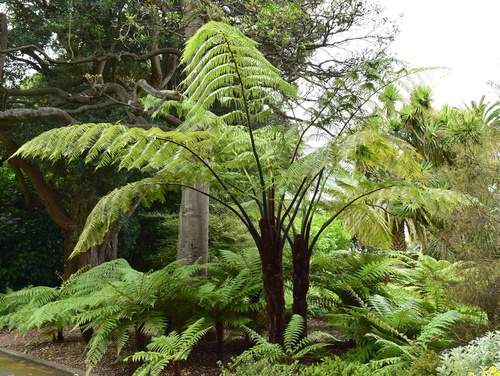
This tree fern has a black trunk covered in distinct hexagonal stipe bases. Its fronds arch upward from the crown, reaching up to 6 m (20 ft) long, and may occasionally grow as long as 7 m (23 ft), with petioles up to 9 cm (3.5 in) thick. Dead fronds are naturally shed, except on very young plants. Primary pinnae range from 40 cm (16 in) to 1 m (3 ft 3 in) long, and their undersides bear scales with spines along their margins. A single frond of this species may have as many as 40,000 leaflets. The stipes are thick, black, very rough to the touch, and also covered in black scales that have spines along their margins. Sphaeropteris medullaris can be easily told apart from related species by the hexagonal stipe scars on its trunk and the spine-margined scales it produces. Mature individuals can reach up to 20 m (66 ft) in height, making this species the tallest tree fern native to New Zealand. Alongside Sphaeropteris excelsa, Sphaeropteris medullaris is one of the fastest-growing tree ferns; both species can grow as much as 50 cm (20 in) per year. When its trunk is cut, this tree produces a red mucilage that is a non-Newtonian fluid.
This species grows across many islands in the southwestern Pacific Ocean, including New Zealand, Fiji, the Marquesas Islands, Tahiti, the Austral Islands, and Pitcairn Island. It does not occur in the Kermadec Islands. In New Zealand, it is common throughout lowland forest of the North Island. In the South Island, its distribution is more localized: it is fairly common in wetter coastal areas, but rare in the drier eastern regions, and completely absent from Canterbury and Otago. It also grows in the Three Kings Islands in New Zealand’s far north, Stewart Island / Rakiura in the far south, and the Chatham Islands.
In many high-humidity forests of New Zealand, Sphaeropteris medullaris acts as a colonizer of disturbed hillside areas, a niche filled by mānuka and kānuka in many other parts of the country. Researchers think mānuka and kānuka only became the more common colonizers of disturbed soil recently, following human arrival in New Zealand and the impact of human-caused fires on native forests. Sphaeropteris medullaris is one of the few fern species that sometimes forms pure stands that exclude almost all other vegetation. It can grow 50 cm a year or more.
Sphaeropteris medullaris can be grown from fresh spores, but growth from spores is slow. Young plants transplant easily. Newly felled trunks can also be planted, and they will generally resprout when watered with appropriate care. Once established, this species is hardy across a range of growing conditions. It has received the Royal Horticultural Society's Award of Garden Merit for use as an ornamental plant.
In traditional Māori culture, the drooping fronds of Sphaeropteris medullaris are associated with grief and sorrow. Traditional Māori stories tell of Mamaku and Toroa (the albatross), who were human lovers that argued frequently. Their fighting angered the gods, who turned Toroa into an albatross and Mamaku into this tree fern. The 1889 publication The Useful Native Plants of Australia records that Indigenous Australians ate the pith of this tree fern; the pith contains a notable amount of starch that is similar to sago. The plant is also a traditional food source in New Zealand, where both the pith and coiled young fronds are used. Traditionally, Sphaeropteris medullaris was considered a food source for hard times, because harvesting its pith almost always kills the tree. The malleable, viscous inner portion of the species’ trunk was steamed for consumption, then eaten cold. Its bark is used to make a rōria, a type of traditional Māori taonga pūoro (musical instrument). Tree fern trunks, including those of S. medullaris, have been used as rough building material and for makeshift trackwork.