About Sphaerophysa salsula (Pall.) DC.
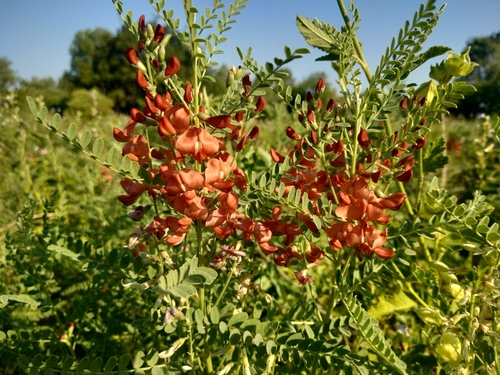
Sphaerophysa salsula (Pall.) DC. is a flowering plant species in the legume family, with common names including alkali swainsonpea, Austrian peaweed, and red bladder-vetch. It is native to Asia, but it is an introduced species in many other regions of the world, where it is often classified as a noxious weed. It grows on cultivated land and in disturbed habitats, and tolerates alkaline substrates easily. It is commonly found in areas where alfalfa is grown, because the seeds of the two species look similar, and the weed seed is easily transported alongside alfalfa crop seed. This species is a long-lived perennial herb that grows up to 1.5 meters tall. It reproduces via both seed and vigorous sprouting from its creeping root system. Its stems are covered in short white hairs. Its leaves are divided into many oval leaflets, each of which reaches up to 2 centimeters in length. The inflorescence is a raceme that holds several pea-like flowers, each just over 1 centimeter wide. Flower colors can range from brick-red to deep pink, brownish, and red-orange. The fruit is a legume pod up to 3.5 centimeters long. The pod is inflated and bladder-like, hairless, translucent, and shiny, becoming papery when dry. It is mottled greenish or reddish, and holds several seeds each about two millimeters long. Like other legumes, this plant hosts endophytes. One of these is the bacterium Paracoccus sphaerophysae, which was recently isolated from the roots of this species and named for it. Other rhizobia found in this species include Shinella kummerowiae, and species from the genera Rhizobium, Agrobacterium, and Mesorhizobium.