About Sphaerolobium vimineum Sm.
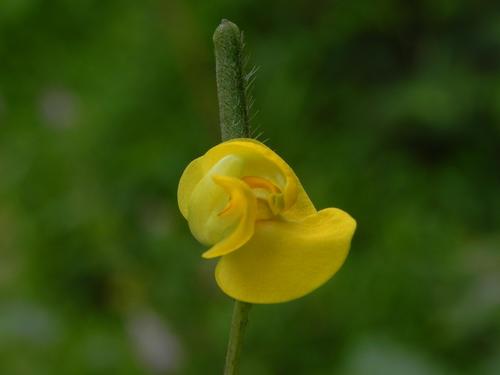
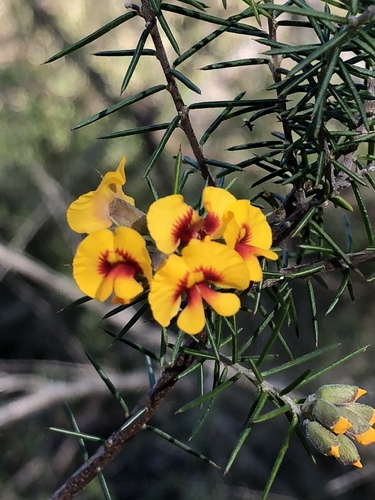
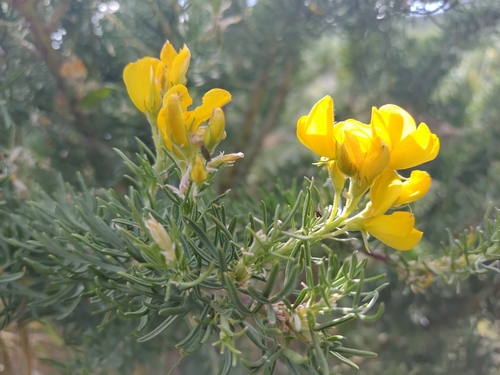
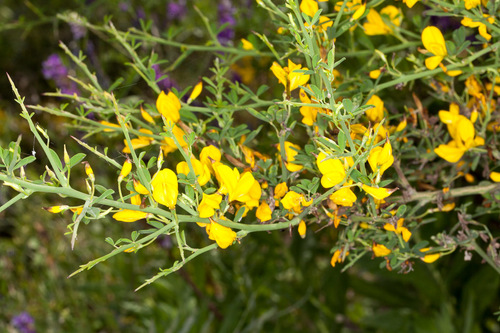
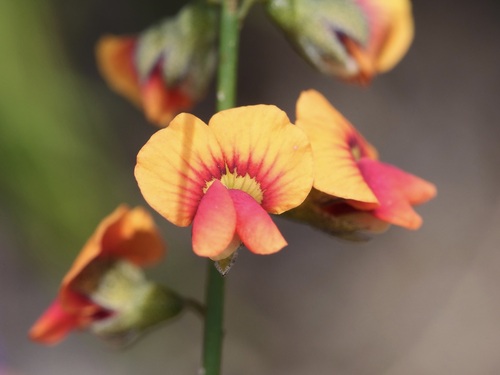
Sphaerolobium vimineum Sm., commonly known as leafless globe-pea, is an erect, rush-like shrub that typically reaches a height of 0.3 to 1.2 meters (1 foot 0 inch to 3 feet 11 inches). It is more or less leafless; when leaves are present, they are linear to lance-shaped and grow up to 8 millimeters (0.31 inches) long. Flowers are arranged in groups of 2 or 3 along the branches, on a peduncle up to approximately 0.5 millimeters (0.020 inches) long. Each individual flower sits on a pedicel 1 to 3 millimeters (0.039 to 0.118 inches) long, with egg-shaped bracts, and 1.5 to 3 millimeters (0.059 to 0.118 inches) long bracteoles at the base of the sepals. The sepals are green with dark grey spots, 3 to 4 millimeters (0.12 to 0.16 inches) long, joined at the base, and have overlapping lobes; the two upper lobes form a wedge-shaped "lip". The standard petal is elliptic, 5 to 6 millimeters (0.20 to 0.24 inches) long, yellow with a red base, and the wings are longer than the keel. Flowering takes place from September to December, and the fruit is a spherical pod 3 to 5 millimeters (0.12 to 0.20 inches) in diameter. The similar species Sphaerolobium minus differs by having uniformly grey sepals, wings that are around the same length as the keel, and wings that are much longer than they are broad. Leafless globe-pea usually grows in heath and forest. Its distribution ranges from south-east Queensland, along the coast and tablelands of New South Wales, through higher rainfall areas of southern Victoria, west to the far south-east of South Australia, and south to Tasmania. It is also widespread across the Esperance Plains, Jarrah Forest, Swan Coastal Plain and Warren bioregions of south-western Western Australia.