About Sphaerocoris annulus
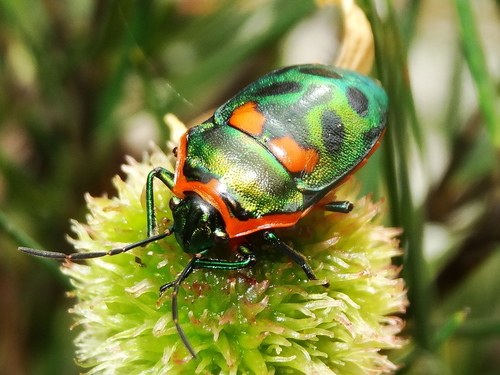
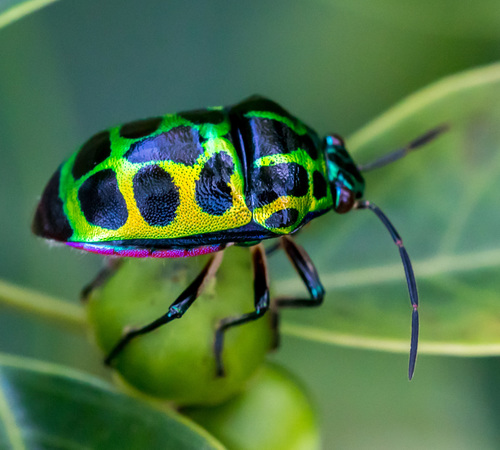
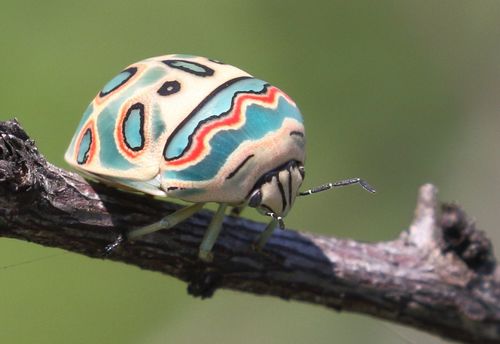
Sphaerocoris annulus adults reach an approximate length of 15 millimetres (0.59 in). Their basic body color is green, with eleven ring-shaped spots on the scutellum. Their distinctive coloration and patterning serve as a warning to predators, and they also release a noxious odor when disturbed. The main host plants for this species include Gossypium species in the family Malvaceae, Coffea arabica in the family Rubiaceae, Citrus species in the family Rutaceae, and Vernonia amygdalina in the family Asteraceae. This species reproduces at the start of the dry season, which falls in November and December. Females lay eggs on the underside of leaves. After hatching, nymphs spend most of their time feeding inside flowers. Once they molt into adults, their feeding habits become more generalized. Full development from egg to adult takes 56 days. Sphaerocoris annulus nymphs are creamy-white with black stripes and black dots, and only develop the species' characteristic colorful spots when they reach maturity. This species is found across tropical and subtropical Africa, with confirmed records in Benin, Cameroon, Côte d'Ivoire, Ethiopia, Ghana, Kenya, Malawi, Mozambique, Namibia, Nigeria, Sierra Leone, South Africa, Tanzania, Togo, Zambia, and Zimbabwe.