About Sphaeramia nematoptera (Bleeker, 1856)
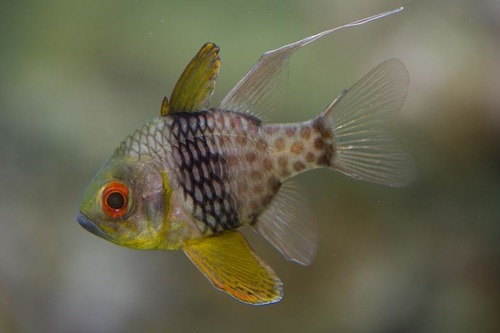
Pajama cardinalfish, Sphaeramia nematoptera, have a wide range of colors. They have greenish-yellow faces, bright orange eyes, and silver-based bodies marked with a bold black slanted edge along the upper half of the body, with orange polka dots covering the rear portion of the body. Despite their prominent bright coloration, this species has a peaceful temperament, making it very well-suited for most community saltwater aquariums. Like many other schooling fish, pajama cardinalfish develop a clear hierarchy when kept in small groups in captivity. However, unlike some other social fish, this species from the cardinalfish family Apogonidae does not use aggression to establish dominance over other members of its kind. Sphaeramia nematoptera is socially monogamous: each individual male forms a long-term pair bond with only one female. The paired fish remain close and mate together across multiple breeding cycles, though extra-pair fertilizations have been documented in the species. If one partner dies or is removed, the surviving fish will typically form a new pair bond. Both males and females prefer to mate with partners of a similar size to themselves. Mating can occur throughout the year at any time of day, but it is most common at night. While mating, the paired fish may become aggressive toward other members of their species. To reproduce, the female deposits her eggs directly into the water column. The male then quickly fertilizes the eggs and collects them into his mouth. Like other cardinalfish, male Sphaeramia nematoptera are mouthbrooders, and they hold the fertilized eggs in their mouths for 8 to 31 days. Males will hold eggs that are not genetically their own, even though this situation is rare. On average, when this occurs, around 18% of the eggs a male carries are genetically unrelated to him. Both males and females have been observed mating outside their established pair bond, which means a single male can carry eggs from multiple partners. Overall, only about 70% of all egg clutches come from monogamous mating between socially bonded pairs.