About Sphaeralcea coccinea (Nutt.) Rydb.
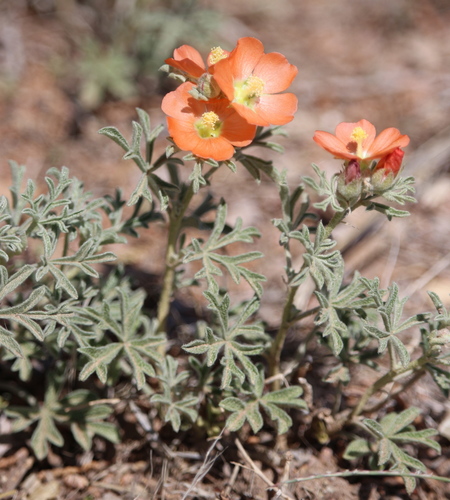
Sphaeralcea coccinea, commonly called scarlet globemallow, scarlet mallow, cowboy's delight, prairie mallow, red false mallow, or globe mallow, is a low-growing perennial plant. It reaches 10 to 30 centimeters in height and grows from spreading rhizomes. Its stems are grayish, covered in dense star-shaped hairs, and its leaves are alternately arranged. Leaf blades measure 2 to 5 centimeters long, are palmately shaped and deeply cut into 3 to 5 main wedge-shaped segments. The undersides of the leaves have gray hairs. The 1 to 2.5 centimeter wide flowers are reddish-orange and saucer-shaped, with five notched, broad petals, and grow in small terminal clusters. Numerous stamens form a tube that surrounds the pistils. Flowering occurs from May to October in southern regions, and from May to July in northern regions. This plant produces a dry fruit called a schizocarp, which splits into roughly 10 or more seed segments once it reaches maturity. This species is native to dry grasslands, prairies, and badlands of the Great Plains and western areas of northern North America. It grows well along roadsides in drier conditions and in sandy soils. Its seeds are released when the plant is disturbed, letting the species spread into new areas. The Blackfoot Confederacy has a recorded traditional use of scarlet globemallow as a cooling agent: the plant is ground or mashed into a mixture that is applied to wounds and burns. Meriwether Lewis collected a specimen of this species near the Marias River during his expedition. Today, the plant can be used as ground cover along roadsides and in fields to prevent erosion. Its fast-spreading growth lets it quickly establish and improve soil stability.