About Sphaeralcea ambigua A.Gray
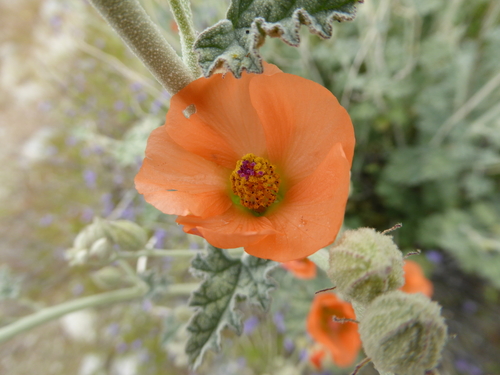
Sphaeralcea ambigua A.Gray, commonly known as desert globemallow, reaches a mature height of 3 ft (0.91 m) and spreads 2–3 ft (0.61–0.91 m) wide. Its leaves grow on long stems, which increase in number as the plant ages; the leaves are fuzzy with white hairs on both sides, lobed, and palmately veined. This species produces bowl-shaped, five-petaled flowers, most commonly apricot to orange in color, though rare morphs may be white or light pink, and it blooms in spring. After flowering, it develops a brown capsule fruit that holds many seeds. The fruit starts spherical, matching the meaning behind its genus name, and later flattens into a disk shape. Sphaeralcea ambigua acts as a larval host plant for multiple butterfly species, including the common checkered skipper, northern white skipper, painted lady, small checkered skipper, and West Coast lady. Desert globemallow is native to parts of California, Nevada, Utah, Arizona, and New Mexico in the United States, and to Sonora and Baja California in northwestern Mexico. It grows naturally in alkaline soils that can be either sandy or clay, typically alongside creosote bush scrub and within desert chaparral habitats. It occurs at elevations ranging from 150–2,500 m (490–8,200 ft), and is found in the Mojave, Great Basin, and Sonoran desert ecoregions. Sphaeralcea ambigua is cultivated as an ornamental plant by specialty nurseries. It is used in desert-themed and drought-tolerant gardens, native natural landscaping, and habitat restoration projects within its native desert region. It requires full sun to grow well, and can survive on natural rainfall alone, though supplemental watering increases its flower production. It prefers sandy, well-drained desert soil, but can tolerate some clay content. It is winter hardy in USDA Zones 6–10, and can withstand temperatures as low as -10°F. This species has low general maintenance requirements; plants may be cut back periodically to maintain a dense, leafy appearance. Propagation is easy from seed, but difficult to do from vegetative cuttings. Members of the Shoshoni Native American tribe, as well as other indigenous peoples and regional settlers, use this plant as both a food source and a medicinal plant.