About Speyeria idalia (Drury, 1773)
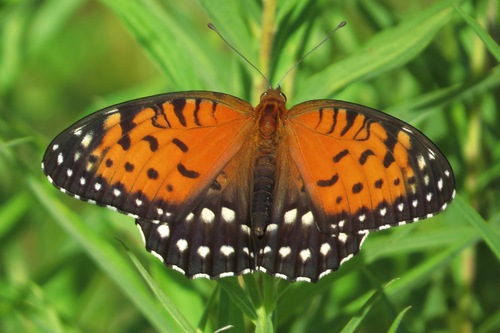
The regal fritillary, scientifically known as Speyeria idalia (Drury, 1773), is a distinctive prairie-specialist nymphalid butterfly. It occurs in some remaining tallgrass and mixed-grass prairies in the east-central United States, and is listed as a species of special concern and believed extirpated in the U.S. state of Connecticut. This species has a characteristic deep orange base color, with easily recognizable dark hindwings that bear two bands of spots. On females, both spot bands are white, while the outer spot band is orange on males; females also tend to be slightly larger than males. The ventral surface of the hindwings ranges from olive brown to black, with prominent silvery white spots. Its typical wingspan measures 68–105 millimetres, or 2.7–4.1 inches. Adults fly between approximately June and September, and are swift fliers that coast close to the ground. Newly hatched regal fritillary larvae are roughly 0.08 inches long, reaching around 1.75 inches when fully mature. Mature larvae have a black body marked with yellowish-orange bands and stripes, plus yellowish middorsal and lateral stripes, with multiple fleshy spines extending from the dorsal, subdorsal, and lateral sections of the body. The mature larva has a small, rounded head that is orangish-red on the top and black on the underside. Like all members of the genus Speyeria, regal fritillary larvae feed exclusively on violets of the genus Viola. Violets are extremely important for maintaining sustainable regal fritillary habitat, and the number of butterflies found in a given area correlates with the number of violets present. Confirmed violet species used as larval food include Viola pedata (bird's-foot violet), V. pedatifida (blue prairie violet), V. papilionacea (common blue violet), V. lanceolata (lance-leafed violet), V. nuttallii (Nuttall's violet), V. sagittata (arrowleaf violet), and V. tricolor (Johnny Jumpup). Different violet species are associated with different parts of the butterfly's range: in the Midwest and Great Plains regions, bird's-foot violet and blue prairie violet are the preferred larval food sources. Adult regal fritillaries feed on nectar from a variety of plant species. The availability of these nectar plants through the summer flight period is just as important as the presence of larval food plants for supporting local butterfly populations. Important nectar sources for adults include milkweeds, thistles, coneflowers, blazing-stars, bergamots, clovers, goldenrods, and ironweeds. Across the species' entire range, milkweeds and thistles are the most preferred nectar sources. Their staggered blooming times provide a constant supply of nectar: common milkweed blooms early in the summer when adult males first emerge, while thistles bloom later in the season, which is critical for females preparing to lay eggs. The regal fritillary is univoltine, meaning it produces only one generation per year. Adult males emerge in early June alongside the first milkweed plants, with adult females emerging shortly after. Mating occurs in late June and early July. After mating, females enter a 6 to 8 week period of reproductive diapause, a suspended state of development during which their ovaries remain undeveloped. Oogenesis (egg development) does not begin until late August, when juvenile hormone levels rise sharply. Once eggs develop and are fertilized, oviposition (egg-laying) occurs. A single female can lay over 1,000 eggs, and sometimes more than 2,000. Small larvae hatch from eggs in late September through October. Immediately after hatching, larvae move into protective leaf litter to overwinter, entering a state of larval diapause where development pauses over the winter. When spring arrives, larvae emerge from diapause and begin feeding on violet foliage. They grow and mature through six instar (developmental) stages, then pupate in late May. This unique life cycle is thought to be an adaptation to the seasonal phenology of its larval food plant, violets. These small perennial violets produce abundant foliage in spring for growing larvae, but senesce (die back) in the heat of summer across most of the butterfly's range, becoming unavailable to larvae at that point. By the time violets senesce, regal fritillaries have already reached their adult life stage and no longer rely on violet foliage. The inability of violets to support larvae through the full summer explains the species' univoltine life cycle. The combination of larval overwintering diapause and adult female reproductive diapause allows larvae to take full advantage of fresh, abundant violet foliage when they are active in spring.