About Speyeria cybele (Fabricius, 1775)
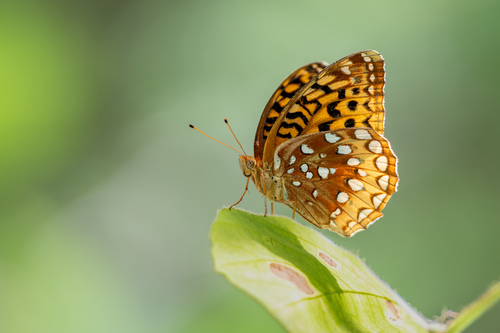
Speyeria cybele, commonly called the great spangled fritillary, has a wingspan of 62 to 88 mm (2.4 to 3.5 inches). The upper side of its wings is orange, with five black dashes near the base of the forewing and several irregular black dashes at the base of the hindwing. Two rows of black crescents run along the edges of all wings. The underside of the forewing is yellowish orange with black markings that match those on the upper side, plus a small number of silver spots at the wing’s tip. The underside of the hindwing is reddish brown, with silver spots on the base and middle of the wing. Adjacent to the brown margin of this hindwing are a broad yellow band and silver triangles, which are the most distinct features of the wing. Females of this species are typically darker than males, and individuals from the western part of the species’ range are usually a brighter orange. This species is similar to three other fritillaries: the Aphrodite fritillary (Speyeria aphrodite), the Atlantis fritillary (Speyeria atlantis), and the northwestern fritillary (Speyeria hesperis). It can be told apart from the Aphrodite and Atlantis fritillaries by its wide light submarginal band on the hindwing, and by black dashes rather than black spots along the forewing margins. The great spangled fritillary has a large range across North America, extending from southern Canada to northern California in the west, and as far east as North Carolina. Its preferred primary habitats are moist meadows and woodland edges.